Xu Ming-Ming, Huang Guang-Yan, Feng Shun-Shan, McShane Graham J, Stronge William J
State Key Laboratory of Explosion Science and Technology, Beijing Institute of Technology, Beijing 100081, China.
Department of Engineering, University of Cambridge, Cambridge CB2 1PZ, UK.
Polymers (Basel). 2016 Mar 28;8(4):77. doi: 10.3390/polym8040077.
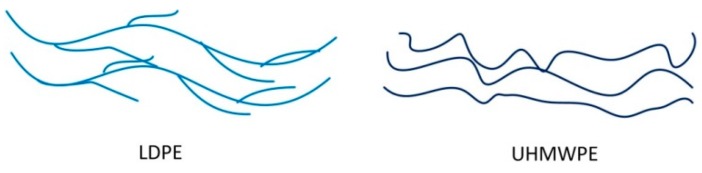
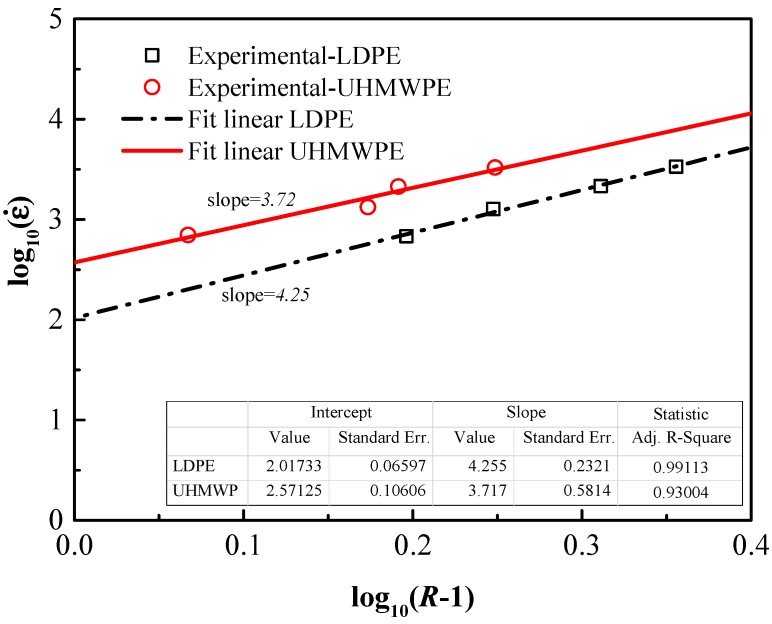
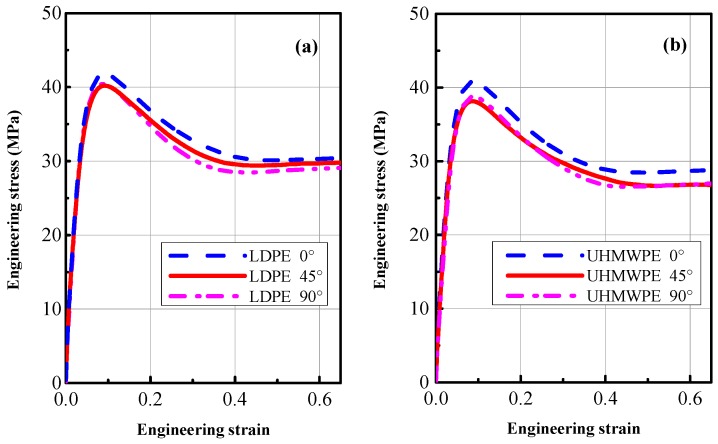
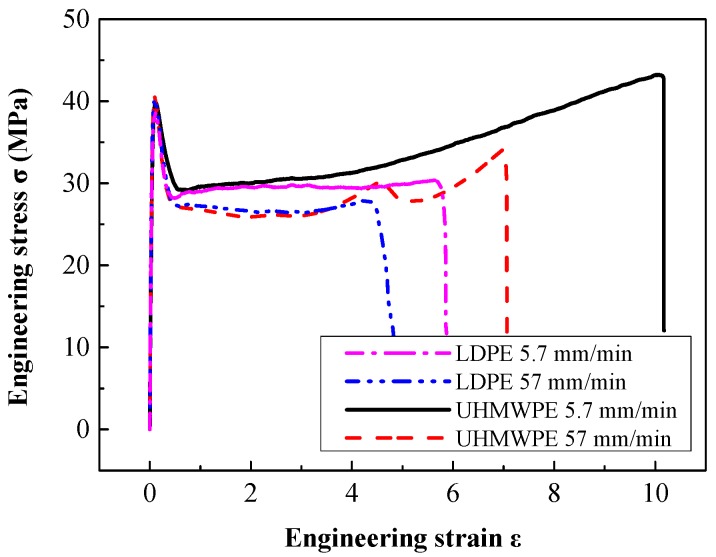
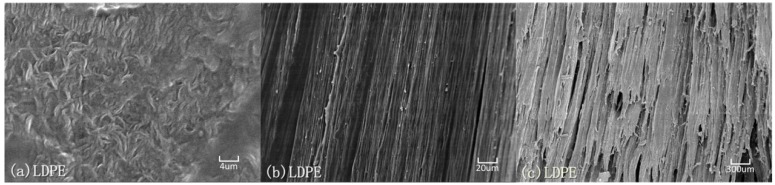
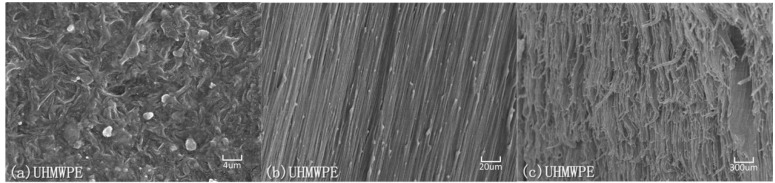
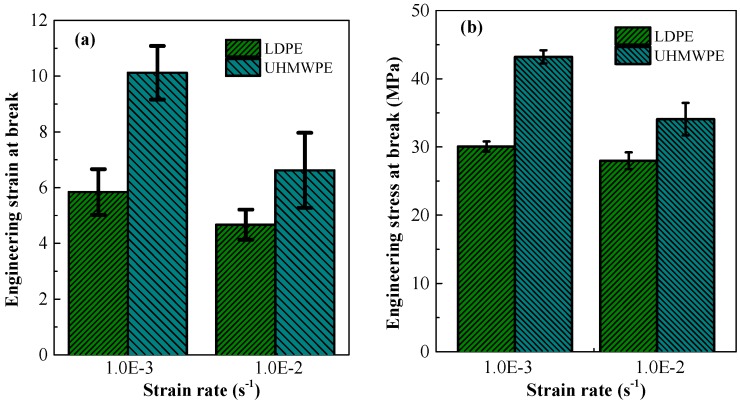
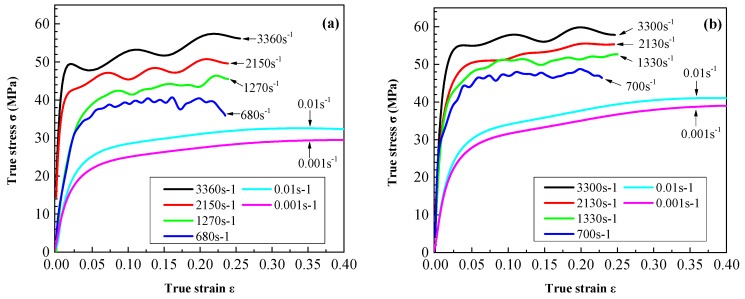
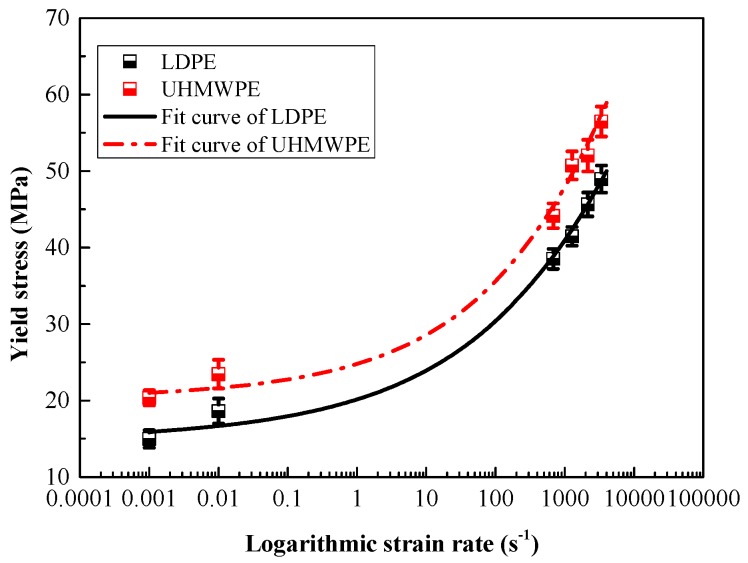
Properties of extruded polymers are strongly affected by molecular structure. For two different semi-crystalline polymers, low-density polyethylene (LDPE) and ultra-high molecular weight polyethylene (UHMWPE), this investigation measures the elastic modulus, plastic flow stress and strain-rate dependence of yield stress. Also, it examines the effect of molecular structure on post-necking tensile fracture. The static and dynamic material tests reveal that extruded UHMWPE has a somewhat larger yield stress and much larger strain to failure than LDPE. For both types of polyethylene, the strain at tensile failure decreases with increasing strain-rate. For strain-rates 0.001⁻3400 s, the yield stress variation is accurately represented by the Cowper⁻Symonds equation. These results indicate that, at high strain rates, UHMWPE is more energy absorbent than LDPE as a result of its long chain molecular structure with few branches.
挤出聚合物的性能受到分子结构的强烈影响。对于两种不同的半结晶聚合物,即低密度聚乙烯(LDPE)和超高分子量聚乙烯(UHMWPE),本研究测量了弹性模量、塑性流动应力以及屈服应力的应变率依赖性。此外,还研究了分子结构对颈缩后拉伸断裂的影响。静态和动态材料测试表明,挤出的UHMWPE比LDPE具有稍大的屈服应力和大得多的破坏应变。对于这两种类型的聚乙烯,拉伸破坏时的应变均随应变率的增加而降低。对于0.001⁻3400 s的应变率,屈服应力变化可由考珀⁻西蒙兹方程精确表示。这些结果表明,在高应变率下,由于UHMWPE具有少分支的长链分子结构,其比LDPE更能吸收能量。