Department of Medicine, Division of Rheumatology and Department of Biomedical Sciences, Cedars Sinai Medical Center, Los Angeles, CA, United States.
Front Immunol. 2019 Mar 29;10:325. doi: 10.3389/fimmu.2019.00325. eCollection 2019.
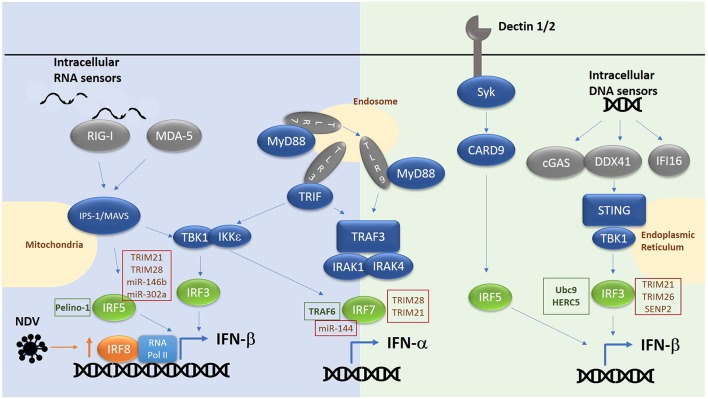
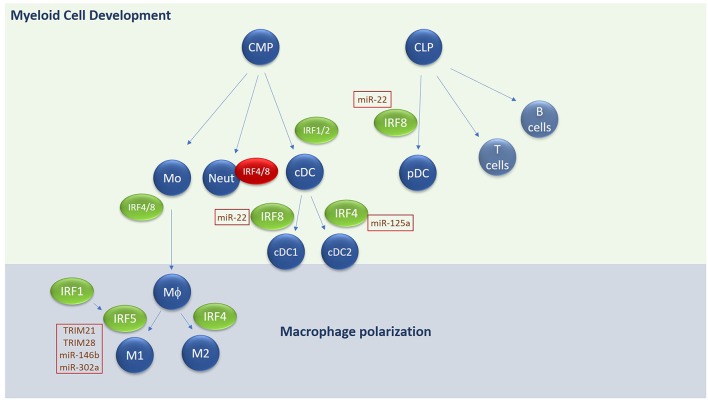
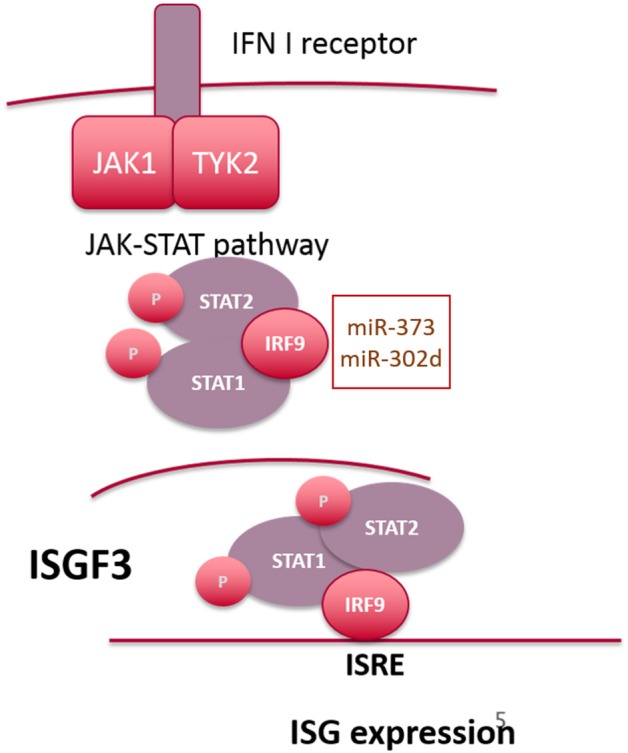
The Interferon regulatory factors (IRFs) are a family of transcription factors that play pivotal roles in many aspects of the immune response, including immune cell development and differentiation and regulating responses to pathogens. Three family members, IRF3, IRF5, and IRF7, are critical to production of type I interferons downstream of pathogen recognition receptors that detect viral RNA and DNA. A fourth family member, IRF9, regulates interferon-driven gene expression. In addition, IRF4, IRF8, and IRF5 regulate myeloid cell development and phenotype, thus playing important roles in regulating inflammatory responses. Thus, understanding how their levels and activity is regulated is of critical importance given that perturbations in either can result in dysregulated immune responses and potential autoimmune disease. This review will focus the role of IRF family members in regulating type I IFN production and responses and myeloid cell development or differentiation, with particular emphasis on how regulation of their levels and activity by ubiquitination and microRNAs may impact autoimmune disease.
干扰素调节因子 (IRFs) 是一类转录因子,在免疫反应的许多方面发挥着关键作用,包括免疫细胞的发育和分化以及调节对病原体的反应。家族中的三个成员,IRF3、IRF5 和 IRF7,对于识别病毒 RNA 和 DNA 的病原体识别受体下游的 I 型干扰素的产生至关重要。第四个家族成员,IRF9,调节干扰素驱动的基因表达。此外,IRF4、IRF8 和 IRF5 调节髓样细胞的发育和表型,因此在调节炎症反应方面发挥着重要作用。因此,了解它们的水平和活性如何受到调节至关重要,因为它们的任何干扰都可能导致免疫反应失调和潜在的自身免疫性疾病。这篇综述将重点介绍 IRF 家族成员在调节 I 型 IFN 产生和反应以及髓样细胞发育或分化中的作用,特别强调泛素化和 microRNAs 对其水平和活性的调节如何影响自身免疫性疾病。