Nuti Francesca, Gellini Cristina, Larregola Maud, Squillantini Lorenzo, Chelli Riccardo, Salvi Pier Remigio, Lequin Olivier, Pietraperzia Giangaetano, Papini Anna Maria
Laboratory of Peptide and Protein Chemistry and Biology (PeptLab), Sesto Fiorentino, Italy.
Department of Chemistry "Ugo Schiff", University of Florence, Sesto Fiorentino, Italy.
Front Chem. 2019 Mar 29;7:180. doi: 10.3389/fchem.2019.00180. eCollection 2019.
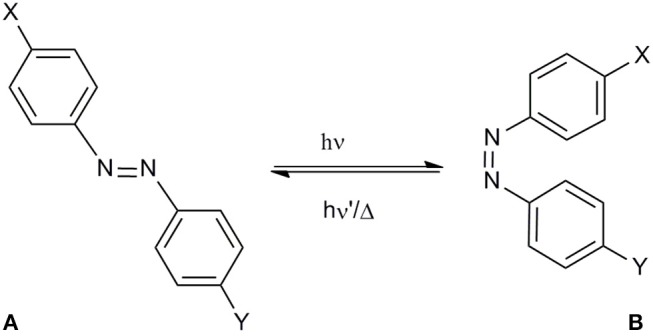
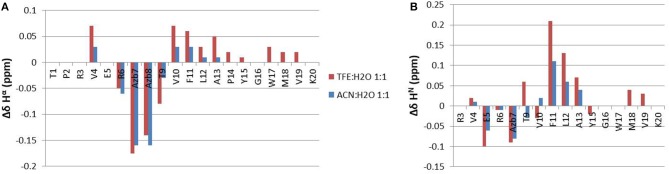
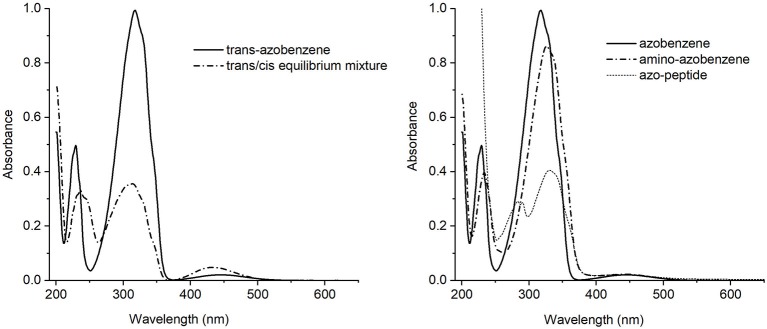
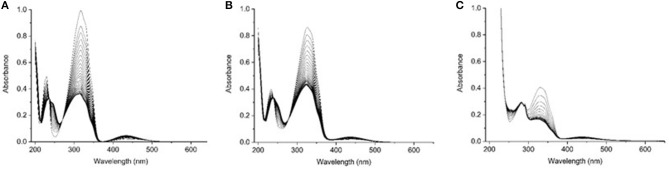
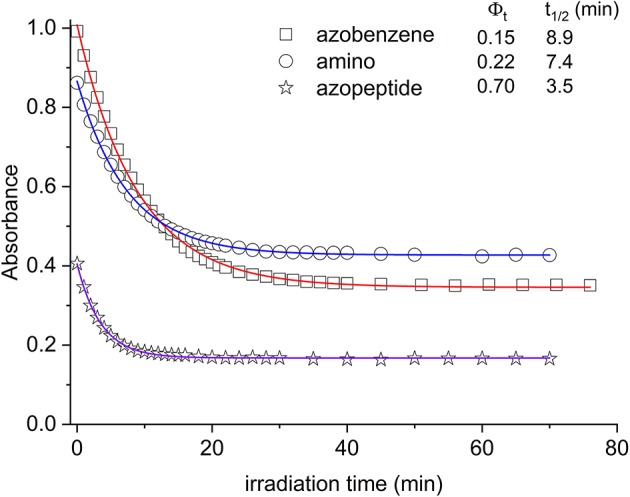
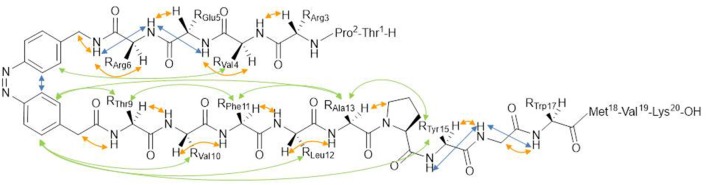
The insertion of azobenzene moiety in complex molecular protein or peptide systems can lead to molecular switches to be used to determine kinetics of folding/unfolding properties of secondary structures, such as α-helix, β-turn, or β-hairpin. In fact, in azobenzene, absorption of light induces a reversible trans ↔ cis isomerization, which in turns generates a strain or a structure relaxation in the chain that causes peptide folding/unfolding. In particular azobenzene may permit reversible conformational control of hairpin formation. In the present work a synthetic photochromic azobenzene amino acid derivative was incorporated as a turn element to modify the synthetic peptide [Pro,Asn,Thr]CSF114 previously designed to fold as a type I β-turn structure in biomimetic HFA/water solution. In particular, the P-N-H fragment at positions 7-9, involved in a β-hairpin, was replaced by an azobenzene amino acid derivative (synthesized ) to investigate if the electronic properties of the novel peptidomimetic analog could induce variations in the isomerization process. The absorption spectra of the azopeptidomimetic analog of the type I β-turn structure and of the azobenzene amino acid as control were measured as a function of the irradiation time exciting into the respective first ππ and nπ transition bands. Isomerization of the azopeptidomimetic results strongly favored by exciting into the ππ transition. Moreover, conformational changes induced by the ↔ azopeptidomimetic switch were investigated by NMR in different solvents.
在复杂的分子蛋白质或肽系统中插入偶氮苯部分可导致分子开关,用于确定二级结构(如α-螺旋、β-转角或β-发夹)折叠/去折叠特性的动力学。事实上,在偶氮苯中,光的吸收会诱导可逆的反式↔顺式异构化,进而在链中产生应变或结构松弛,导致肽的折叠/去折叠。特别是偶氮苯可以实现发夹形成的可逆构象控制。在本工作中,一种合成的光致变色偶氮苯氨基酸衍生物被作为转角元件引入,以修饰先前设计为在仿生HFA/水溶液中折叠成I型β-转角结构的合成肽[Pro,Asn,Thr]CSF114。特别是,参与β-发夹结构的7-9位的P-N-H片段被一种偶氮苯氨基酸衍生物(合成的)取代,以研究这种新型拟肽类似物的电子性质是否会在异构化过程中引起变化。测量了I型β-转角结构的偶氮拟肽类似物和作为对照的偶氮苯氨基酸的吸收光谱,作为激发到各自的第一个ππ和nπ跃迁带的照射时间的函数。通过激发到ππ跃迁,偶氮拟肽的异构化结果强烈有利。此外,通过核磁共振在不同溶剂中研究了偶氮拟肽开关诱导的构象变化。