Bessen D, Gotschlich E C
Infect Immun. 1987 Jan;55(1):141-7. doi: 10.1128/iai.55.1.141-147.1987.
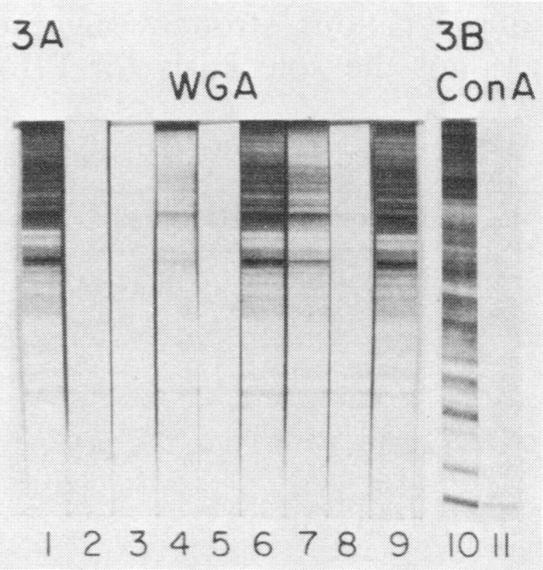
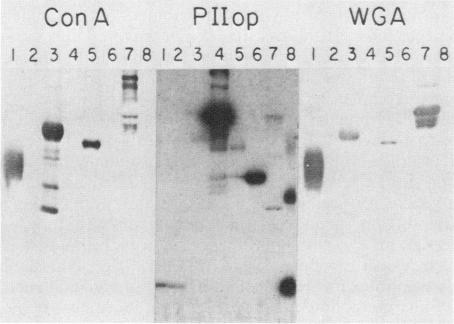
Binding of an opacity-associated protein II (PIIop) from Neisseria gonorrhoeae to eucaryotic macromolecules was studied. HeLa cell extracts were subjected to sodium dodecyl sulfate-polyacrylamide gel electrophoresis and transferred to nitrocellulose, and purified PIIop bound to approximately 50 distinct molecular species. The binding of PIIop to HeLa cell components was stable in high salt and nonionic detergent and was not inhibited by a variety of monosaccharides and polyionic substances. PIIop binding behavior was compared with that of two model carbohydrate-binding proteins, wheat germ agglutinin (WGA) and concanavalin A (ConA). Model glycoproteins (ovomucoid, fetuin, mucin, ovalbumin) inhibited binding by PIIop, WGA, and ConA to various degrees. HeLa cell glycopeptides, generated by pronase digestion of chloroform-methanol-extracted cells, were tested for their ability to inhibit binding by PIIop to Western blots of HeLa cell macromolecules. HeLa cell extracts inhibited PIIop binding before pronase treatment, but inhibitory activity was lost as a result of pronase digestion. Direct binding to defined glycosylated and nonglycosylated proteins revealed that ConA and WGA bound only glycoproteins, whereas PIIop bound to proteins lacking carbohydrate as well. PIIop binding to human and bovine serum albumins was of high affinity and required partial unfolding of albumin; native albumin was not bound by PIIop; however, both the denatured, reduced form of albumin and the compact, nonreduced form of carboxymethylated albumin were bound strongly by PIIop. Albumin-PIIop interaction did not involve covalent bond formation through sulfhydryl groups. The predominant binding interactions of PIIop found in this study were with protein rather than carbohydrate, and the chemical nature of the interactions is more complex than involvement of purely ionic or hydrophobic forces.
研究了淋病奈瑟菌的一种不透明相关蛋白II(PIIop)与真核生物大分子的结合情况。将HeLa细胞提取物进行十二烷基硫酸钠-聚丙烯酰胺凝胶电泳,然后转移至硝酸纤维素膜上,纯化后的PIIop与大约50种不同的分子种类结合。PIIop与HeLa细胞成分的结合在高盐和非离子去污剂中稳定,且不受多种单糖和多离子物质的抑制。将PIIop的结合行为与两种典型的碳水化合物结合蛋白——麦胚凝集素(WGA)和伴刀豆球蛋白A(ConA)进行了比较。典型糖蛋白(卵类粘蛋白、胎球蛋白、粘蛋白、卵清蛋白)对PIIop、WGA和ConA的结合有不同程度的抑制作用。用链霉蛋白酶消化氯仿-甲醇提取的细胞所产生的HeLa细胞糖肽,检测其抑制PIIop与HeLa细胞大分子Western印迹结合的能力。HeLa细胞提取物在链霉蛋白酶处理前可抑制PIIop结合,但链霉蛋白酶消化后抑制活性丧失。与特定糖基化和非糖基化蛋白的直接结合表明,ConA和WGA仅结合糖蛋白,而PIIop也结合缺乏碳水化合物的蛋白。PIIop与人及牛血清白蛋白的结合具有高亲和力,且需要白蛋白部分展开;天然白蛋白不被PIIop结合;然而,变性、还原形式的白蛋白以及紧密、非还原形式的羧甲基化白蛋白均被PIIop强烈结合。白蛋白与PIIop的相互作用不涉及通过巯基形成共价键。本研究中发现的PIIop的主要结合相互作用是与蛋白质而非碳水化合物,且相互作用的化学性质比单纯的离子或疏水作用力更为复杂。