Digestive Disease Department, Marqués de Valdecilla University Hospital, Cantabria University, 39008 Santander, Spain.
Health Research Institute Marques de Valdecilla (IDIVAL), 39008 Santander, Spain.
Int J Mol Sci. 2019 Apr 2;20(7):1634. doi: 10.3390/ijms20071634.
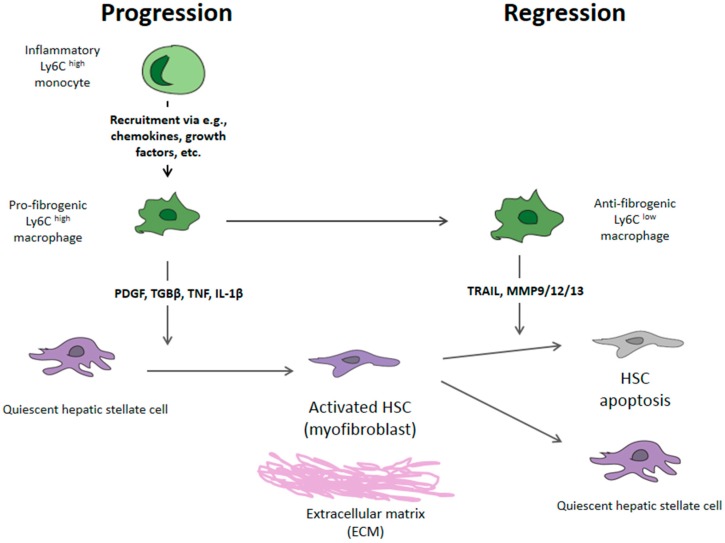
The concept of liver fibrosis and cirrhosis being static and therefore irreversible is outdated. Indeed, both human and animal studies have shown that fibrogenesis is a dynamic and potentially reversible process that can be modulated either by stopping its progression and/or by promoting its resolution. Therefore, the study of the molecular mechanisms involved in the pathogenesis of liver fibrosis is critical for the development of future antifibrotic therapies. The fibrogenesis process, common to all forms of liver injury, is characterized by the increased deposition of extracellular matrix components (EMCs), including collagen, proteoglycans, and glycoproteins (laminin and fibronectin 2). These changes in the composition of the extracellular matrix components alter their interaction with cell adhesion molecules, influencing the modulation of cell functions (growth, migration, and gene expression). Hepatic stellate cells and Kupffer cells (liver macrophages) are the key fibrogenic effectors. The antifibrogenic mechanism starts with the activation of Ly6C macrophages, which can differentiate into macrophages with antifibrogenic action. The research of biochemical changes affecting fibrosis irreversibility has identified lysyl oxidase-like 2 (LOXL2), an enzyme that promotes the network of collagen fibers of the extracellular matrix. LOXL2 inhibition can decrease cell numbers, proliferation, colony formations, and cell growth, and it can induce cell cycle arrest and increase apoptosis. The development of a new humanized IgG4 monoclonal antibody against LOXL2 could open the window of a new antifibrogenic treatment. The current therapeutic target in patients with liver cirrhosis should focus (after the eradication of the causal agent) on the development of new antifibrogenic drugs. The development of these drugs must meet three premises: Patient safety, in non-cirrhotic phases, down-staging or at least stabilization and slowing the progression to cirrhosis must be achieved; whereas in the cirrhotic stage, the objective should be to reduce fibrosis and portal pressure.
肝纤维化和肝硬化的概念是静态的,因此是不可逆转的,这种观念已经过时了。事实上,人类和动物研究都表明,纤维化是一个动态的、潜在可逆转的过程,可以通过阻止其进展和/或促进其消退来调节。因此,研究肝纤维化发病机制中涉及的分子机制对于开发未来的抗纤维化治疗方法至关重要。纤维化过程是所有形式的肝损伤所共有的,其特征是细胞外基质成分(ECM)的沉积增加,包括胶原、蛋白聚糖和糖蛋白(层粘连蛋白和纤维连接蛋白 2)。细胞外基质成分组成的这些变化改变了它们与细胞黏附分子的相互作用,影响细胞功能(生长、迁移和基因表达)的调节。肝星状细胞和枯否细胞(肝巨噬细胞)是关键的纤维化效应细胞。抗纤维化机制始于 Ly6C 巨噬细胞的激活,后者可以分化为具有抗纤维化作用的巨噬细胞。影响纤维化不可逆性的生化变化的研究已经确定了赖氨酰氧化酶样 2(LOXL2),这是一种促进细胞外基质胶原纤维网络形成的酶。LOXL2 抑制可以减少细胞数量、增殖、集落形成和细胞生长,并可以诱导细胞周期停滞和增加细胞凋亡。针对 LOXL2 的新型人源化 IgG4 单克隆抗体的开发可能为新的抗纤维化治疗方法开辟了新的窗口。目前,肝硬化患者的治疗靶点应集中在开发新的抗纤维化药物上。这些药物的开发必须满足三个前提:患者安全,在非肝硬化阶段,必须实现降级或至少稳定和减缓向肝硬化的进展;而在肝硬化阶段,目标应该是减少纤维化和门脉压。