Department of Radiology & Nuclear Medicine, Erasmus University Medical Center, 3015 GD Rotterdam, The Netherlands.
Department of Urology, Erasmus University Medical Center, 3015 GD Rotterdam, The Netherlands.
Int J Mol Sci. 2019 Apr 2;20(7):1637. doi: 10.3390/ijms20071637.
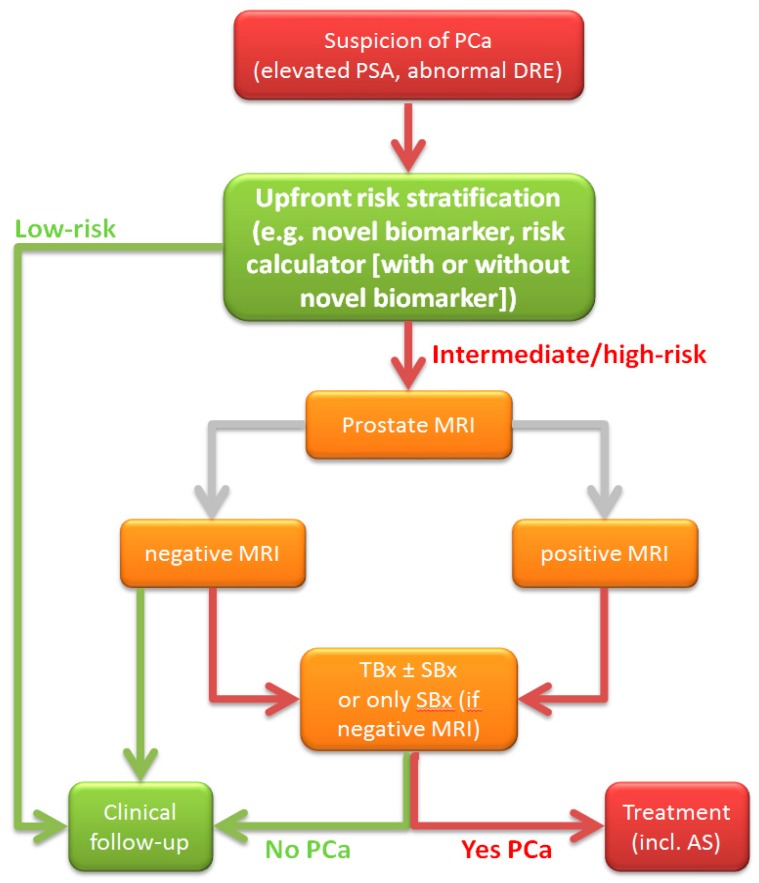
This review discusses the most recent evidence for currently available risk stratification tools in the detection of clinically significant prostate cancer (csPCa), and evaluates diagnostic strategies that combine these tools. Novel blood biomarkers, such as the Prostate Health Index (PHI) and 4Kscore, show similar ability to predict csPCa. Prostate cancer antigen 3 (PCA3) is a urinary biomarker that has inferior prediction of csPCa compared to PHI, but may be combined with other markers like TMPRSS2-ERG to improve its performance. Original risk calculators (RCs) have the advantage of incorporating easy to retrieve clinical variables and being freely accessible as a web tool/mobile application. RCs perform similarly well as most novel biomarkers. New promising risk models including novel (genetic) markers are the SelectMDx and Stockholm-3 model (S3M). Prostate magnetic resonance imaging (MRI) has evolved as an appealing tool in the diagnostic arsenal with even stratifying abilities, including in the initial biopsy setting. Merging biomarkers, RCs and MRI results in higher performances than their use as standalone tests. In the current era of prostate MRI, the way forward seems to be multivariable risk assessment based on blood and clinical parameters, potentially extended with information from urine samples, as a triaging test for the selection of candidates for MRI and biopsy.
这篇综述讨论了目前用于检测临床显著前列腺癌(csPCa)的风险分层工具的最新证据,并评估了结合这些工具的诊断策略。新型血液生物标志物,如前列腺健康指数(PHI)和 4Kscore,显示出类似的预测 csPCa 的能力。前列腺癌抗原 3(PCA3)是一种尿生物标志物,与 PHI 相比,其预测 csPCa 的能力较差,但可能与 TMPRSS2-ERG 等其他标志物联合使用以提高其性能。原始风险计算器(RC)的优势在于可以结合易于检索的临床变量,并且可以作为网络工具/移动应用程序免费使用。RC 的性能与大多数新型生物标志物相似。新的有前途的风险模型包括新型(遗传)标志物,即 SelectMDx 和斯德哥尔摩-3 模型(S3M)。前列腺磁共振成像(MRI)作为诊断工具不断发展,甚至具有分层能力,包括在初始活检中。将生物标志物、RC 和 MRI 的结果结合起来,可以比单独使用这些测试获得更高的性能。在当前的前列腺 MRI 时代,似乎需要基于血液和临床参数的多变量风险评估,并可能通过尿液样本的信息扩展,作为 MRI 和活检候选者选择的分诊测试。