Bortot Coelho Fabrício Eduardo, Gionco Chiara, Paganini Maria Cristina, Calza Paola, Magnacca Giuliana
Department of Chemistry, University of Torino, Via P.Giuria 7, 10125 Torino, Italy.
NIS (Nanostructured Interfaces and surfaces), University of Torino, Via P.Giuria 7, 10125 Torino, Italy.
Nanomaterials (Basel). 2019 Apr 3;9(4):534. doi: 10.3390/nano9040534.
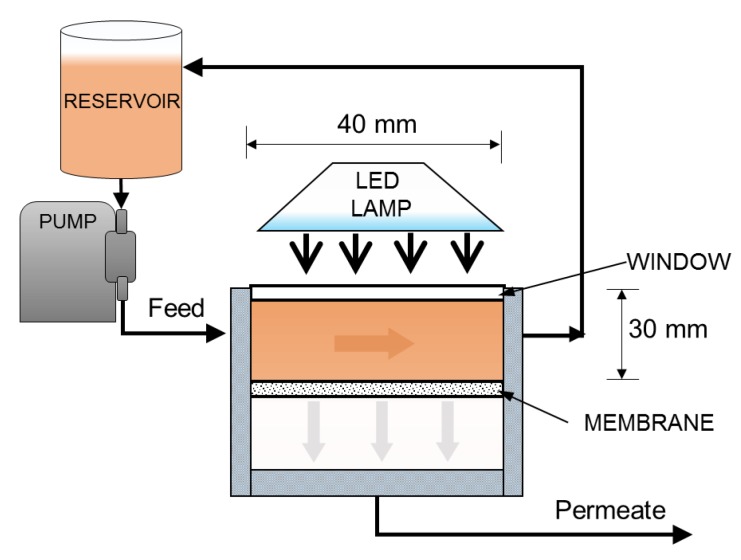
Membrane fouling has been a major issue in the development of more efficient water treatment processes. Specifically in surface waters filtration, organic matter, such as humic-like substances, can cause irreversible fouling. Therefore, this study evaluates the activity of a photocatalytic layer composed of Ce-doped zirconia nanoparticles in improving the fouling resistance during filtration of an aqueous solution of humic acid (HA). These nanoparticles were prepared by hydrothermal and sol-gel processes and then characterized. Before the filtration experiments, the photodegradation of HA catalyzed by Ce-doped zirconia nanoparticles in dispersion was studied. It was observed that the sol-gel prepared Ce-ZrO₂ exhibited higher HA removal in practically neutral pH, achieving 93% efficiency in 180 min of adsorption in the dark followed by 180 min under visible-light irradiation using light-emitting diodes (LEDs). Changes in spectral properties and in total organic carbon confirmed HA degradation and contributed to the proposal of a mechanism for HA photodegradation. Finally, in HA filtration tests, Ce-ZrO₂ photocatalytic membranes were able to recover the flux in a fouled membrane using visible-light by degrading HA. The present findings point to the further development of anti-fouling membranes, in which solar light can be used to degrade fouling compounds and possibly contaminants of emerging concern, which will have important environmental implications.
膜污染一直是更高效水处理工艺发展中的一个主要问题。特别是在地表水过滤中,诸如类腐殖质等有机物会导致不可逆污染。因此,本研究评估了由铈掺杂氧化锆纳米颗粒组成的光催化层在提高腐殖酸(HA)水溶液过滤过程中抗污染性能方面的活性。这些纳米颗粒通过水热法和溶胶 - 凝胶法制备,然后进行表征。在过滤实验之前,研究了分散状态下铈掺杂氧化锆纳米颗粒对HA的光催化降解。观察到溶胶 - 凝胶法制备的Ce - ZrO₂在实际接近中性的pH值下表现出更高的HA去除率,在黑暗中吸附180分钟后,再使用发光二极管(LED)在可见光照射下180分钟,去除效率达到93%。光谱特性和总有机碳的变化证实了HA的降解,并有助于提出HA光降解的机制。最后,在HA过滤测试中,Ce - ZrO₂光催化膜能够通过降解HA利用可见光使污染膜中的通量恢复。目前的研究结果表明了防污膜的进一步发展方向,即可以利用太阳光降解污染化合物以及可能的新出现的关注污染物,这将具有重要的环境意义。