Shriberg Lawrence D, Kwiatkowski Joan, Mabie Heather L
a Intellectual and Developmental Disabilities Research Center, Waisman Center , University of Wisconsin-Madison , Madison , WI . USA.
Clin Linguist Phon. 2019;33(8):679-706. doi: 10.1080/02699206.2019.1595731. Epub 2019 Apr 15.
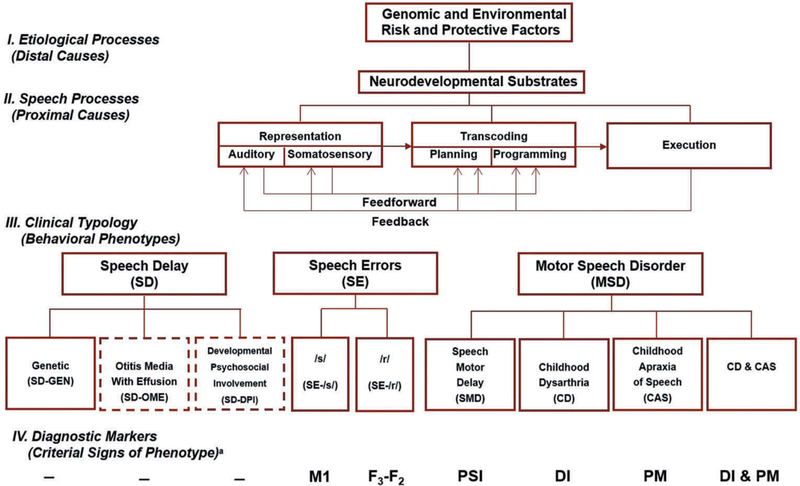
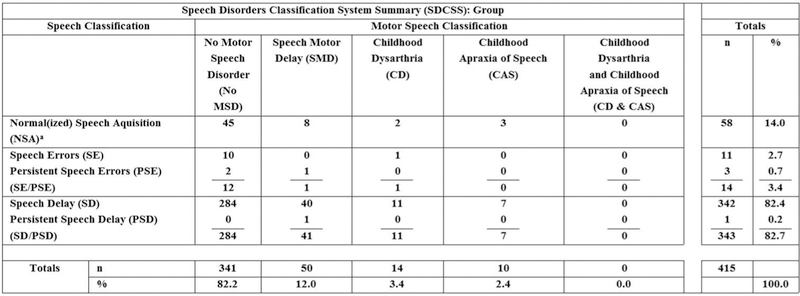
The goal of this research was to obtain initial estimates of the prevalence of each of four types of motor speech disorders in children with idiopathic Speech Delay (SD) and to use findings to estimate the population-based prevalence of each disorder. Analyses were completed on audio-recorded conversational speech samples from 415 children recruited for research in idiopathic SD in six USA cities during the past three decades. The speech and motor speech status of each participant was cross-classified using standardized measures in the finalized version of the Speech Disorders Classification System described in the Supplement. Population-based prevalence estimates for the four motor speech disorders were calculated from epidemiological studies of SD conducted in Australia, England, and the USA. A total of 82.2% of the 415 participants with SD met criteria for No Motor Speech Disorder at assessment, 12% met criteria for Speech Motor Delay, 3.4% met criteria for Childhood Dysarthria, 2.4% met criteria for Childhood Apraxia of Speech, and 0% met criteria for concurrent Childhood Dysarthria and Childhood Apraxia of Speech. The estimated population-based prevalence of each of the first three motor speech disorders at 4 to 8 years of age were Speech Motor Delay: 4 children per 1,000; Childhood Dysarthria: 1 child per 1,000; and Childhood Apraxia of Speech: 1 child per 1,000. The latter finding cross-validates a prior prevalence estimate for Childhood Apraxia of Speech of 1-2 children per 1,000. Findings are interpreted to indicate a substantial prevalence of motor speech disorders in children with idiopathic SD. CAS, childhood apraxia of speech; CD, childhood dysarthria; CND, complex neurodevelopmental disorders; DI, dysarthria index; DSI, dysarthria subtype indices; MSD, motor speech disorder; No MSD, no motor speech disorder; NSA, normal(ized) speech acquisition; PEPPER, programs to examine phonetic and phonologic evaluation records; PM, pause marker; PMI, pause marker index; PSD, persistent speech delay; PSE, persistent speech errors; SD, speech delay; SDCS, speech disorders classification system; SDCSS, speech disorders classification system summary; SE, speech errors; SMD, speech motor delay.
本研究的目的是初步估计特发性言语延迟(SD)儿童中四种运动性言语障碍各自的患病率,并利用研究结果估计每种障碍基于人群的患病率。对过去三十年在美国六个城市招募的415名参与特发性SD研究的儿童的录音对话语音样本进行了分析。使用附录中所述的言语障碍分类系统最终版本中的标准化测量方法,对每位参与者的言语和运动性言语状态进行交叉分类。基于澳大利亚、英国和美国对SD进行的流行病学研究,计算了四种运动性言语障碍基于人群的患病率估计值。在415名患有SD的参与者中,共有82.2%在评估时符合无运动性言语障碍的标准,12%符合言语运动延迟的标准,3.4%符合儿童构音障碍的标准,2.4%符合儿童言语失用症的标准,0%符合同时患有儿童构音障碍和儿童言语失用症的标准。4至8岁时,前三种运动性言语障碍基于人群的患病率估计值分别为:言语运动延迟:每1000名儿童中有4名;儿童构音障碍:每1000名儿童中有1名;儿童言语失用症:每1000名儿童中有1名。后一结果对先前每1000名儿童中有1 - 2名儿童患儿童言语失用症的患病率估计值进行了交叉验证。研究结果表明,特发性SD儿童中运动性言语障碍的患病率相当高。CAS,儿童言语失用症;CD,儿童构音障碍;CND,复杂神经发育障碍;DI,构音障碍指数;DSI,构音障碍亚型指数;MSD,运动性言语障碍;无MSD,无运动性言语障碍;NSA,正常(化)言语获得;PEPPER,检查语音和音系评估记录的程序;PM,停顿标记;PMI,停顿标记指数;PSD,持续性言语延迟;PSE,持续性言语错误;SD,言语延迟;SDCS,言语障碍分类系统;SDCSS,言语障碍分类系统摘要;SE,言语错误;SMD,言语运动延迟