The James Comprehensive Cancer Center and.
Center for Biostatistics, The Ohio State University, Columbus, OH; and.
Blood Adv. 2019 Apr 23;3(8):1255-1266. doi: 10.1182/bloodadvances.2018025973.
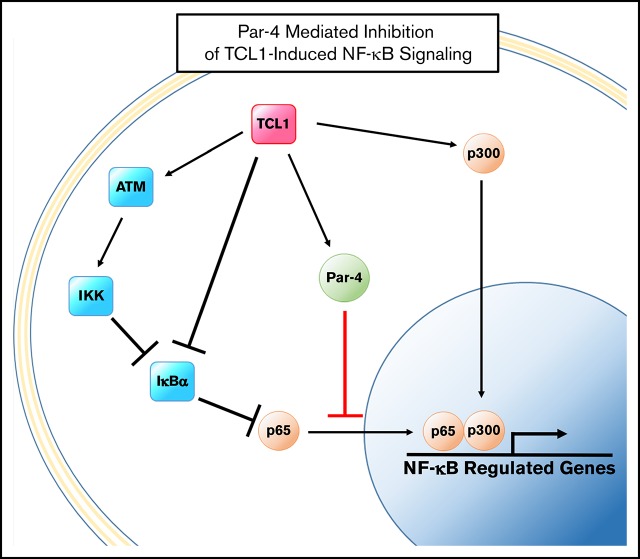
Prostate apoptosis response 4 (Par-4) is a tumor suppressor that prevents proliferation and induces cell death in several solid tumors. However, its role in B-cell malignancies has not been elucidated. To describe the role of Par-4 in chronic lymphocytic leukemia (CLL) pathogenesis, we developed a B-cell-specific human Par-4-overexpressing mouse model of CLL using the TCL1 leukemia model. While Par-4 transgenic mice did not display any obvious defects in B-cell development or function, disease burden as evidenced by abundance of CD19CD5 B cells in the peripheral blood was significantly reduced in Par-4 × TCL1 mice compared with TCL1 littermates. This conferred a survival advantage on the Par-4-overexpressing mice. In addition, a B-cell-specific knockout model displayed the opposite effect, where lack of Par-4 expression resulted in accelerated disease progression and abbreviated survival in the TCL1 model. Histological and flow cytometry-based analysis of spleen and bone marrow upon euthanasia revealed comparable levels of malignant B-cell infiltration in Par-4 × TCL1 and TCL1 individuals, indicating delayed but pathologically normal disease progression in Par-4 × TCL1 mice. In vivo analysis of splenic B-cell proliferation by 5-ethynyl-2-deoxyuridine incorporation indicated >50% decreased expansion of CD19CD5 cells in Par-4 × TCL1 mice compared with TCL1 littermates. Moreover, reduced nuclear p65 levels were observed in Par-4 × TCL1 splenic B cells compared with TCL1, suggesting suppressed NF-κB signaling. These findings have identified an in vivo antileukemic role for Par-4 through an NF-κB-dependent mechanism in TCL1-mediated CLL-like disease progression.
前列腺凋亡反应蛋白 4(Par-4)是一种肿瘤抑制因子,可防止几种实体肿瘤的增殖并诱导细胞死亡。然而,其在 B 细胞恶性肿瘤中的作用尚未阐明。为了描述 Par-4 在慢性淋巴细胞白血病(CLL)发病机制中的作用,我们使用 TCL1 白血病模型开发了一种 B 细胞特异性人 Par-4 过表达的 CLL 小鼠模型。虽然 Par-4 转基因小鼠在 B 细胞发育或功能方面没有显示出任何明显缺陷,但与 TCL1 同窝仔相比,Par-4 × TCL1 小鼠外周血中 CD19CD5 B 细胞的数量明显减少,表明疾病负担降低。这为 Par-4 过表达小鼠带来了生存优势。此外,B 细胞特异性敲除模型显示出相反的效果,缺乏 Par-4 表达导致 TCL1 模型中的疾病进展加速和生存时间缩短。安乐死后脾脏和骨髓的组织学和流式细胞术分析显示,Par-4 × TCL1 和 TCL1 个体中恶性 B 细胞浸润程度相当,表明 Par-4 × TCL1 小鼠中的疾病进展延迟但病理性正常。体内通过 5-乙炔基-2-脱氧尿苷掺入分析脾 B 细胞增殖的研究表明,与 TCL1 同窝仔相比,Par-4 × TCL1 小鼠中 CD19CD5 细胞的扩增减少了>50%。此外,与 TCL1 相比,Par-4 × TCL1 脾 B 细胞中的核 p65 水平降低,提示 NF-κB 信号受到抑制。这些发现确定了 Par-4 通过 NF-κB 依赖性机制在 TCL1 介导的 CLL 样疾病进展中发挥体内抗白血病作用。