
性与肱骨髓腔形态的左右侧差异。
Sex and Laterality Differences in Medullary Humerus Morphology.
机构信息
Department of Orthopaedics, University of Utah, Salt Lake City, Utah.
Department of Biomedical Engineering, University of Utah, Salt Lake City, Utah.
出版信息
Anat Rec (Hoboken). 2019 Oct;302(10):1709-1717. doi: 10.1002/ar.24138. Epub 2019 May 1.
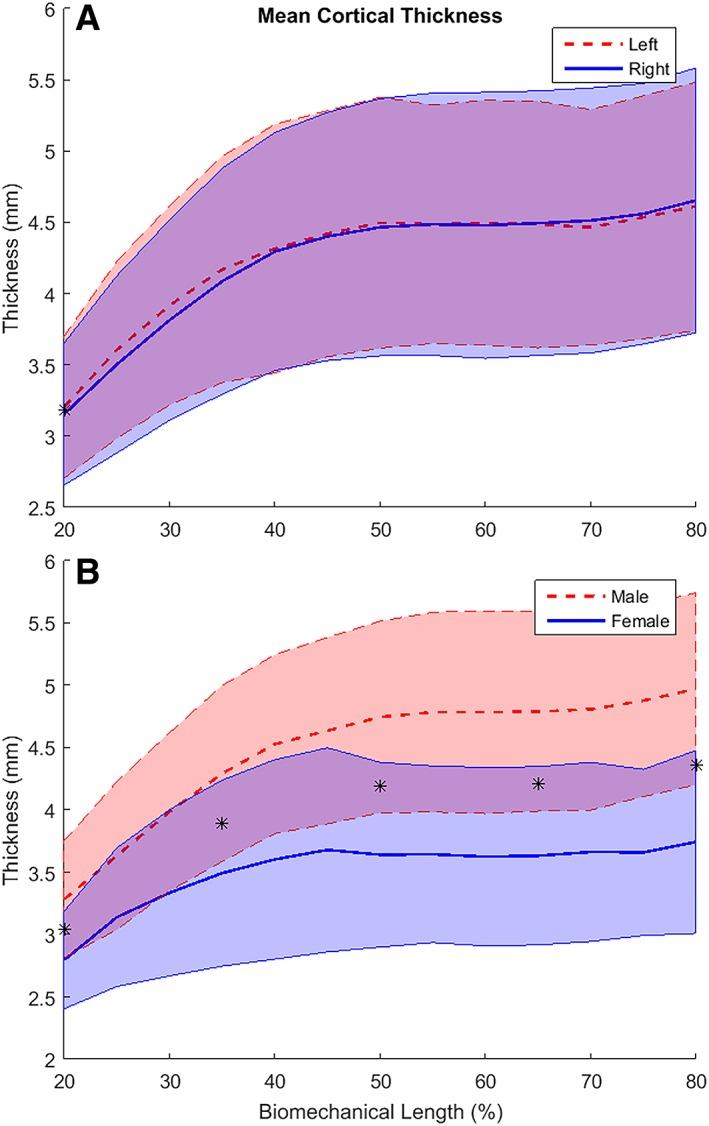
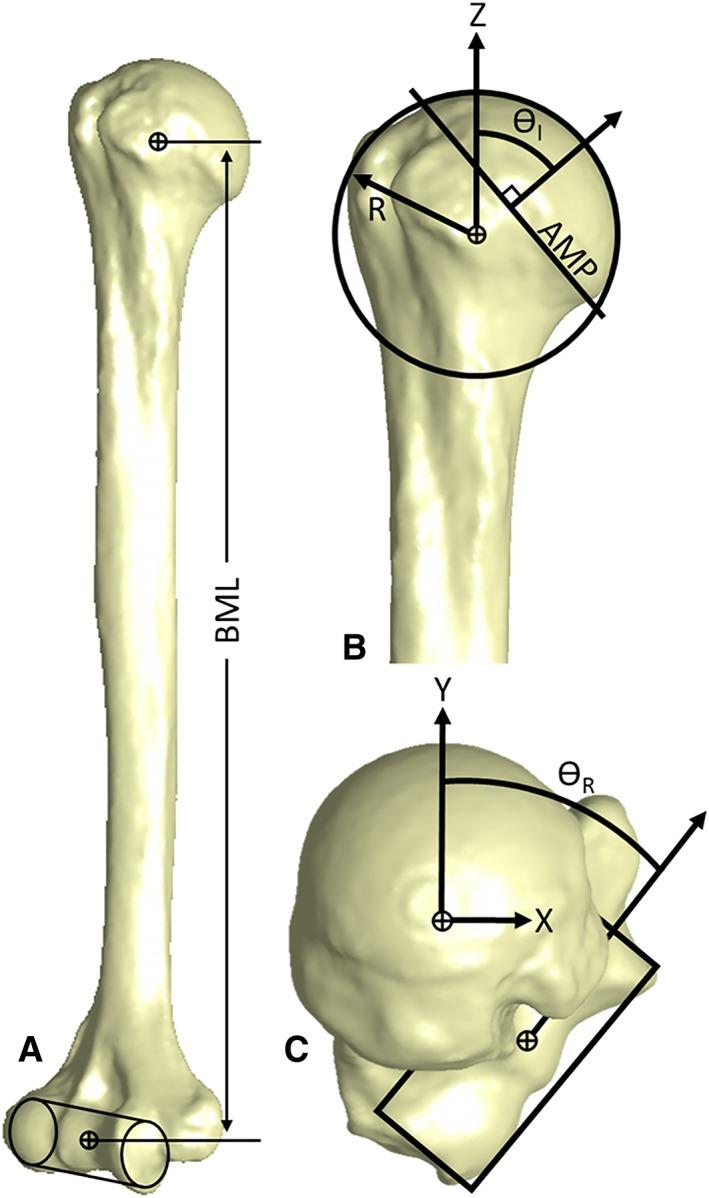
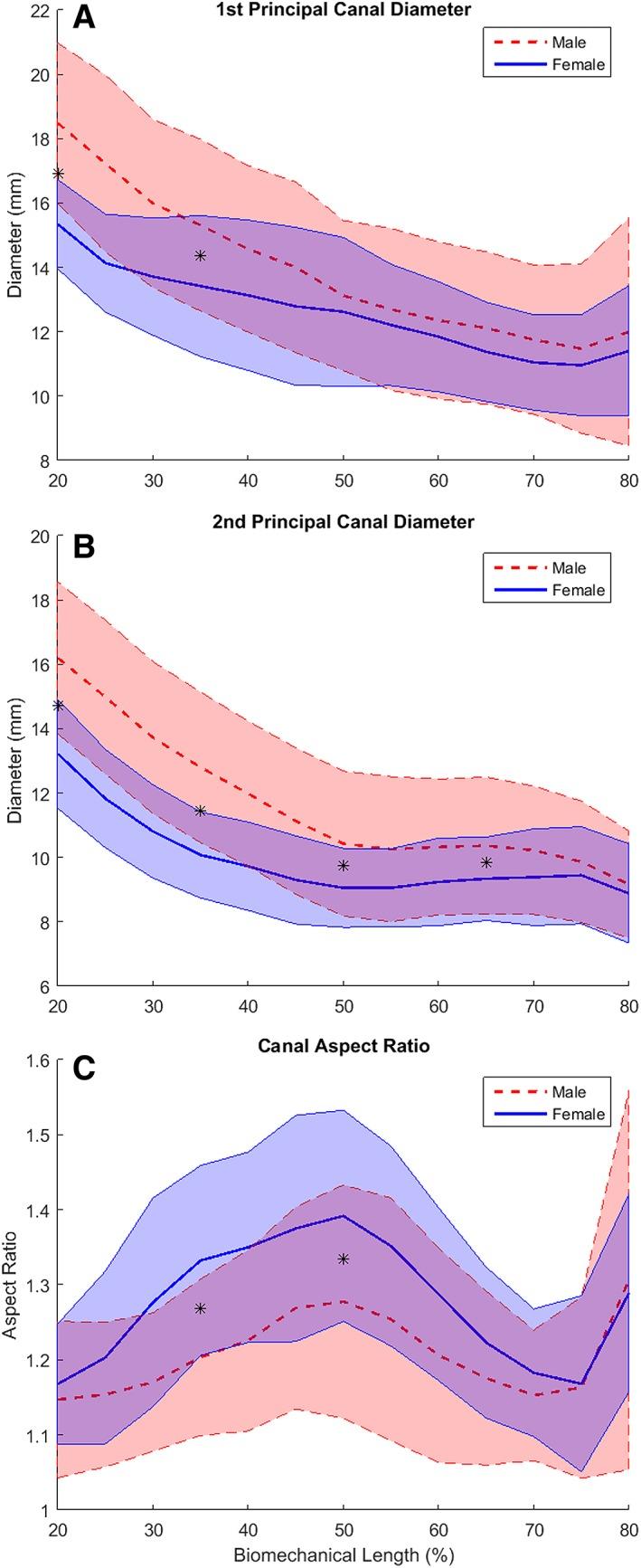
Percutaneous osseointegrated (OI) prosthetic limb attachment holds promise for transhumeral amputees. Understanding humeral medullary morphology is necessary for informed design of upper extremity OI systems, and is beneficial to the field of megaprosthetic reconstruction of the distal humerus where diaphyseal fixation is desired. The purpose of this study was to quantify the sex and laterality differences in humerus morphology, specifically over the diaphysis. Three-dimensional surface reconstructions of 58 pairs of cadaveric humeri (43 male, 15 female) were generated from CT data. Measures describing periosteal and medullary morphology were collected relative to an anatomic coordinate system. Sex and laterality differences in biomechanical length (BML) were observed (P ≤ 0.001 and 0.022, respectively). Head radius was larger in males than females (P ≤ 0.001). Retroversion was increased in right humeri relative to left (P ≤ 0.001). Canal orientation exhibited a conformational shift from anteversion to retroversion distally at approximately 65% BML. Right humeri exhibited larger medullary diameters than left in the 1st and 2nd principal directions (P ≤ 0.024). Males displayed larger diameter medullary canals proximally (P ≤ 0.029) and an increased rate of divergence of the endosteal cortex in the proximal diaphysis (P ≤ 0.009). Females exhibited higher canal aspect ratios at mid-shaft (P ≤ 0.014) and lower mean cortical thickness (P ≤ 0.001). Human humeral diaphysis morphology exhibits sex and laterality differences, which are dependent on position along the diaphysis. Understanding humeral morphology is necessary to achieve adequate primary stability and bone apposition in design of endoprosthetic stems for percutaneous OI implants, and distal humerus replacement. Anat Rec, 302:1709-1717, 2019. © 2019 The Authors. The Anatomical Record published by Wiley Periodicals, Inc. on behalf of American Association for Anatomy.
经皮骨整合(OI)假体肢体附着有望应用于肱骨截肢患者。了解肱骨髓腔形态对于上肢 OI 系统的设计至关重要,并且对于需要骨干固定的肱骨远端 megaprosthetic 重建领域也有益处。本研究的目的是量化肱骨形态的性别和侧别差异,特别是骨干。从 CT 数据生成了 58 对尸体肱骨(43 名男性,15 名女性)的三维表面重建。收集了描述骨外膜和髓腔形态的测量值,这些测量值相对于解剖坐标系进行了测量。观察到生物力学长度(BML)的性别和侧别差异(P≤0.001 和 0.022)。男性的头半径大于女性(P≤0.001)。与左侧相比,右侧肱骨的后倾角度更大(P≤0.001)。在大约 65% BML 处,管腔方向从前倾变为后倾。右侧肱骨在第 1 和第 2 主方向上的髓腔直径大于左侧(P≤0.024)。男性肱骨近端髓腔直径较大(P≤0.029),骨干近端骨内皮质的发散率增加(P≤0.009)。女性在中轴处具有较高的管腔纵横比(P≤0.014)和较低的平均皮质厚度(P≤0.001)。人类肱骨骨干形态存在性别和侧别差异,这些差异取决于骨干的位置。了解肱骨形态对于设计经皮 OI 植入物的内假体柄和肱骨远端置换以实现足够的初始稳定性和骨附着是必要的。解剖学记录,302:1709-1717,2019。©2019 作者。美国解剖学协会的 Wiley 期刊出版公司出版了《解剖学记录》。



 Zotero 插件