Division of Sleep and Circadian Disorders, Brigham and Women's Hospital, Boston, MA, United States of America.
Division of Sleep Medicine, Harvard Medical School, Boston, MA, United States of America.
PLoS Genet. 2019 Apr 16;15(4):e1007739. doi: 10.1371/journal.pgen.1007739. eCollection 2019 Apr.
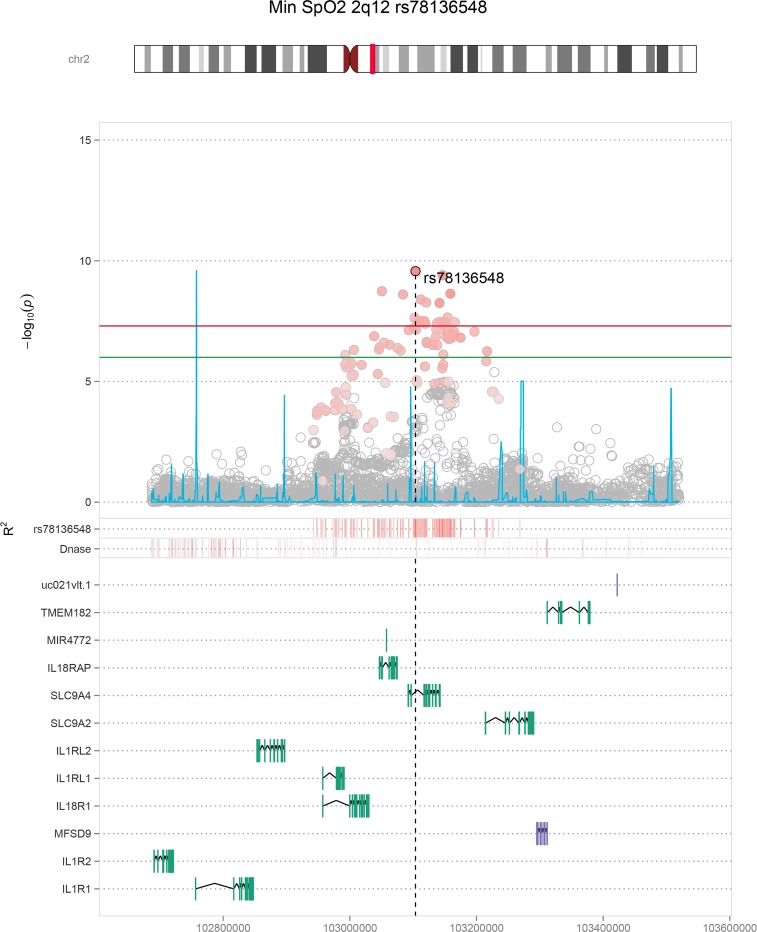
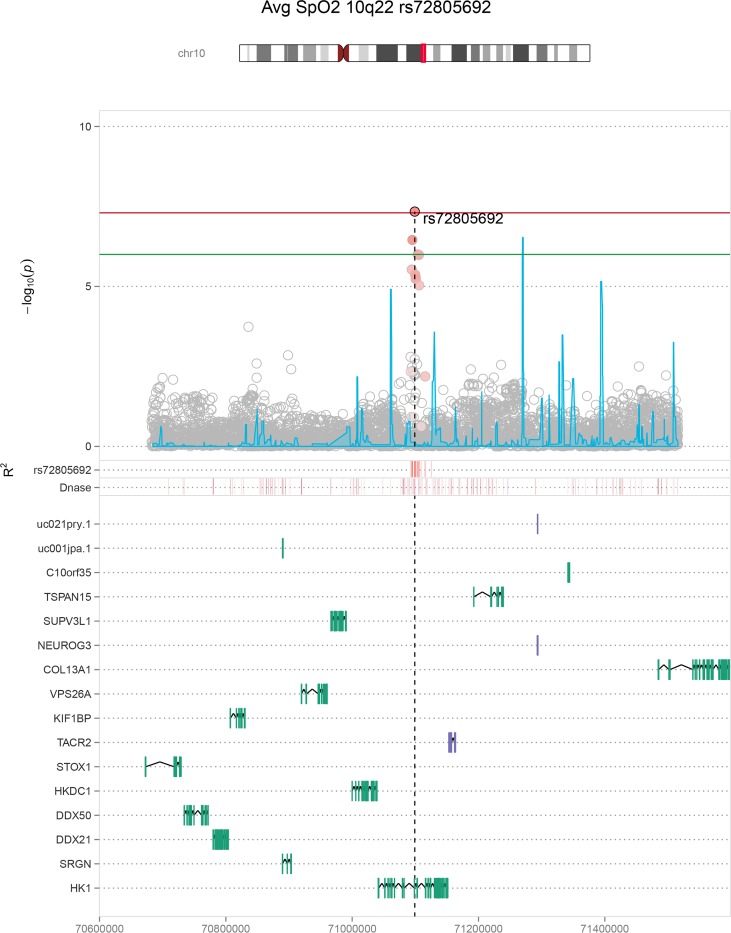
Sleep disordered breathing (SDB)-related overnight hypoxemia is associated with cardiometabolic disease and other comorbidities. Understanding the genetic bases for variations in nocturnal hypoxemia may help understand mechanisms influencing oxygenation and SDB-related mortality. We conducted genome-wide association tests across 10 cohorts and 4 populations to identify genetic variants associated with three correlated measures of overnight oxyhemoglobin saturation: average and minimum oxyhemoglobin saturation during sleep and the percent of sleep with oxyhemoglobin saturation under 90%. The discovery sample consisted of 8,326 individuals. Variants with p < 1 × 10(-6) were analyzed in a replication group of 14,410 individuals. We identified 3 significantly associated regions, including 2 regions in multi-ethnic analyses (2q12, 10q22). SNPs in the 2q12 region associated with minimum SpO2 (rs78136548 p = 2.70 × 10(-10)). SNPs at 10q22 were associated with all three traits including average SpO2 (rs72805692 p = 4.58 × 10(-8)). SNPs in both regions were associated in over 20,000 individuals and are supported by prior associations or functional evidence. Four additional significant regions were detected in secondary sex-stratified and combined discovery and replication analyses, including a region overlapping Reelin, a known marker of respiratory complex neurons.These are the first genome-wide significant findings reported for oxyhemoglobin saturation during sleep, a phenotype of high clinical interest. Our replicated associations with HK1 and IL18R1 suggest that variants in inflammatory pathways, such as the biologically-plausible NLRP3 inflammasome, may contribute to nocturnal hypoxemia.
睡眠呼吸障碍(SDB)相关的夜间低氧血症与心脏代谢疾病和其他合并症有关。了解夜间低氧血症变异的遗传基础可能有助于了解影响氧合和 SDB 相关死亡率的机制。我们在 10 个队列和 4 个人群中进行了全基因组关联测试,以确定与夜间氧合血红蛋白饱和度的三个相关指标相关的遗传变异:睡眠期间的平均和最小氧合血红蛋白饱和度以及氧合血红蛋白饱和度低于 90%的睡眠时间百分比。发现样本由 8326 个人组成。在包含 14410 个人的复制组中分析了 p<1×10(-6)的变体。我们确定了 3 个显著相关的区域,包括多民族分析中的 2 个区域(2q12,10q22)。与最低 SpO2 相关的 2q12 区域中的 SNP(rs78136548 p=2.70×10(-10))。10q22 上的 SNP 与所有三个特征(包括平均 SpO2)相关(rs72805692 p=4.58×10(-8))。这两个区域中的 SNP 与超过 20000 个人相关,并且得到了先前关联或功能证据的支持。在二次性别分层和综合发现和复制分析中还检测到了另外 4 个显著区域,包括一个与 Reelin 重叠的区域,Reelin 是呼吸复合体神经元的已知标志物。这是首次报告的与睡眠期间氧合血红蛋白饱和度相关的全基因组显著发现,这是一种具有高临床意义的表型。我们对 HK1 和 IL18R1 的复制关联表明,炎症途径中的变体,如生物学上合理的 NLRP3 炎症小体,可能导致夜间低氧血症。