• 文献检索
  • 文档翻译
  • 深度研究
  • 学术资讯
  • Suppr Zotero 插件Zotero 插件
  • 邀请有礼
  • 套餐&价格
  • 历史记录
应用&插件
Suppr Zotero 插件Zotero 插件浏览器插件Mac 客户端Windows 客户端微信小程序
定价
高级版会员购买积分包购买API积分包
服务
文献检索文档翻译深度研究API 文档MCP 服务
关于我们
关于 Suppr公司介绍联系我们用户协议隐私条款
关注我们

Suppr 超能文献

核心技术专利:CN118964589B侵权必究
粤ICP备2023148730 号-1Suppr @ 2026

文献检索

告别复杂PubMed语法,用中文像聊天一样搜索,搜遍4000万医学文献。AI智能推荐,让科研检索更轻松。

立即免费搜索

文件翻译

保留排版,准确专业,支持PDF/Word/PPT等文件格式,支持 12+语言互译。

免费翻译文档

深度研究

AI帮你快速写综述,25分钟生成高质量综述,智能提取关键信息,辅助科研写作。

立即免费体验

儿科物理治疗课程:对澳大利亚入门级物理治疗项目的审核和调查。

Paediatric Physiotherapy curriculum: an audit and survey of Australian entry-level Physiotherapy programs.

机构信息

Faculty of Health Sciences and Medicine, Bond Institute of Health and Sport, Bond University, Robina, QLD, Gold Coast, 4226, Australia.

出版信息

BMC Med Educ. 2019 Apr 16;19(1):109. doi: 10.1186/s12909-019-1540-z.

DOI:10.1186/s12909-019-1540-z
PMID:30992074
原文链接:https://pmc.ncbi.nlm.nih.gov/articles/PMC6469150/
Abstract

BACKGROUND

No documented standard or core competencies exist for paediatric curriculum in entry-level physiotherapy programs in Australia. Consequently, extensive variability is thought to exist amongst Australian entry-level physiotherapy programs for preparing physiotherapists to work safely and effectively with children. The purpose of this study was to explore the landscape of paediatric curriculum in Australian entry-level physiotherapy programs and identify the paediatric content being covered, its perceived importance according to university academics who teach paediatrics, the mode of delivery and assessment, and the strengths, weaknesses, barriers and facilitators to implementing paediatric curriculum.

METHODS

A web-based desktop audit and an online cross-sectional survey using closed and open-ended questions was administered to all Australian universities offering entry-level physiotherapy programs in November 2017. Content coverage and perceived level of importance for paediatric content areas were determined using Likert scale responses. Open-ended responses were thematically analysed to identify key themes for strengths, weaknesses and facilitators to implementation of paediatric curriculum.

RESULTS

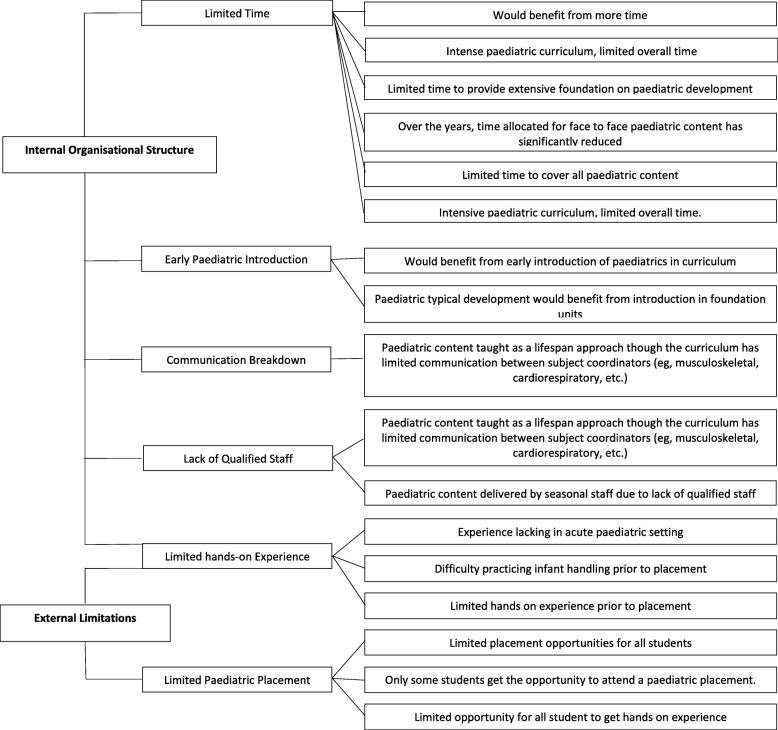
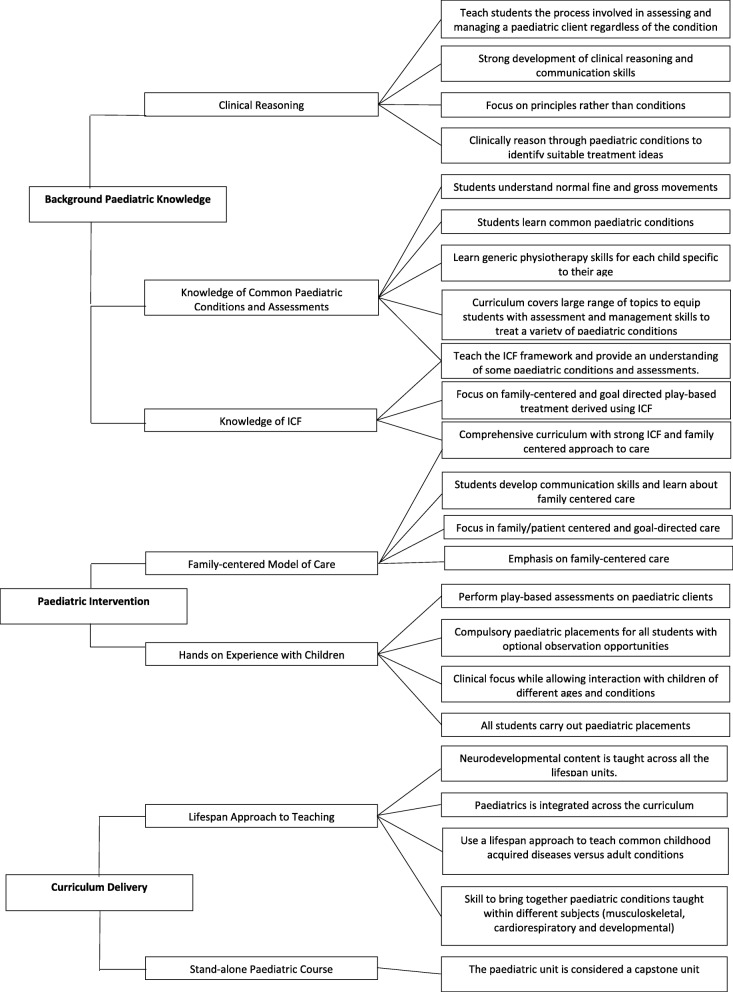
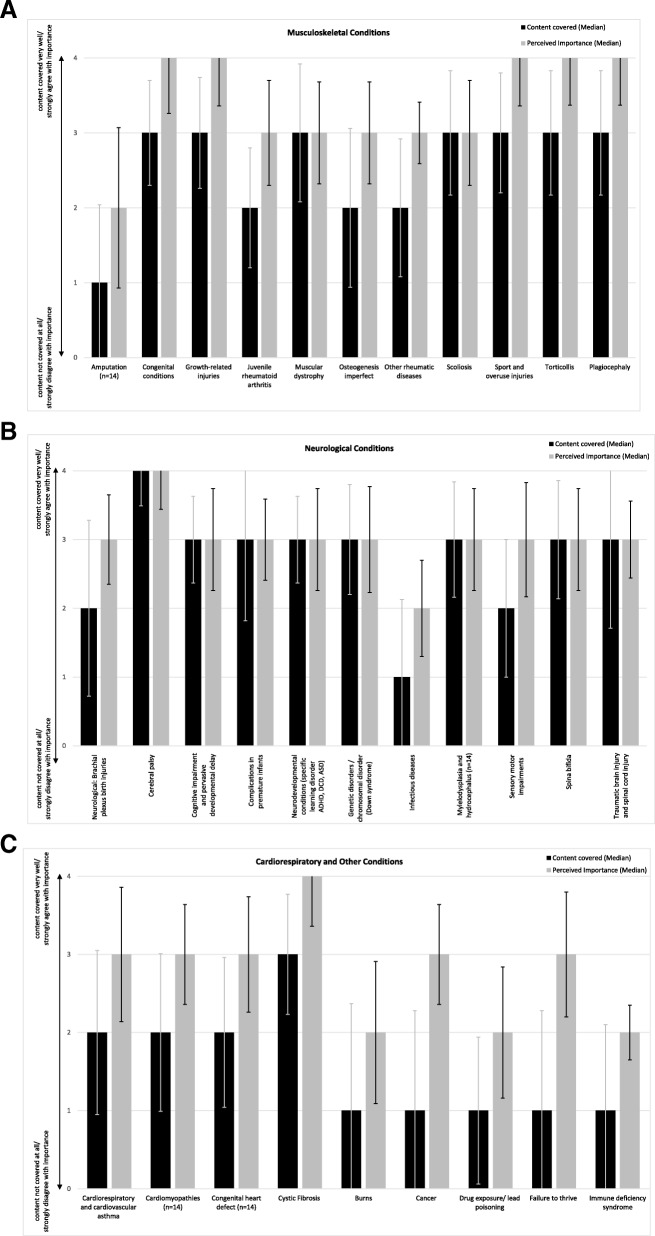
All (n = 20, 100%) entry-level programs used the terms lifespan, child and/or paediatrics somewhere in at least one subject descriptor. Forty-five percent (n = 9) of universities did not use the terms lifespan, child or paediatric in their published learning objectives. Eight (40%) universities offered a paediatric stand-alone course. Sixty-five (13/20) percent of universities invited, responded to the survey. For paediatric conditions the perceived level of importance was predominately higher than its course content coverage for 19 of the 31 conditions surveyed. Key barriers to implementating paediatric curriculum were: crowded curriculum, limited financial resources resulting in a lack of qualified staff, lack of prioritisation of paediatric curriculum and inadequate paediatric placement availability. Facilitators for effective implementation of paediatric content were stand-alone paediatric subjects, demonstrated dedication to paediatric curriculum and having suitably qualified faculty members.

CONCLUSION

The results of this survey provide the physiotherapy community with the views of paediatric physiotherapy academic educators regarding the content, perceived need to expand content delivery in identified clinical areas, and the barriers and facilitators to implementing paediatric content in Australian entry-level physiotherapy programs. Further research exploring similar questions with paediatric physiotherapy clinicians would complement the findings of this study.

摘要

背景

澳大利亚入门级物理治疗课程中,没有针对儿科课程的记录标准或核心能力。因此,人们认为澳大利亚入门级物理治疗课程在为物理治疗师提供安全有效地治疗儿童的能力方面存在很大差异。本研究的目的是探索澳大利亚入门级物理治疗课程中的儿科课程,并确定所涵盖的儿科内容、教授儿科的大学学者认为的重要程度、教学模式和评估方法,以及实施儿科课程的优势、劣势、障碍和促进因素。

方法

2017 年 11 月,我们对所有提供入门级物理治疗课程的澳大利亚大学进行了基于网络的桌面审计和在线横断面调查,使用封闭式和开放式问题。使用李克特量表的回答来确定儿科内容领域的内容覆盖范围和感知重要性。对开放式回答进行主题分析,以确定实施儿科课程的优势、劣势和促进因素的关键主题。

结果

所有(n=20,100%)入门级课程在至少一个学科描述中使用了“生命周期”、“儿童”和/或“儿科”这几个术语。45%(n=9)的大学在其发布的学习目标中没有使用“生命周期”、“儿童”或“儿科”这几个术语。8 所(40%)大学提供了单独的儿科课程。65%(13/20)的大学受邀并对调查做出了回应。对于儿科疾病,在所调查的 31 种疾病中,有 19 种疾病的感知重要性明显高于其课程内容覆盖范围。实施儿科课程的主要障碍是:课程拥挤、有限的财务资源导致缺乏合格的员工、对儿科课程的重视程度不够以及儿科实习机会不足。有效实施儿科内容的促进因素是单独的儿科科目、对儿科课程的投入以及拥有合格的教师。

结论

本调查结果为物理治疗界提供了儿科物理治疗学术教育者对内容、在已确定的临床领域扩大内容提供的感知需求、以及在澳大利亚入门级物理治疗课程中实施儿科内容的障碍和促进因素的看法。对儿科物理治疗临床医生进行类似问题的进一步研究将补充本研究的结果。
https://cdn.ncbi.nlm.nih.gov/pmc/blobs/2e1e/6469150/d8128d96645a/12909_2019_1540_Fig3_HTML.jpg
https://cdn.ncbi.nlm.nih.gov/pmc/blobs/2e1e/6469150/aee9cd57c0d4/12909_2019_1540_Fig1_HTML.jpg
https://cdn.ncbi.nlm.nih.gov/pmc/blobs/2e1e/6469150/25c599cc646a/12909_2019_1540_Fig2_HTML.jpg
https://cdn.ncbi.nlm.nih.gov/pmc/blobs/2e1e/6469150/d8128d96645a/12909_2019_1540_Fig3_HTML.jpg
https://cdn.ncbi.nlm.nih.gov/pmc/blobs/2e1e/6469150/aee9cd57c0d4/12909_2019_1540_Fig1_HTML.jpg
https://cdn.ncbi.nlm.nih.gov/pmc/blobs/2e1e/6469150/25c599cc646a/12909_2019_1540_Fig2_HTML.jpg
https://cdn.ncbi.nlm.nih.gov/pmc/blobs/2e1e/6469150/d8128d96645a/12909_2019_1540_Fig3_HTML.jpg

相似文献

1
Paediatric Physiotherapy curriculum: an audit and survey of Australian entry-level Physiotherapy programs.儿科物理治疗课程:对澳大利亚入门级物理治疗项目的审核和调查。
BMC Med Educ. 2019 Apr 16;19(1):109. doi: 10.1186/s12909-019-1540-z.
2
Fostering cultural responsiveness in physiotherapy: curricula survey of Australian and Aotearoa New Zealand physiotherapy programs.在物理治疗中培养文化反应能力:澳大利亚和新西兰物理治疗课程调查。
BMC Med Educ. 2019 Aug 30;19(1):326. doi: 10.1186/s12909-019-1766-9.
3
The paediatric physiotherapy curricula landscape: A survey of United Kingdom entry-level programs.儿科物理治疗课程概况:对英国入门级课程的一项调查。
Physiother Res Int. 2023 Oct;28(4):e2012. doi: 10.1002/pri.2012. Epub 2023 May 13.
4
The current state of pain education within Canadian physiotherapy programs: a national survey of pain educators.加拿大物理治疗项目中疼痛教育的现状:对疼痛教育者的全国性调查。
Disabil Rehabil. 2020 May;42(9):1332-1338. doi: 10.1080/09638288.2018.1519044. Epub 2019 Jan 8.
5
Predictors of self-perceived cultural responsiveness in entry-level physiotherapy students in Australia and Aotearoa New Zealand.澳大利亚和新西兰入门级物理治疗学生自我感知文化反应能力的预测因素。
BMC Med Educ. 2019 Feb 13;19(1):56. doi: 10.1186/s12909-019-1487-0.
6
Telehealth education and training in entry-to-practice physiotherapy programs in Australian universities: A qualitative study with university educators.澳大利亚大学入门级物理治疗实践课程中的远程医疗教育和培训:对大学教育者的一项定性研究。
Musculoskeletal Care. 2023 Jun;21(2):491-501. doi: 10.1002/msc.1723. Epub 2022 Dec 13.
7
Building capacity in the rural physiotherapy workforce: a paediatric training partnership.提升农村物理治疗劳动力的能力:一项儿科培训合作项目。
Rural Remote Health. 2014;14:2475. Epub 2014 Mar 23.
8
Perceived barriers and facilitators to the provision of physiotherapy in residential aged care facilities: A national survey of Australian physiotherapists.澳大利亚养老院中物理治疗服务提供的感知障碍与促进因素:对澳大利亚物理治疗师的全国性调查
Australas J Ageing. 2023 Mar;42(1):165-175. doi: 10.1111/ajag.13123. Epub 2022 Aug 8.
9
Factors affecting curriculum content and the integration of evidence-based practice in entry-level physiotherapy programs.影响入门级物理治疗课程内容及循证实践整合的因素。
J Allied Health. 2007 Spring;36(1):17-23.
10
Does UK Entry-Level Physiotherapy Education Prepare Graduates for a Future in Pediatric Clinical Practice? A Mixed-Methods Study.英国入门级物理治疗教育是否为毕业生在儿科临床实践中做好准备?一项混合方法研究。
Phys Occup Ther Pediatr. 2024;44(5):748-764. doi: 10.1080/01942638.2024.2338934. Epub 2024 Apr 22.

引用本文的文献

1
Understanding the Perspectives of Paediatric Physicians on Physiotherapy in Paediatric Rehabilitation in Chennai, India: A Qualitative Approach.了解印度钦奈儿科医生对儿科康复中物理疗法的看法:一种定性方法。
J Prev Med Public Health. 2024 Mar;57(2):157-166. doi: 10.3961/jpmph.23.426. Epub 2024 Jan 21.
2
A step in the right direction: Delphi consensus on a UK and Australian paediatric podiatry curriculum.朝着正确方向迈出的一步:德尔菲共识在英国和澳大利亚儿科足病学课程中的体现。
BMC Med Educ. 2022 Feb 24;22(1):125. doi: 10.1186/s12909-022-03138-8.
3
Physiotherapy and related management for childhood obesity: A systematic scoping review.

本文引用的文献

1
How to Create a Bad Survey Instrument.如何设计一份糟糕的调查问卷。
J Grad Med Educ. 2017 Aug;9(4):411-415. doi: 10.4300/JGME-D-17-00375.1.
2
Essential competencies in entry-level pediatric physical therapy education.入门级儿科物理治疗教育中的基本能力。
Pediatr Phys Ther. 2014 Spring;26(1):7-18. doi: 10.1097/PEP.0000000000000003.
3
Perspectives of academic faculty and clinical instructors on entry-level DPT preparation for pediatric physical therapist practice.学术教师和临床讲师对入门级物理治疗博士(DPT)准备从事儿科物理治疗实践的看法。
儿童肥胖的物理治疗及相关管理:系统范围界定综述。
PLoS One. 2021 Jun 14;16(6):e0252572. doi: 10.1371/journal.pone.0252572. eCollection 2021.
Phys Ther. 2013 Dec;93(12):1661-72. doi: 10.2522/ptj.20120538. Epub 2013 Jun 27.
4
Clinical instructors' perspectives: what should we be teaching in pediatrics?临床带教老师的观点:我们在儿科学中应该教授什么?
Pediatr Phys Ther. 2012 Summer;24(2):183-91; discussion 192. doi: 10.1097/PEP.0b013e31824d0e8a.
5
The assessment of physiotherapy practice (APP) is a reliable measure of professional competence of physiotherapy students: a reliability study.物理治疗实践评估(APP)是评估物理治疗学生专业能力的可靠方法:一项可靠性研究。
J Physiother. 2012;58(1):49-56. doi: 10.1016/S1836-9553(12)70072-3.
6
The Assessment of Physiotherapy Practice (APP) is a valid measure of professional competence of physiotherapy students: a cross-sectional study with Rasch analysis.《物理治疗实践评估》(APP)是一种评估物理治疗学生专业能力的有效方法:一项横断面研究与 Rasch 分析。
J Physiother. 2011;57(4):239-46. doi: 10.1016/S1836-9553(11)70054-6.
7
Family-centered care: current applications and future directions in pediatric health care.以家庭为中心的护理:儿科保健中的当前应用和未来方向。
Matern Child Health J. 2012 Feb;16(2):297-305. doi: 10.1007/s10995-011-0751-7.
8
Patient referral and the physiotherapist: three decades later.患者转诊与物理治疗师:三十年后
J Physiother. 2010;56(4):217-8. doi: 10.1016/s1836-9553(10)70001-1.
9
Assistive technology curriculum structure and content in professional preparation service provider training programs.专业预备服务提供商培训项目中的辅助技术课程结构与内容
J Allied Health. 2007 Winter;36(4):183-92.
10
Research guidelines for the Delphi survey technique.德尔菲调查技术的研究指南。
J Adv Nurs. 2000 Oct;32(4):1008-15.