Institute for NanoBioTechnology, Johns Hopkins University, Baltimore, Maryland, USA.
Department of Chemistry, King's College London, London, UK.
Sci Rep. 2019 Apr 16;9(1):6117. doi: 10.1038/s41598-019-42272-0.
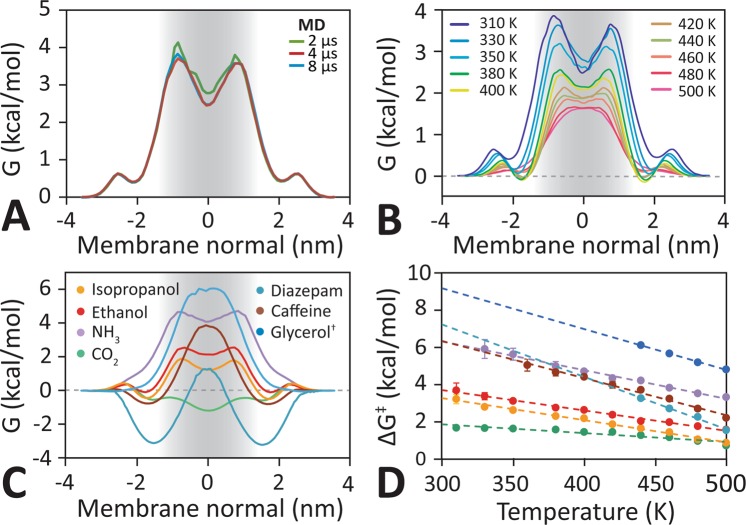
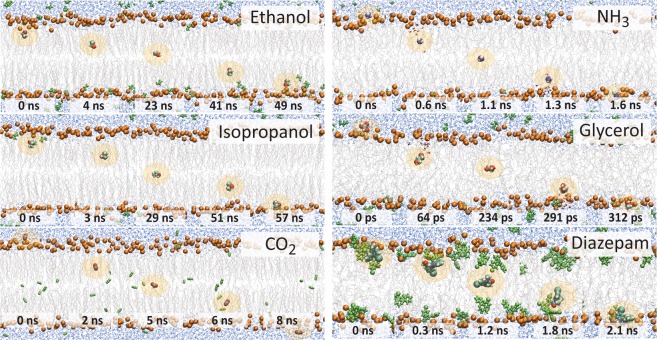
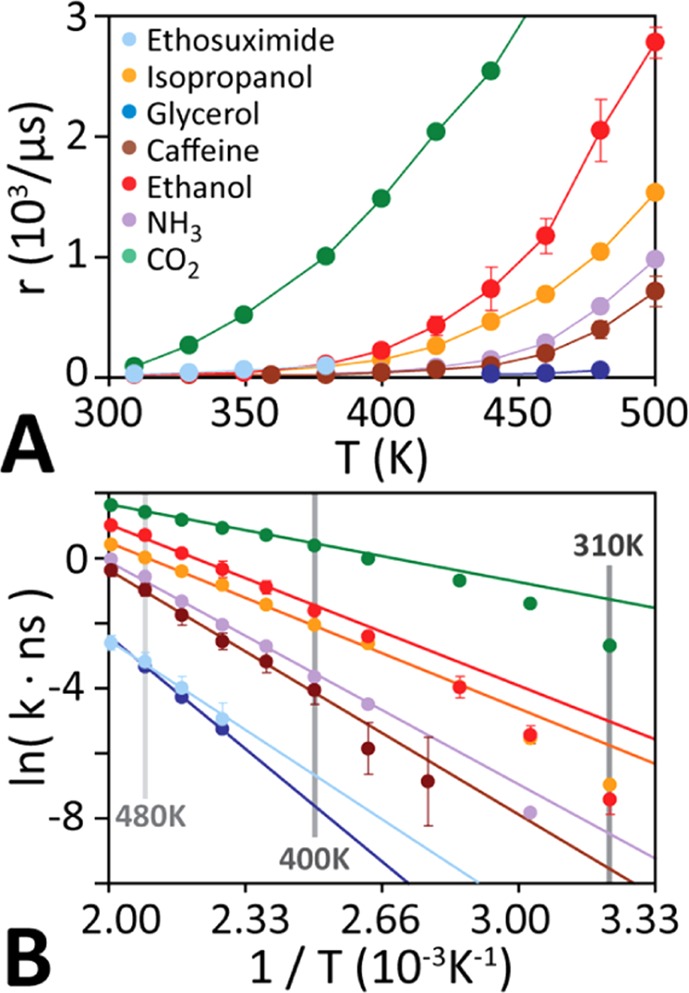
Drug development for the treatment of central nervous system (CNS) diseases is extremely challenging, in large part due to the difficulty in crossing the blood-brain barrier (BBB). Here we develop and experimentally validate a new in silico method to predict quantitatively the BBB permeability for small-molecule drugs. We show accurate prediction of solute permeabilities at physiological temperature using high-temperature unbiased atomic detail molecular dynamics simulations of spontaneous drug diffusion across BBB bilayers. These simulations provide atomic detail insights into the transport mechanisms, as well as converged kinetics and thermodynamics. The method is validated computationally against physiological temperature simulations for fast-diffusing compounds, as well as experimentally by direct determination of the compound permeabilities using a transwell assay as an in vitro BBB model. The overall agreement of the predicted values with both direct simulations at physiological temperatures and experimental data is excellent. This new tool has the potential to replace current semi-empirical in silico screening and in vitro permeability measurements in CNS drug discovery.
治疗中枢神经系统(CNS)疾病的药物开发极具挑战性,在很大程度上是由于难以穿透血脑屏障(BBB)。在这里,我们开发并实验验证了一种新的计算方法,用于定量预测小分子药物的 BBB 通透性。我们使用无偏原子细节的高温分子动力学模拟来模拟药物在生理温度下的自发扩散,从而实现了对溶质渗透性的精确预测。这些模拟提供了对传输机制的原子细节洞察,以及收敛的动力学和热力学。该方法通过与快速扩散化合物的生理温度模拟进行计算验证,并通过使用 Transwell 测定法作为体外 BBB 模型直接测定化合物通透性进行实验验证。预测值与生理温度下的直接模拟值和实验数据的整体一致性非常好。这种新工具有可能取代目前 CNS 药物发现中的半经验计算筛选和体外通透性测量。