Brozek Wolfgang, Reichardt Berthold, Zwerina Jochen, Dimai Hans Peter, Klaushofer Klaus, Zwettler Elisabeth
Ludwig Boltzmann Institute of Osteology, Hanusch Hospital of the WGKK and AUVA Trauma Center, 1 Medical Department at Hanusch Hospital, Heinrich Collin Str. 30, 1140 Vienna, Austria.
Sickness Fund Burgenland, Burgenländische Gebietskrankenkasse, Siegfried Marcus Str. 5, 7000 Eisenstadt, Austria.
Bone Rep. 2019 Apr 1;10:100204. doi: 10.1016/j.bonr.2019.100204. eCollection 2019 Jun.
To examine the association of proton pump inhibitor (PPI) use with subsequent hip fracture incidence in hip fracture patients, accounting for gender, age, PPI doses, PPI initiation before or after first fracture, and year from first fracture in which the first subsequent fracture occurred.
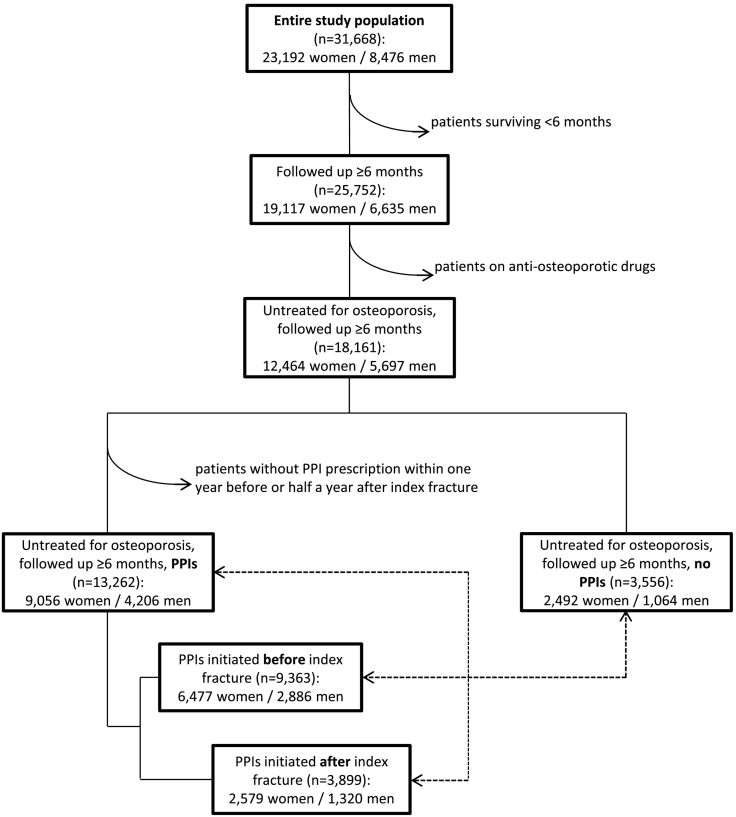
Data from 31,668 Austrian patients ≥50 years with the first hip fracture between July 2008 and December 2010 were analyzed retrospectively. After exclusion of patients on anti-osteoporotic medication, incidence of subsequent hip fractures was compared between users and non-users of PPIs using regression models.
In general, use of PPIs among hip fracture patients was associated with increased risk for subsequent hip fracture (OR 1.58, 95%-CI 1.25-2.00), in particular in men, in the age group of 70-84 years, and when PPIs were initiated before the first fracture. Low PPI doses of ≤90 cumulative DDDs and ≤0.25 DDDs/day, however, were not linked to elevated subsequent fracture risk, especially among female patients. Subsequent hip fracture incidence was elevated within the first year after first fracture in female and male PPI users (OR 1.75, 95%-CI 1.28-2.38) and dropped in women but not in men in the second year.
Low-dose PPI use is not associated with increased risk of subsequent hip fractures, especially in women. Patients thus get most benefit of short-term PPI use after a hip fracture that has previously been linked to lowered mortality if low doses are not exceeded. Varying risk profiles for the time of subsequent hip fracture could have implications for risk group-specific follow-up care.
研究质子泵抑制剂(PPI)的使用与髋部骨折患者后续髋部骨折发生率之间的关联,同时考虑性别、年龄、PPI剂量、首次骨折前或后开始使用PPI的情况,以及首次骨折后首次发生后续骨折的年份。
对2008年7月至2010年12月期间奥地利31668例年龄≥50岁且首次发生髋部骨折的患者数据进行回顾性分析。在排除使用抗骨质疏松药物的患者后,使用回归模型比较PPI使用者和非使用者后续髋部骨折的发生率。
总体而言,髋部骨折患者使用PPI与后续髋部骨折风险增加相关(比值比1.58,95%置信区间1.25 - 2.00),尤其是男性、70 - 84岁年龄组以及在首次骨折前开始使用PPI的患者。然而,低PPI剂量(累积限定日剂量≤90 DDDs且每日≤0.25 DDDs)与后续骨折风险升高无关,特别是在女性患者中。女性和男性PPI使用者在首次骨折后的第一年后续髋部骨折发生率升高(比值比1.75,95%置信区间1.28 - 2.38),而在第二年女性发生率下降但男性未下降。
低剂量使用PPI与后续髋部骨折风险增加无关,尤其是在女性中。因此,髋部骨折后短期使用PPI(如不超过低剂量)对患者最有益,此前已证明这与降低死亡率有关。后续髋部骨折发生时间的不同风险特征可能对特定风险组的后续护理有影响。