Romański Michał, Główka Franciszek K
Department of Physical Pharmacy and Pharmacokinetics, Poznan University of Medical Sciences, 6 Święcickiego Street, 60-781, Poznań, Poland.
Eur J Drug Metab Pharmacokinet. 2019 Oct;44(5):653-657. doi: 10.1007/s13318-019-00555-x.
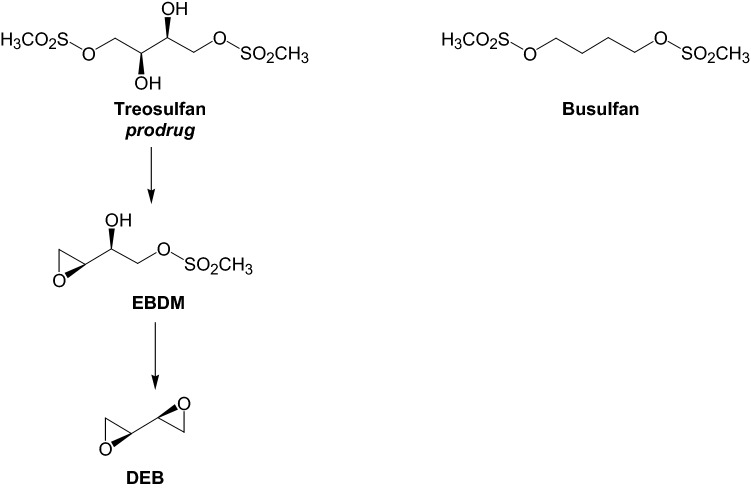
Treosulfan (dihydroxybusulfan), licensed for the treatment of ovarian carcinoma, is investigated in clinical trials as a myeloablative agent for conditioning prior to hematopoietic stem cell transplantation. Clinical experience shows that treosulfan exhibits lower organ toxicity than busulfan, including hepatotoxicity. Elimination of busulfan primarily via enzymatic conjugation with glutathione (GSH) in the liver is considered to be the main cause of the drug's hepatotoxicity and interpatient clearance variability. It is believed that treosulfan undergoes no hepatic metabolism but empirical evidence is lacking. The aim of this kinetic study was to verify if treosulfan is capable of conjugating with GSH.
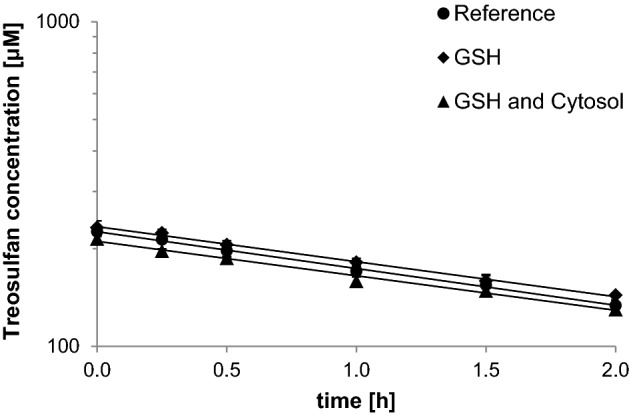
Treosulfan (200 μM) was incubated at pH 7.2 and 37 °C with 5 mM GSH in the presence or absence of human liver cytosol, the main store of glutathione S-transferase in the body. Concentrations of treosulfan were determined using liquid chromatography-tandem mass spectrometry and then subjected to kinetic analysis.
The decay of treosulfan in the solution followed a one-exponential model in the presence of either GSH or liver cytosol and GSH. The first-order reaction rate constants (0.25 h) did not differ statistically from those found for treosulfan conversion in pH 7.2 buffer only.
Treosulfan does not undergo either spontaneous or enzymatic conjugation with GSH at a noticeable rate. The result indicates that the clearance of treosulfan is independent of glutathione S-transferase activity, GSH stores, and co-administration of drugs utilizing the GSH metabolic pathway.
曲奥舒凡(二羟基白消安)已获许可用于治疗卵巢癌,正在进行临床试验,作为造血干细胞移植前预处理的清髓性药物。临床经验表明,曲奥舒凡的器官毒性低于白消安,包括肝毒性。白消安主要通过在肝脏中与谷胱甘肽(GSH)进行酶促结合而消除,这被认为是该药物肝毒性和患者间清除率变异性的主要原因。据信曲奥舒凡不发生肝脏代谢,但缺乏实证依据。本动力学研究的目的是验证曲奥舒凡是否能够与GSH结合。
在pH 7.2和37°C条件下,将曲奥舒凡(200μM)与5 mM GSH一起孵育,同时存在或不存在人肝细胞溶胶(体内谷胱甘肽S-转移酶的主要储存部位)。使用液相色谱-串联质谱法测定曲奥舒凡的浓度,然后进行动力学分析。
在存在GSH或肝细胞溶胶与GSH的情况下,溶液中曲奥舒凡的衰减遵循单指数模型。一级反应速率常数(0.25 h)与仅在pH 7.2缓冲液中曲奥舒凡转化的速率常数无统计学差异。
曲奥舒凡不会以明显的速率与GSH发生自发或酶促结合。该结果表明,曲奥舒凡的清除与谷胱甘肽S-转移酶活性、GSH储备以及利用GSH代谢途径的药物联合给药无关。