Rui Qiu Hong, Ma Jian Bo, Liao Yu Feng, Dai Jin Hua, Cai Zhen Yu
Department of Clinical Laboratory, HwaMei Hospital, University of Chinese Academy of Sciences (Ningbo No. 2 Hospital), Ningbo, Zhejiang, China.
Department of Pain Clinic, The First Affiliated Hospital of Xiamen University, Fujian Medical University, Xiamen, Fujian, China.
Braz J Med Biol Res. 2019;52(4):e7728. doi: 10.1590/1414-431X20197728. Epub 2019 Apr 15.
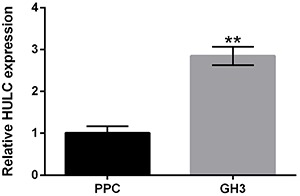
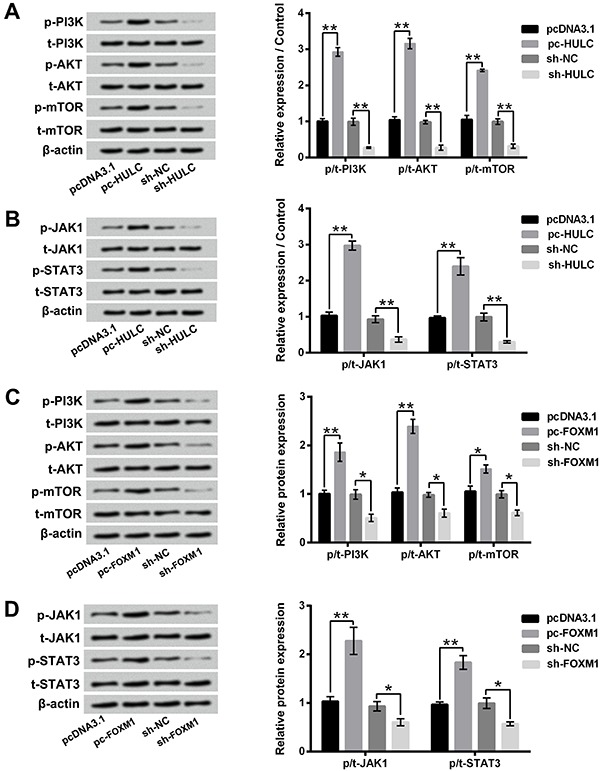
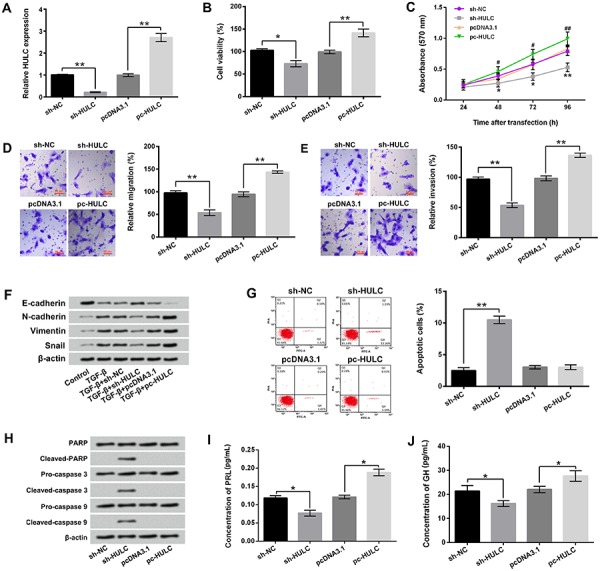
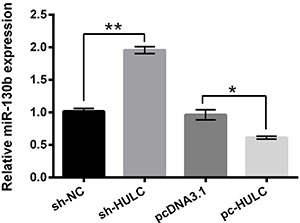
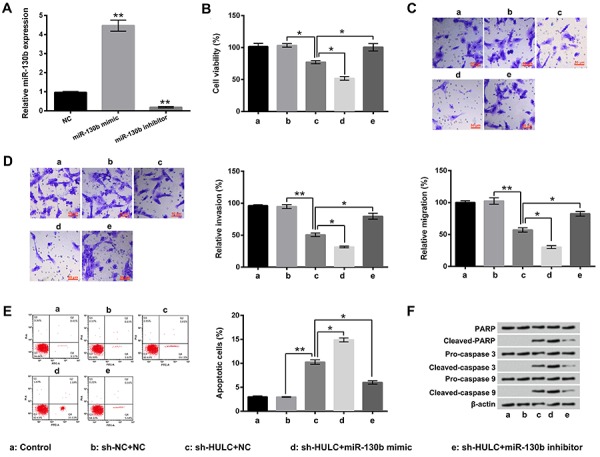
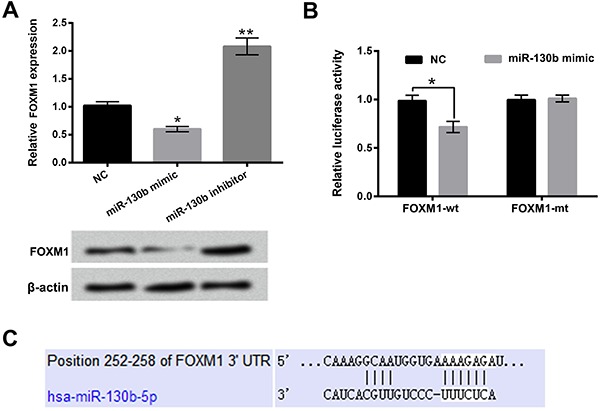
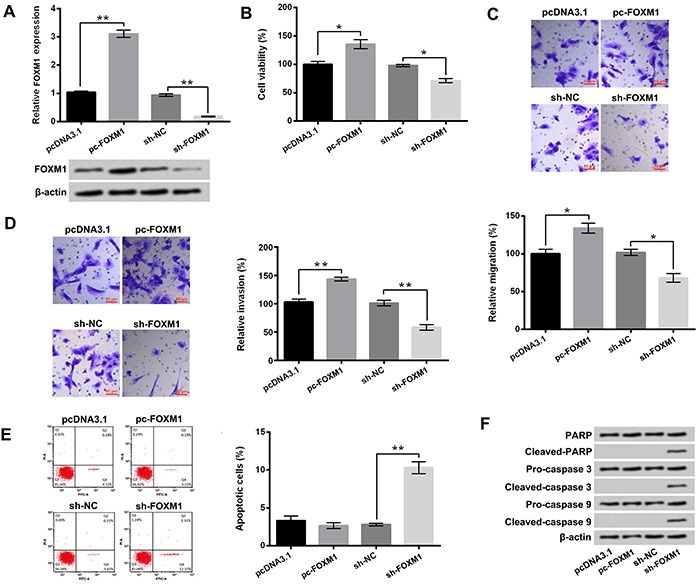
Pituitary adenoma is one of the most common tumors in the neuroendocrine system. This study investigated the effects of long non-coding RNAs (lncRNAs) highly up-regulated in liver cancer (HULC) on rat secreting pituitary adenoma GH3 cell viability, migration, invasion, apoptosis, and hormone secretion, as well as the underlying potential mechanisms. Cell transfection and qRT-PCR were used to change and measure the expression levels of HULC, miR-130b, and FOXM1. Cell viability, migration, invasion, and apoptosis were assessed using trypan blue staining assay, MTT assay, two-chamber transwell assay, Guava Nexin assay, and western blotting. The concentrations of prolactin (PRL) and growth hormone (GH) in culture supernatant of GH3 cells were assessed using ELISA. The targeting relationship between miR-130b and FOXM1 was verified using dual luciferase activity. Finally, the expression levels of key factors involved in PI3K/AKT/mTOR and JAK1/STAT3 pathways were evaluated using western blotting. We found that HULC was highly expressed in GH3 cells. Overexpression of HULC promoted GH3 cell viability, migration, invasion, PRL and GH secretion, as well as activated PI3K/AKT/mTOR and JAK1/STAT3 pathways. Knockdown of HULC had opposite effects and induced cell apoptosis. HULC negatively regulated the expression of miR-130b, and miR-130b participated in the effects of HULC on GH3 cells. FOXM1 was a target gene of miR-130b, which was involved in the regulation of GH3 cell viability, migration, invasion, and apoptosis, as well as PI3K/AKT/mTOR and JAK1/STAT3 pathways. In conclusion, HULC tumor-promoting roles in secreting pituitary adenoma might be via down-regulating miR-130b, up-regulating FOXM1, and activating PI3K/AKT/mTOR and JAK1/STAT3 pathways.
垂体腺瘤是神经内分泌系统中最常见的肿瘤之一。本研究调查了肝癌中高度上调的长链非编码RNA(lncRNA)HULC对大鼠分泌性垂体腺瘤GH3细胞活力、迁移、侵袭、凋亡和激素分泌的影响,以及潜在的作用机制。采用细胞转染和qRT-PCR技术改变并检测HULC、miR-130b和FOXM1的表达水平。通过台盼蓝染色法、MTT法、双室Transwell法、Guava Nexin法和蛋白质印迹法评估细胞活力、迁移、侵袭和凋亡。采用ELISA法检测GH3细胞培养上清液中催乳素(PRL)和生长激素(GH)的浓度。利用双荧光素酶活性验证miR-130b与FOXM1之间的靶向关系。最后,通过蛋白质印迹法评估PI3K/AKT/mTOR和JAK1/STAT3通路中关键因子的表达水平。我们发现HULC在GH3细胞中高表达。HULC的过表达促进了GH3细胞活力、迁移、侵袭、PRL和GH分泌,并激活了PI3K/AKT/mTOR和JAK1/STAT3通路。HULC的敲低产生相反的效果并诱导细胞凋亡。HULC负向调节miR-130b的表达,且miR-130b参与了HULC对GH3细胞的作用。FOXM1是miR-130b的靶基因,参与调节GH3细胞活力、迁移、侵袭和凋亡,以及PI3K/AKT/mTOR和JAK1/STAT3通路。总之,HULC在分泌性垂体腺瘤中的促肿瘤作用可能是通过下调miR-130b、上调FOXM1以及激活PI3K/AKT/mTOR和JAK1/STAT3通路实现的。