Universidade Federal Fluminense, Departamento de Odontologia, Área de Periodontia, Nova Friburgo, Rio de Janeiro, Brasil.
Universidade de São Paulo, Instituto de Ciências Biomédicas, Departamento de Microbiologia, São Paulo, São Paulo, Brasil.
J Appl Oral Sci. 2019;27:e20180205. doi: 10.1590/1678-7757-2018-0205. Epub 2019 Apr 11.
Porphyromonas gingivalis is one of the most important Gram-negative anaerobe bacteria involved in the pathogenesis of periodontitis. P. gingivalis has an arsenal of specialized virulence factors that contribute to its pathogenicity. Among them, fimbriae play a role in the initial attachment and organization of biofilms. Different genotypes of fimA have been related to length of fimbriae and pathogenicity of the bacterium.
The aim of this study was to identify 5 types of fimA genotype strains in smokers and nonsmokers with periodontitis, before and after periodontal therapy.
Thirty-one patients with periodontitis harboring P. gingivalis were selected: 16 nonsmokers (NS) and 15 smokers (SM). Clinical and microbiological parameters were evaluated at baseline and 3 months after periodontal treatment, namely: plaque index, bleeding on probe, probing depth, gingival recession and clinical attachment level. The frequency of P. gingivalis and fimA genotype strains were determined by polymerase chain reaction.
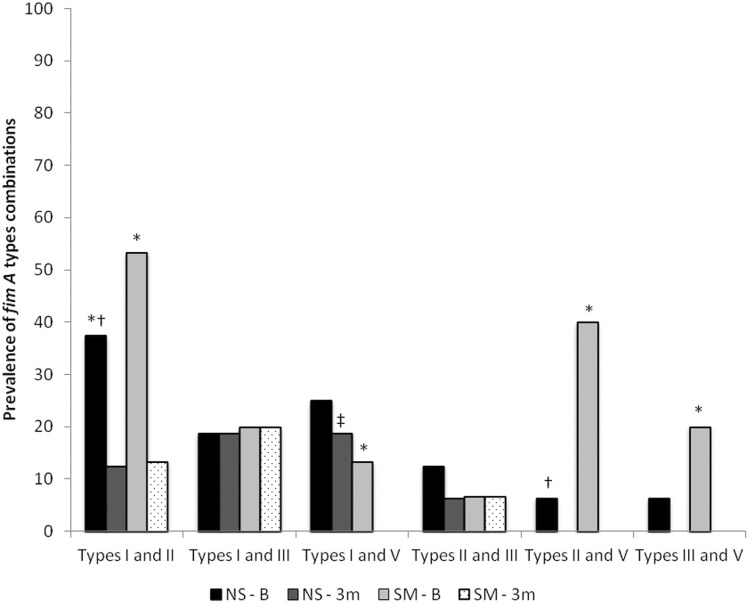
Type I fimA was detected in the majority of SM and NS at baseline, and the frequency did not diminish after 3 months of treatment. The frequency of type II genotype was higher in SM than NS at baseline. After 3 months, statistical reduction was observed only for types II and V fimA genotypes in SM. The highest association was found between types I and II at baseline for NS (37.5%) and SM (53.3%).
The most prevalent P. gingivalis fimA genotypes detected in periodontal and smoker patients were genotypes I and II. However, the presence of fimA genotype II was higher in SM. Periodontal treatment was effective in controlling periodontal disease and reducing type II and V P. gingivalis fimA.
本研究旨在鉴定吸烟和不吸烟牙周炎患者治疗前后牙周炎治疗前后牙周炎患者中 5 种 fimA 基因型菌株。
选择 31 名患有牙周炎的患者,携带牙龈卟啉单胞菌:16 名不吸烟者(NS)和 15 名吸烟者(SM)。在基线和牙周治疗 3 个月后评估临床和微生物学参数,即:菌斑指数、探针出血、探诊深度、牙龈退缩和临床附着水平。通过聚合酶链反应确定牙龈卟啉单胞菌和 fimA 基因型菌株的频率。
在基线时,SM 和 NS 中大多数都检测到了 I 型 fimA,治疗 3 个月后其频率并未降低。在基线时,SM 中 II 型基因型的频率高于 NS。治疗 3 个月后,仅在 SM 中观察到 II 型和 V 型 fimA 基因型的统计减少。在 NS(37.5%)和 SM(53.3%)中,基线时 I 型和 II 型之间存在最高的相关性。
在牙周炎和吸烟者患者中检测到的最常见的牙龈卟啉单胞菌 fimA 基因型是 I 型和 II 型。然而,SM 中 II 型 fimA 基因型的存在更高。牙周治疗有效控制牙周病,降低 II 型和 V 型牙龈卟啉单胞菌 fimA。