Department of Environmental and Occupational Health, Center for Health, Work, and Environment Colorado School of Public Health, University of Colorado, Anschutz Medical Campus 13001 E. 17th Pl., Ste. W3111, Aurora, CO, 80045, USA.
Colorado Consortium on Climate Change and Human Health, University of Colorado, Anschutz Medical Campus, Aurora, CO, USA.
Int Arch Occup Environ Health. 2019 Oct;92(7):977-990. doi: 10.1007/s00420-019-01426-3. Epub 2019 Apr 17.
Agricultural workers worldwide exposed to heat stress could be at the risk of kidney injury, which could lead to chronic kidney disease of an unknown origin (CKDu). Hydration has been promoted as a key measure to reduce kidney injury. In the presence of a hydration intervention, the incidence of acute kidney injury (AKI) was calculated in a sugarcane worker population in Guatemala and several risk factors were evaluated.
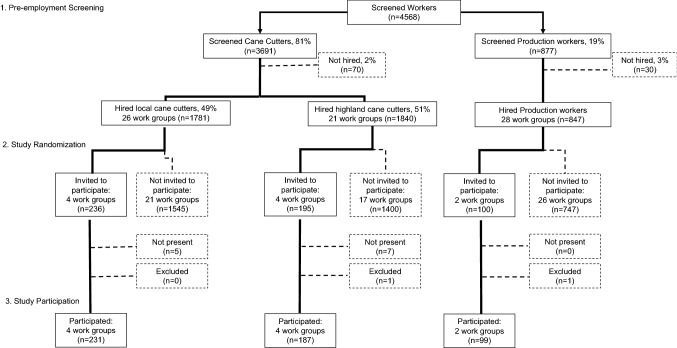
We measured kidney function at the beginning and end of the work shift at three time points in 517 sugarcane workers. We defined AKI as an increase in serum creatinine of 26.5 µmol/L or 50% or more from the pre-shift value. Associations between AKI and risk factors were examined, including interactions with hydration status.
The prevalence of dehydration post-shift (> 1.020 specific gravity) was 11% in February, 9% in March, and 6% in April. Cumulative incidence of AKI was 53% in February, 54% in March, and 51% in April. AKI was associated with increasing post-shift specific gravity, a dehydration marker, (OR 1.24, 95% CI 1.02-1.52) and with lower electrolyte solution intake (OR 0.94, 95% CI 0.89-0.99).
Dehydration and insufficient electrolyte consumption are risk factors for AKI. However even well-hydrated sugarcane workers routinely experience AKI. While hydration is important and protective, there is a need to understand other contributors to risk of AKI and identify prevention strategies with these workers.
全世界暴露于热应激下的农业工作者可能有肾脏损伤的风险,这可能导致原因不明的慢性肾病(CKDu)。补水已被推广为减少肾脏损伤的关键措施。在存在补水干预的情况下,我们计算了危地马拉甘蔗工人群体中急性肾损伤(AKI)的发病率,并评估了几个风险因素。
我们在 517 名甘蔗工人的三个时间点测量了工作班次前后的肾功能。我们将 AKI 定义为血清肌酐从班前值升高 26.5µmol/L 或 50%以上。检查了 AKI 与风险因素之间的关联,包括与补水状态的相互作用。
轮班后脱水(比重>1.020)的患病率在 2 月为 11%,3 月为 9%,4 月为 6%。AKI 的累积发病率在 2 月为 53%,3 月为 54%,4 月为 51%。AKI 与轮班后比重的增加(脱水标志物)(OR 1.24,95%CI 1.02-1.52)和电解质溶液摄入减少(OR 0.94,95%CI 0.89-0.99)相关。
脱水和电解质消耗不足是 AKI 的危险因素。然而,即使是补水良好的甘蔗工人也经常发生 AKI。虽然补水很重要且具有保护作用,但仍需要了解 AKI 风险的其他因素,并为这些工人确定预防策略。