Children's Hospital of Fudan University, Shanghai, China.
International Peace Maternity & Child Health Hospital of China Welfare Institute, Shanghai, China.
JMIR Mhealth Uhealth. 2019 Apr 18;7(4):e12081. doi: 10.2196/12081.
Low glycemic index (LGI) diet has shown to be effective in reducing maternal and neonatal complications in high-risk pregnancies.
This trial aimed to examine the effectiveness of individualized LGI diet consultations based on the accurate diet glycemic load (GL) assessment tool on maternal and neonatal insulin resistance levels and diet behavior changes in overweight and obese pregnant women.
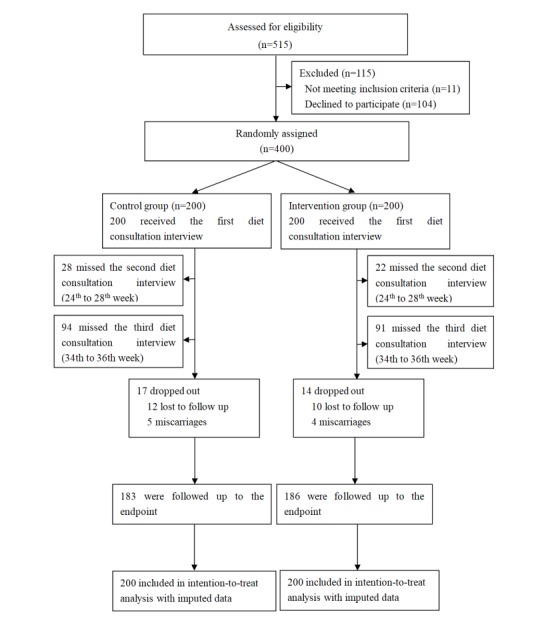
Overweight and obese pregnant women were recruited before 16 weeks of gestation and randomized to the LGI diet arm or the control arm. All participants received standard dietary education according to the Chinese Dietary Guide for Pregnant Women. In the intervention arm, additional individualized dietary GL assessments were performed using an app and instructions of lowering diet glycemic index (GI) to achieve LGI diet were provided by a clinical dietitian at early, middle, and late gestation. Primary outcomes were serum insulin at late gestation, incidence of gestational diabetes mellitus (GDM) for mothers, and cord blood C-peptide level of neonates.
In total, 400 subjects were randomized and received different interventions. There were no significant differences in maternal serum insulin levels (13.2 [9.3-13.2] uU/mL vs 12.4 [10.5-12.4] uU/mL), incidence of GDM (45 [22.5%] vs 43 [21.5%]), or cord blood C-peptide levels (mean 0.9ng/mL [SD 0.7] vs mean 0.8ng/mL [SD 0.6]) in the intervention group compared with the controls. The diet GI at late gestation was similar (mean 63.2 [SD 10.4] vs mean 64.3 [SD 10.4]), whereas greater diet fiber intake was observed in the intervention group (mean 11.6 grams [SD 8.0] vs mean 9.0 grams [SD 5.6]; P=.006). Adherence measurements did not significantly differ between 2 groups.
Individualized LGI diet consultations for overweight and obese pregnant women failed to make a significant difference in maternal or neonatal insulin resistance compared with the standard gestational diet consultation.
ClinicalTrials.gov NCT01628835; http://clinicaltrials.gov/ct2/show/NCT01628835 (Archived by WebCite at http://www.webcitation.org/77LHgWP0k).
低升糖指数(LGI)饮食已被证明可有效降低高危妊娠中的母婴并发症。
本试验旨在研究基于准确饮食血糖负荷(GL)评估工具的个体化 LGI 饮食咨询对超重和肥胖孕妇的母婴胰岛素抵抗水平和饮食行为改变的有效性。
在妊娠 16 周前招募超重和肥胖孕妇,并随机分为 LGI 饮食组或对照组。所有参与者均根据《中国孕妇膳食指南》接受标准饮食教育。在干预组中,使用应用程序进行额外的个体化饮食 GL 评估,并由临床营养师在孕早期、中期和晚期提供降低饮食血糖指数(GI)以实现 LGI 饮食的指导。主要结局为妊娠晚期血清胰岛素、母亲妊娠期糖尿病(GDM)发生率和新生儿脐血 C 肽水平。
共随机分配 400 名受试者接受不同干预。干预组孕妇血清胰岛素水平(13.2[9.3-13.2]uU/mL 与 12.4[10.5-12.4]uU/mL)、GDM 发生率(45[22.5%]与 43[21.5%])或脐血 C 肽水平(均值 0.9ng/mL[SD 0.7]与均值 0.8ng/mL[SD 0.6])均无显著差异。妊娠晚期饮食 GI 也相似(均值 63.2[SD 10.4]与均值 64.3[SD 10.4]),但干预组饮食纤维摄入量更高(均值 11.6 克[SD 8.0]与均值 9.0 克[SD 5.6];P=.006)。两组的依从性测量值无显著差异。
与标准妊娠饮食咨询相比,对超重和肥胖孕妇进行个体化 LGI 饮食咨询并未显著改善母婴胰岛素抵抗。
ClinicalTrials.gov NCT01628835;http://clinicaltrials.gov/ct2/show/NCT01628835(由 WebCite 存档;http://www.webcitation.org/77LHgWP0k)。