Department of Microbiology and Immunology, Guangdong Pharmaceutical University, Guangzhou, 510006, China.
Institute of Biochemistry and Molecular Biology, Guangdong Medical University, Zhanjiang, 524023, China.
Stem Cell Res Ther. 2019 Apr 18;10(1):123. doi: 10.1186/s13287-019-1221-1.
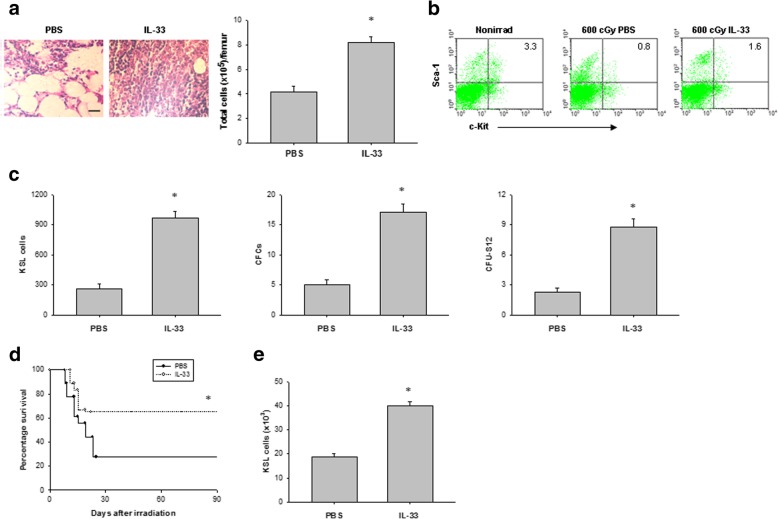
IL-33 is a pleiotropic cytokine of the IL-1 family, which has been reported to implicate in both innate and adaptive immune responses. Recent studies suggest IL-33 is crucial for regulation of myelopoiesis and myeloid cell activity. Here, we explore the potential effect of IL-33 against hematopoietic injury after total body irradiation (TBI).
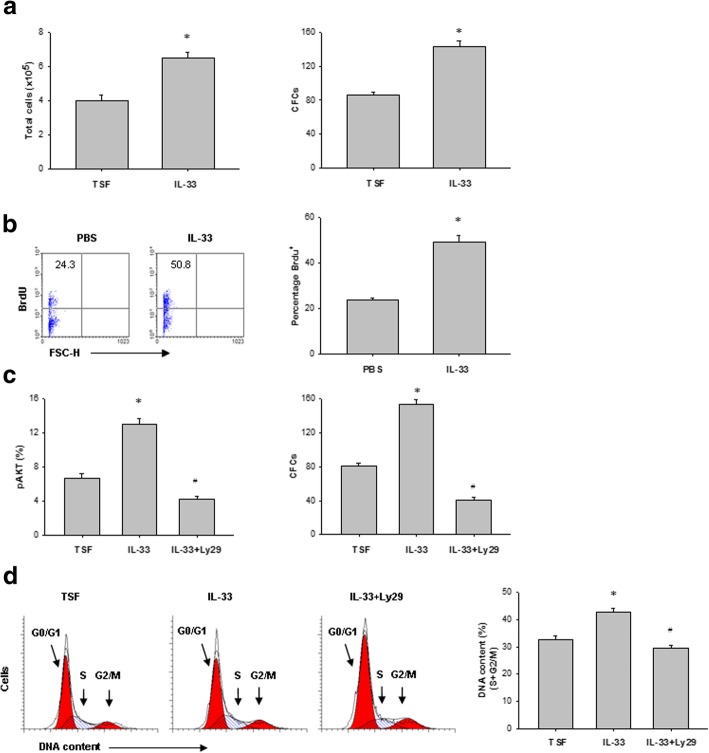
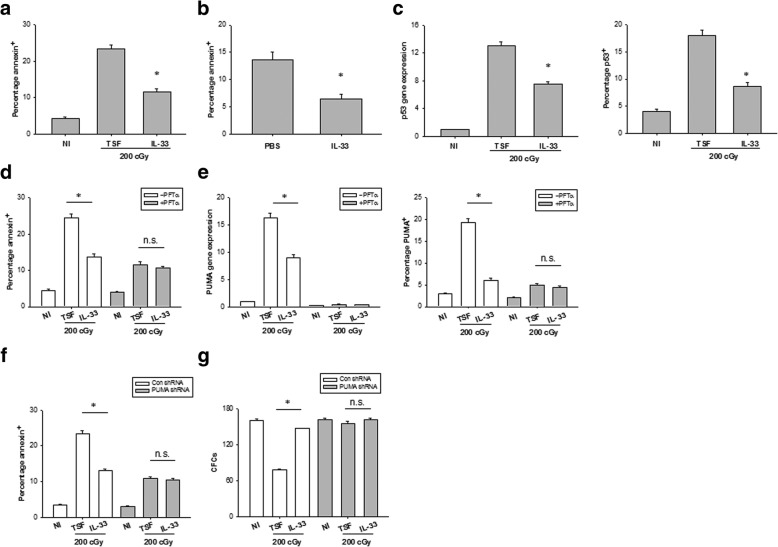
C57BL/6 mice were irradiated with a sublethal dose of radiation (600 cGy) and treated with IL-33 at a dose of 3 μg/dose i.p. once a day for seven consecutive days. H&E staining was used to determine the bone marrow cellularity. A flow cytometer was used to quantify the hematopoietic stem cell (HSC) population, cell proliferation, and apoptosis. The colony-forming assay was used to evaluate the clonogenic function of HSCs. RT-qPCR was used to determine the expression of apoptosis-associated genes.
Bone marrow HSCs from wild-type mice expressed functional IL-33 receptor (ST2), and treatment with IL-33 promoted the recovery of the HSC pool in vivo and improved the survival of mice after TBI. Conversely, mice with ST2 deficiency showed decreased HSC regeneration and mouse survival after TBI. Of note, IL-33 reduced radiation-induced apoptosis of HSCs and mediated this effect through repression of the p53-PUMA pathway.
IL-33 regulates HSC regeneration after myelosuppressive injury through protecting HSCs from apoptosis and enhancing proliferation of the surviving HSCs.
IL-33 是白细胞介素 1 家族的一种多效细胞因子,据报道它与先天和适应性免疫反应有关。最近的研究表明,IL-33 对于髓系细胞的生成和髓系细胞的活性的调节至关重要。在这里,我们探索了 IL-33 对全身照射(TBI)后造血损伤的潜在作用。
用亚致死剂量的辐射(600cGy)照射 C57BL/6 小鼠,并每天腹腔内给予 IL-33 剂量为 3μg/剂量,连续 7 天。用 H&E 染色法确定骨髓细胞的数量。用流式细胞仪定量分析造血干细胞(HSC)群体、细胞增殖和凋亡。用集落形成实验评估 HSCs 的克隆形成功能。用 RT-qPCR 测定凋亡相关基因的表达。
野生型小鼠的骨髓 HSC 表达功能性的 IL-33 受体(ST2),IL-33 治疗促进了体内 HSC 池的恢复,并改善了 TBI 后小鼠的生存。相反,ST2 缺陷型小鼠的 HSC 再生减少,TBI 后小鼠的生存率降低。值得注意的是,IL-33 减少了辐射诱导的 HSC 凋亡,并通过抑制 p53-PUMA 通路介导了这一作用。
IL-33 通过保护 HSCs 免于凋亡并增强存活的 HSCs 的增殖来调节骨髓抑制性损伤后 HSC 的再生。