Division of Psychiatry, University College London, London, UK.
Division of Psychiatry, University College London, London, UK.
Lancet Glob Health. 2019 May;7(5):e596-e603. doi: 10.1016/S2214-109X(19)30074-9.
Nine potentially modifiable risk factors (less childhood education, midlife hearing loss, hypertension, and obesity, and later-life smoking, depression, physical inactivity, social isolation, and diabetes) account for 35% of worldwide dementia, but most data to calculate these risk factors come from high-income countries only. We aimed to calculate population attributable fractions (PAFs) for dementia in selected low-income and middle-income countries (LMICs) to identify potential dementia prevention targets in these countries.
The study was an analysis of cross-sectional data obtained from the 10/66 Dementia Research surveys of representative populations in India, China, and six Latin America countries (Cuba, Dominican Republic, Mexico, Peru, Puerto Rico, and Venezuela), which used identical risk factor ascertainment methods in each country. Between 2004 and 2006 (and between 2007 and 2010 for Puerto Rico), all residents aged 65 years and older in predefined catchment areas were invited to participate in the survey. We used risk factor prevalence estimates from this 10/66 survey data, and relative risk estimates from previous meta-analyses, to calculate PAFs for each risk factor. To account for individuals having overlapping risk factors, we adjusted PAF for communality between risk factors, and used these values to calculate overall weighted PAFs for India, China, and the Latin American sample.
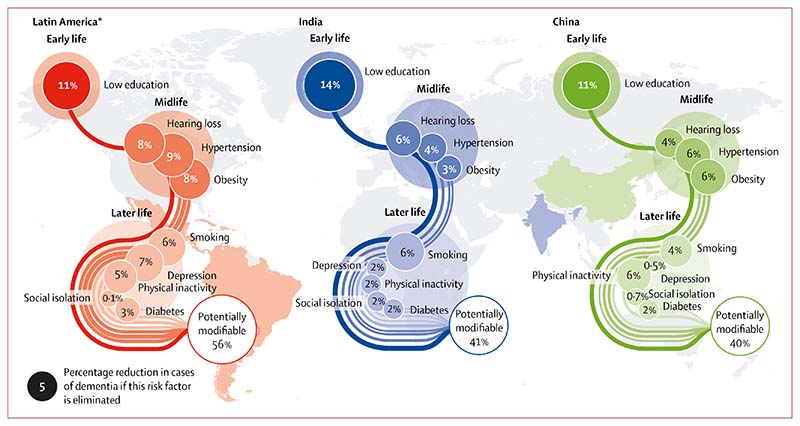
The overall weighted PAF for potentially modifiable risk factors for dementia was 39·5% (95% CI 37·5-41·6) in China (n=2162 participants), 41·2% (39·1-43·4) in India (n=2004), and 55·8% (54·9-56·7) in our Latin American sample (n=12 865). Five dementia risk factors were more prevalent in these LMICs than worldwide estimates, leading to higher PAFs for dementia: less childhood education (weighted PAF of 10·8% in China, 13·6% in India, and 10·9% in Latin America vs 7·5% worldwide), smoking (14·7%, 6·4%, and 5·7%, respectively, vs 5·5% worldwide), hypertension (6·4%, 4·0%, and 9·3%, vs 2·0%), obesity (5·6%, 2·9%, and 7·9%, vs 0·8%), and diabetes (1·6%, 1·7%, and 3·2%, vs 1·2%).
The dementia prevention potential in India, China, and this sample of Latin American countries is large, and greater than in high-income countries. Less education in early life, hypertension, hearing loss, obesity, and physical inactivity have particularly high PAFs and could be initial targets for dementia prevention strategies.
No funding.
九个潜在可改变的风险因素(受教育年限较少、中年听力损失、高血压和肥胖,以及晚年吸烟、抑郁、身体活动不足、社会隔离和糖尿病)占全球痴呆症的 35%,但计算这些风险因素的大多数数据仅来自高收入国家。我们旨在计算选定的低收入和中等收入国家(LMIC)中痴呆症的人群归因分数(PAF),以确定这些国家潜在的痴呆症预防目标。
本研究是对来自印度、中国和六个拉丁美洲国家(古巴、多米尼加共和国、墨西哥、秘鲁、波多黎各和委内瑞拉)的 10/66 痴呆症研究代表性人群的横断面数据进行的分析,这些国家在每个国家都使用了相同的风险因素确定方法。在 2004 年至 2006 年(以及 2007 年至 2010 年在波多黎各)期间,预先划定的抽样地区内所有 65 岁及以上的居民都被邀请参加了这项调查。我们使用了这项 10/66 调查数据中的风险因素流行率估计值,以及之前荟萃分析中的相对风险估计值,来计算每个风险因素的 PAF。为了考虑个体存在重叠的风险因素,我们调整了风险因素之间的共同性的 PAF,并使用这些值来计算中国、印度和拉丁美洲样本的总体加权 PAF。
在中国(n=2162 名参与者)、印度(n=2004 名参与者)和我们的拉丁美洲样本(n=12865 名参与者)中,潜在可改变的痴呆症风险因素的总体加权 PAF 分别为 39.5%(95%CI 37.5-41.6)、41.2%(39.1-43.4)和 55.8%(54.9-56.7)。这些 LMIC 中五个痴呆症风险因素比全球估计值更为普遍,导致痴呆症的 PAF 更高:受教育年限较少(中国为 10.8%、印度为 13.6%、拉丁美洲为 10.9%,全球为 7.5%)、吸烟(14.7%、6.4%和 5.7%,全球为 5.5%)、高血压(6.4%、4.0%和 9.3%,全球为 2.0%)、肥胖(5.6%、2.9%和 7.9%,全球为 0.8%)和糖尿病(1.6%、1.7%和 3.2%,全球为 1.2%)。
印度、中国和拉丁美洲国家的痴呆症预防潜力很大,且大于高收入国家。生命早期受教育年限较少、高血压、听力损失、肥胖和身体活动不足的 PAF 特别高,可能是痴呆症预防策略的初始目标。
无资金支持。