Setty Karen, McConnell Robert, Raucher Robert, Bartram Jamie
The Water Institute Department of Environmental Sciences and Engineering, Gillings School of Global Public Health, University of North Carolina at Chapel Hill Chapel Hill North Carolina.
Tampa Bay Water Clearwater Florida.
AWWA Water Sci. 2019 Jan-Feb;1(1):e1125. doi: 10.1002/aws2.1125. Epub 2019 Feb 19.
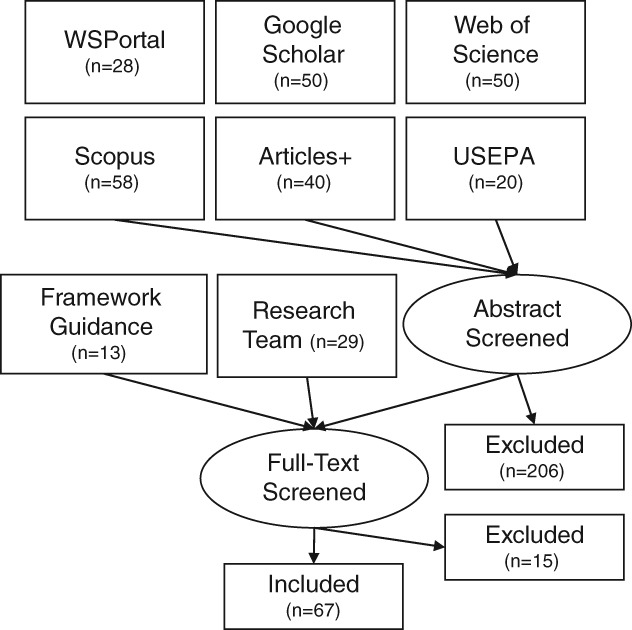
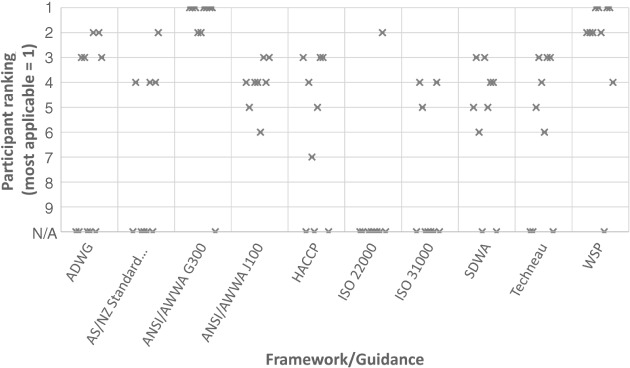
The U.S. Safe Drinking Water Act required states to develop source water assessment programs identifying existing and potential contamination sources; however, comprehensive risk prioritization and management approaches for surface water supplies have seen limited application. This participatory study assessed which permutation(s) of risk management frameworks and tools might benefit U.S. utilities by combining a literature review with external utility interviews. Qualitative data provided a basis for categorical assignments of goodness of fit with each of 24 framework evaluation criteria across five categories. Weighted integration using stakeholder input provided a relative ranking of applicability, later validated at a decision-making workshop. Hybridization of the American National Standards Institute/American Water Works Association (ANSI/AWWA G300) source water protection standard and World Health Organization Water Safety Plan guidance was recommended to develop a comprehensive risk management approach for U.S. source waters. Cost-benefit components of other guidance materials were recommended to incorporate financial considerations into risk ranking and mitigation decisions.
美国《安全饮用水法》要求各州制定原水评估计划,以识别现有的和潜在的污染源;然而,地表水供应的全面风险优先级划分和管理方法的应用有限。这项参与性研究通过将文献综述与外部公用事业公司访谈相结合,评估了风险管理框架和工具的哪些组合可能使美国公用事业公司受益。定性数据为根据五类24项框架评估标准对适用性进行分类赋值提供了基础。利用利益相关者的意见进行加权整合,得出了适用性的相对排名,随后在一次决策研讨会上得到了验证。建议将美国国家标准学会/美国水行业协会(ANSI/AWWA G300)原水保护标准与世界卫生组织《水安全计划》指南相结合,为美国原水制定全面的风险管理方法。建议纳入其他指导材料中的成本效益要素,以便将财务考虑因素纳入风险排名和缓解决策中。