Chamberlain Samuel R, Tiego Jeggan, Fontenelle Leonardo F, Hook Roxanne, Parkes Linden, Segrave Rebecca, Hauser Tobias U, Dolan Ray J, Goodyer Ian M, Bullmore Ed, Grant Jon E, Yücel Murat
1 Cambridge and Peterborough NHS Foundation Trust and Department of Psychiatry, University of Cambridge, Addenbrooke's Hospital, Cambridge, UK.
2 Monash Institute of Cognitive and Clinical Neurosciences, School of Psychological Sciences, Monash University, Clayton, VIC, Australia.
Aust N Z J Psychiatry. 2019 Sep;53(9):896-907. doi: 10.1177/0004867419844325. Epub 2019 Apr 19.
Young adulthood is a crucial neurodevelopmental period during which impulsive and compulsive problem behaviours commonly emerge. While traditionally considered diametrically opposed, impulsive and compulsive symptoms tend to co-occur. The objectives of this study were as follows: (a) to identify the optimal trans-diagnostic structural framework for measuring impulsive and compulsive problem behaviours, and (b) to use this optimal framework to identify common/distinct antecedents of these latent phenotypes.
In total, 654 young adults were recruited as part of the Neuroscience in Psychiatry Network, a population-based cohort in the United Kingdom. The optimal trans-diagnostic structural model capturing 33 types of impulsive and compulsive problem behaviours was identified. Baseline predictors of subsequent impulsive and compulsive trans-diagnostic phenotypes were characterised, along with cross-sectional associations, using partial least squares.
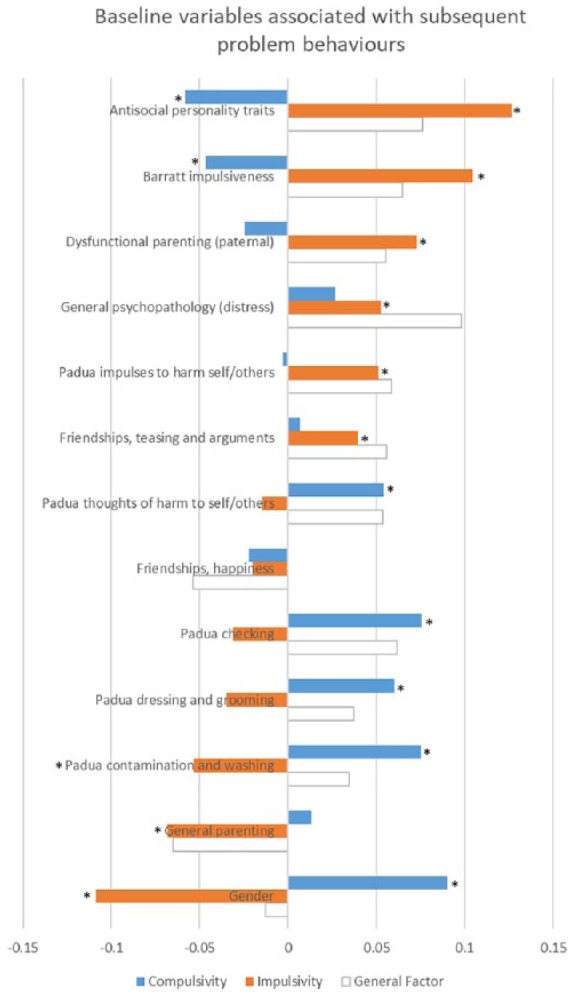
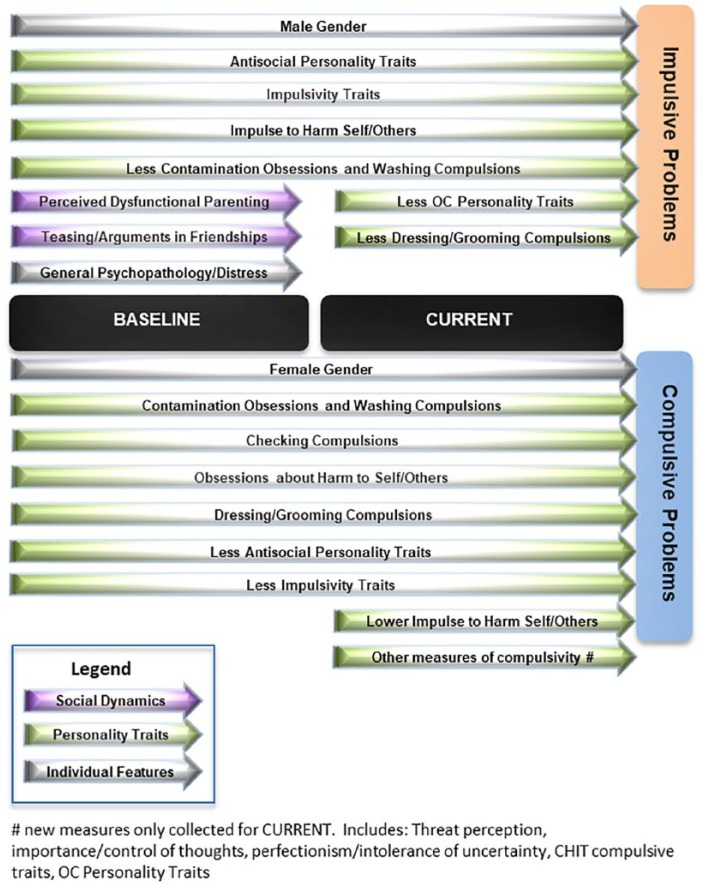
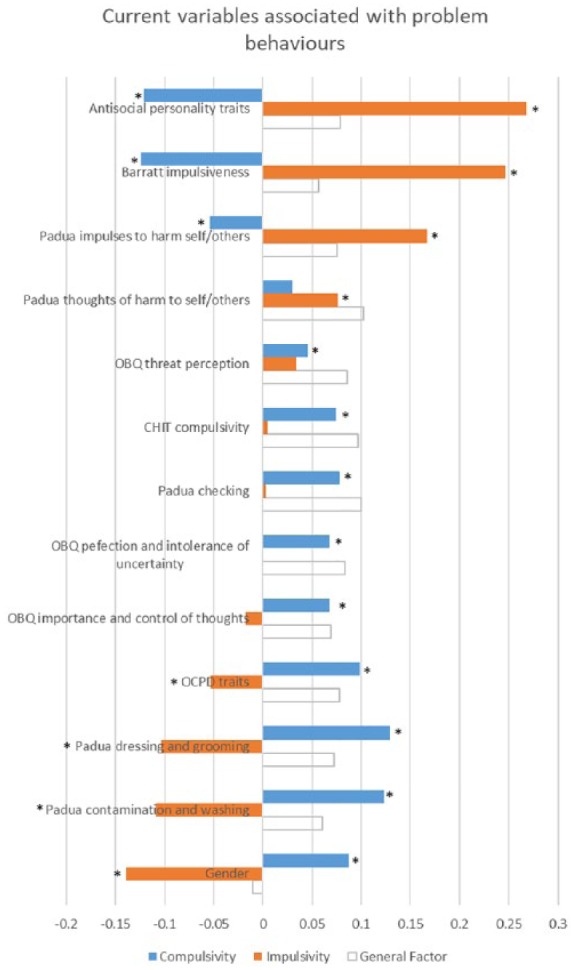
Current problem behaviours were optimally explained by a bi-factor model, which yielded dissociable measures of impulsivity and compulsivity, as well as a general disinhibition factor. Impulsive problem behaviours were significantly explained by prior antisocial and impulsive personality traits, male gender, general distress, perceived dysfunctional parenting and teasing/arguments within friendships. Compulsive problem behaviours were significantly explained by prior compulsive traits and female gender.
This study demonstrates that trans-diagnostic phenotypes of 33 impulsive and compulsive problem behaviours are identifiable in young adults, utilising a bi-factor model based on responses to a single questionnaire. Furthermore, these phenotypes have different antecedents. The findings yield a new framework for fractionating impulsivity and compulsivity, and suggest different early intervention targets to avert emergence of problem behaviours. This framework may be useful for future biological and clinical dissection of impulsivity and compulsivity.
青年期是一个关键的神经发育阶段,在此期间冲动和强迫问题行为通常会出现。虽然传统上认为冲动和强迫症状截然相反,但它们往往同时出现。本研究的目的如下:(a)确定测量冲动和强迫问题行为的最佳跨诊断结构框架,以及(b)使用该最佳框架确定这些潜在表型的共同/不同前因。
总共招募了654名青年作为精神病学网络神经科学研究的一部分,该网络是英国一个基于人群的队列。确定了捕获33种冲动和强迫问题行为的最佳跨诊断结构模型。使用偏最小二乘法对后续冲动和强迫跨诊断表型的基线预测因素以及横断面关联进行了表征。
当前问题行为通过双因素模型得到了最佳解释,该模型产生了可分离的冲动性和强迫性测量指标,以及一个一般去抑制因素。冲动问题行为由先前的反社会和冲动人格特质、男性性别、一般困扰、感知到的功能失调的养育方式以及友谊中的取笑/争吵显著解释。强迫问题行为由先前的强迫特质和女性性别显著解释。
本研究表明,利用基于对单一问卷的回答的双因素模型,可以在青年中识别出33种冲动和强迫问题行为的跨诊断表型。此外,这些表型有不同的前因。这些发现产生了一个区分冲动性和强迫性的新框架,并提出了不同的早期干预目标以避免问题行为的出现。该框架可能对未来冲动性和强迫性的生物学和临床剖析有用。