St Clair Michelle C, Neufeld Sharon, Jones Peter B, Fonagy Peter, Bullmore Edward T, Dolan Raymond J, Moutoussis Michael, Toseeb Umar, Goodyer Ian M
Department of Psychology, University of Bath, Bath, United Kingdom.
Department of Psychiatry, University of Cambridge, Cambridge, United Kingdom.
PLoS One. 2017 Apr 12;12(4):e0175381. doi: 10.1371/journal.pone.0175381. eCollection 2017.
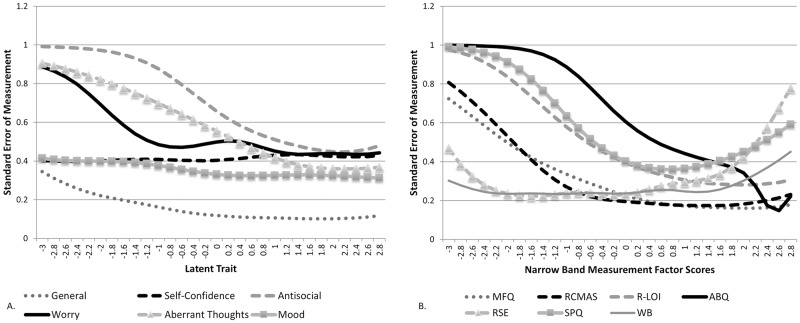
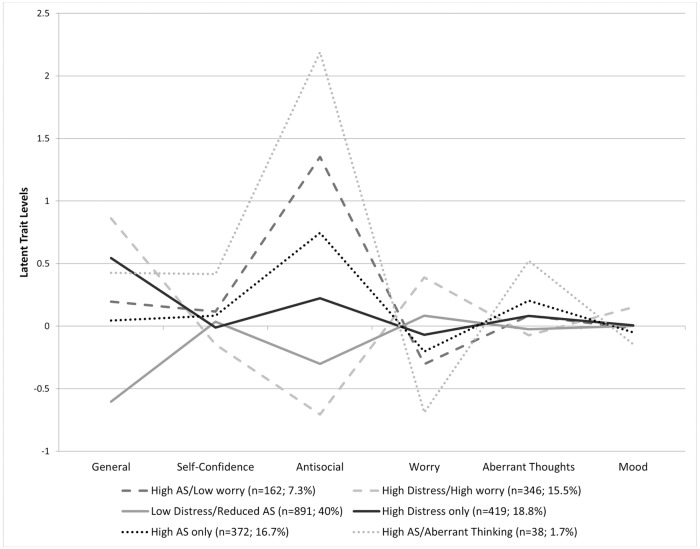
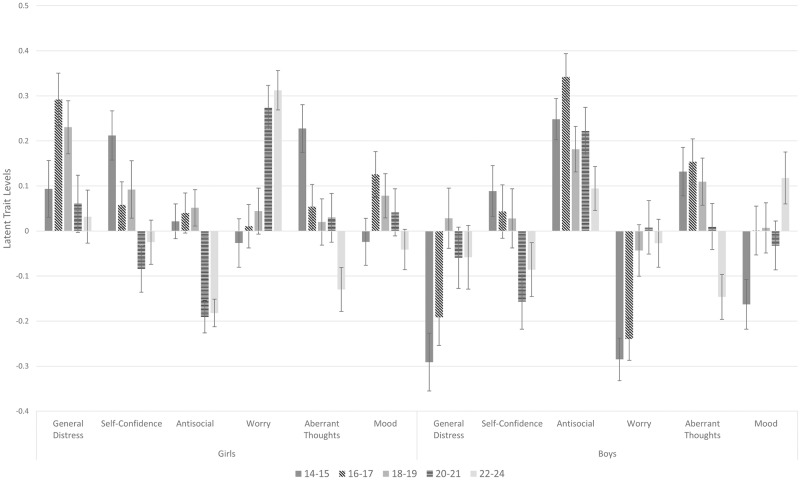
Little is known about the underlying relationships between self-reported mental health items measuring both positive and negative emotional and behavioural symptoms at the population level in young people. Improved measurement of the full range of mental well-being and mental illness may aid in understanding the aetiological substrates underlying the development of both mental wellness as well as specific psychiatric diagnoses. A general population sample aged 14 to 24 years completed self-report questionnaires on anxiety, depression, psychotic-like symptoms, obsessionality and well-being. Exploratory and confirmatory factor models for categorical data and latent profile analyses were used to evaluate the structure of both mental wellness and illness items. First order, second order and bifactor structures were evaluated on 118 self-reported items obtained from 2228 participants. A bifactor solution was the best fitting latent variable model with one general latent factor termed 'distress' and five 'distress independent' specific factors defined as self-confidence, antisocial behaviour, worry, aberrant thinking, and mood. Next, six distinct subgroups were derived from a person-centred latent profile analysis of the factor scores. Finally, concurrent validity was assessed using information on hazardous behaviours (alcohol use, substance misuse, self-harm) and treatment for mental ill health: both discriminated between the latent traits and latent profile subgroups. The findings suggest a complex, multidimensional mental health structure in the youth population rather than the previously assumed first or second order factor structure. Additionally, the analysis revealed a low hazardous behaviour/low mental illness risk subgroup not previously described. Population sub-groups show greater validity over single variable factors in revealing mental illness risks. In conclusion, our findings indicate that the structure of self reported mental health is multidimensional in nature and uniquely finds improved prediction to mental illness risk within person-centred subgroups derived from the multidimensional latent traits.
在年轻人群体层面,对于测量积极和消极情绪及行为症状的自我报告心理健康项目之间的潜在关系,人们了解甚少。对全方位心理健康和精神疾病进行更完善的测量,可能有助于理解心理健康以及特定精神疾病诊断发展背后的病因基础。一个14至24岁的普通人群样本完成了关于焦虑、抑郁、类精神病症状、强迫观念和幸福感的自我报告问卷。使用分类数据的探索性和验证性因素模型以及潜在剖面分析来评估心理健康和疾病项目的结构。对从2228名参与者那里获得的118个自我报告项目,评估了一阶、二阶和双因素结构。双因素解决方案是最合适的潜在变量模型,有一个被称为“痛苦”的一般潜在因素和五个“独立于痛苦”的特定因素,分别定义为自信、反社会行为、担忧、异常思维和情绪。接下来,通过对因素得分进行以人为中心的潜在剖面分析,得出了六个不同的亚组。最后,使用关于危险行为(饮酒、药物滥用、自我伤害)和精神疾病治疗的信息评估了同时效度:两者都能区分潜在特质和潜在剖面亚组。研究结果表明,青年人群的心理健康结构复杂且多维,而非先前假定的一阶或二阶因素结构。此外,分析还揭示了一个此前未被描述的低危险行为/低精神疾病风险亚组。在揭示精神疾病风险方面,人群亚组比单一变量因素具有更高的效度。总之,我们的研究结果表明,自我报告的心理健康结构本质上是多维的,并且在从多维潜在特质得出的以人为中心的亚组中,能独特地更好预测精神疾病风险。