de Vries Jorad, Evers Jochem B, Dicke Marcel, Poelman Erik H
Laboratory of Entomology Wageningen University Wageningen The Netherlands.
Centre for Crop System Analysis Wageningen University Wageningen The Netherlands.
Funct Ecol. 2019 Jan;33(1):129-138. doi: 10.1111/1365-2435.13234. Epub 2018 Nov 20.
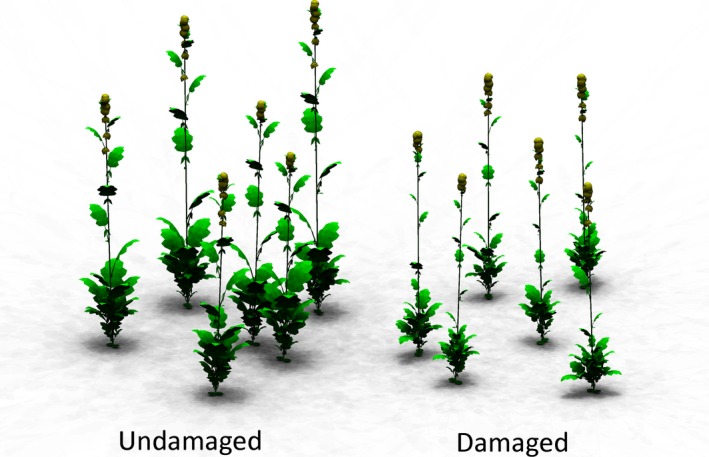
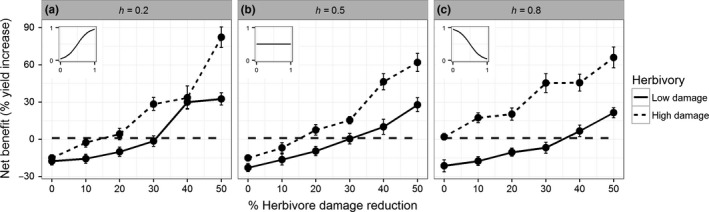
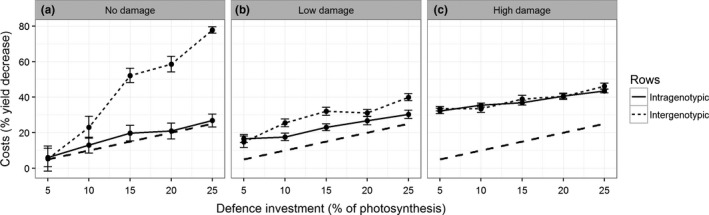
Plants defend themselves against diverse communities of herbivorous insects. This requires an investment of limited resources, for which plants also compete with neighbours. The consequences of an investment in defence are determined by the metabolic costs of defence as well as indirect or ecological costs through interactions with other organisms. These ecological costs have a potentially strong impact on the evolution of defensive traits, but have proven to be difficult to quantify.We aimed to quantify the relative impact of the direct and indirect or ecological costs and benefits of an investment in plant defence in relation to herbivory and intergenotypic competition for light. Additionally, we evaluated how the benefits of plant defence balance its costs in the context of herbivory and intergenotypic competition.To this end, we utilised a functional-structural plant (FSP) model of that simulates plant growth and development, morphogenesis, herbivory and plant defence. In the model, a simulated investment in defences affected plant growth by competing with other plant organs for resources and affected the level and distribution of herbivore damage.Our results show that the ecological costs of intergenotypic competition for light are highly detrimental to the fitness of defended plants, as it amplifies the size difference between defended and undefended plants. This leads to herbivore damage counteracting the effects of intergenotypic competition under the assumption that herbivore damage scales with plant size. Additionally, we show that plant defence relies on reducing herbivore damage rather than the dispersion of herbivore damage, which is only beneficial under high levels of herbivore damage.We conclude that the adaptive value of plant defence is highly dependent on ecological interactions and is predominantly determined by the outcome of competition for light. plain language summary is available for this article.
植物抵御各种食草昆虫群落。这需要投入有限的资源,而植物在这方面也会与邻居竞争。防御投资的后果由防御的代谢成本以及通过与其他生物相互作用产生的间接或生态成本决定。这些生态成本对防御性状的进化可能有强烈影响,但已证明难以量化。我们旨在量化植物防御投资的直接和间接或生态成本及收益相对于食草作用和光的基因型间竞争的相对影响。此外,我们评估了在食草作用和基因型间竞争的背景下,植物防御的收益如何平衡其成本。为此,我们利用了一个功能 - 结构植物(FSP)模型,该模型模拟植物生长发育、形态发生、食草作用和植物防御。在模型中,模拟的防御投资通过与其他植物器官竞争资源影响植物生长,并影响食草动物损害的程度和分布。我们的结果表明,基因型间对光的竞争的生态成本对防御植物的适合度非常不利,因为它扩大了防御植物和未防御植物之间的大小差异。在食草动物损害随植物大小成比例的假设下,这导致食草动物损害抵消了基因型间竞争的影响。此外,我们表明植物防御依赖于减少食草动物损害,而不是食草动物损害的分散,后者仅在高水平的食草动物损害下才有益。我们得出结论,植物防御的适应性价值高度依赖于生态相互作用,并且主要由对光的竞争结果决定。本文有通俗易懂的总结。