Li Ying, Geng Jun, Wen Laiyou, Chen Jianqing, Wu Zhen
Department of Anesthesiology, Jiangyin Hospital, Affiliated to Southeast University Medical School, Jiangyin, China.
Saudi J Anaesth. 2019 Apr-Jun;13(2):100-105. doi: 10.4103/sja.SJA_533_18.
The objective of this study is to evaluate the postoperative analgesic effect of a combination of ropivacaine and dexmedetomidine for ultrasound-guided fascia iliaca compartment block (FICB) after knee arthroscopy.
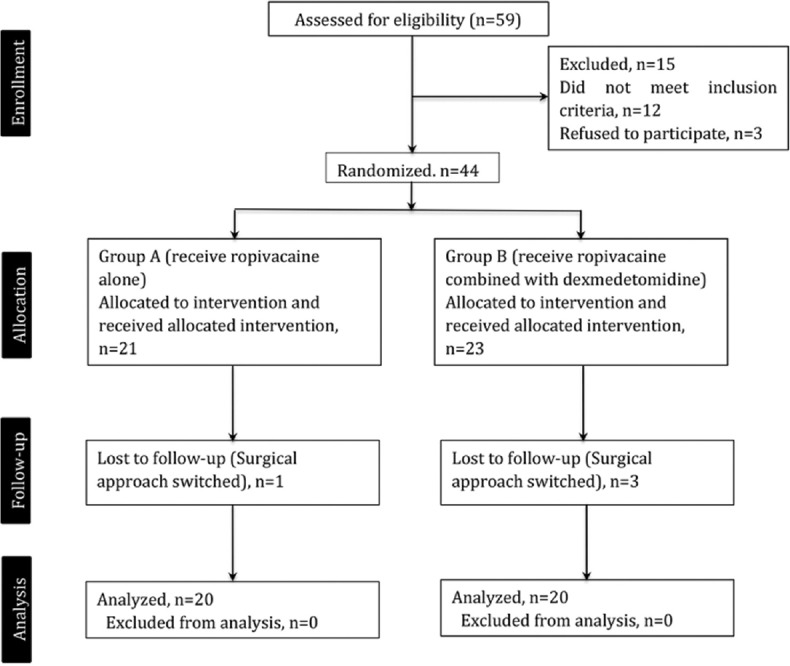
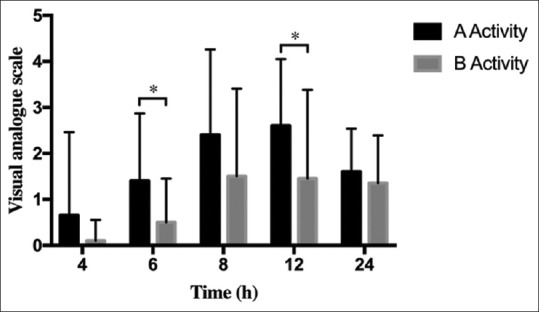
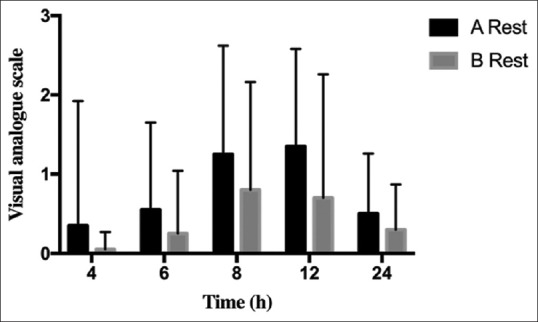
Forty patients scheduled for knee arthroscopy were randomized to receive either 30 ml of 0.25% ropivacaine alone (Group A, = 20) or combined with dexmedetomidine 1 μg/kg (Group B, = 20). Pain intensity was evaluated using the visual analogue scale (VAS), at rest and during activity at 4, 6, 8, 12, and 24 h after surgery. Level of consciousness was evaluated using the Ramsay sedation score. Time to first analgesic request after surgery, the dose of analgesic used in the first 24 h after surgery, variation of heart rate, and adverse reactions were also recorded.
VAS scores at 6 and 12 h after surgery were significantly lower in Group B compared to Group A ( < 0.05). No significant difference was observed in the Ramsay sedation score or time to first analgesic request after surgery ( > 0.05). The total dose of analgesic used in the first 24 h after surgery was higher in Group A than in Group B. The incidence of bradycardia was higher in Group B compared to Group A. No adverse reactions were observed in either group.
FICB with a combination of ropivacaine and dexmedetomidine resulted in significant reduction of VAS scores with lower postoperative analgesic requirement after arthroscopic knee surgery. No adverse reactions or complications were noted except for lower heart rate in Group B patients.
本研究旨在评估罗哌卡因与右美托咪定联合用于膝关节镜检查后超声引导下髂筋膜间隙阻滞(FICB)的术后镇痛效果。
40例计划行膝关节镜检查的患者被随机分为两组,每组20例。A组单独接受30 ml 0.25%罗哌卡因,B组接受30 ml 0.25%罗哌卡因联合1 μg/kg右美托咪定。采用视觉模拟评分法(VAS)在术后4、6、8、12和24小时评估静息和活动时的疼痛强度。采用Ramsay镇静评分评估意识水平。记录术后首次镇痛需求时间、术后24小时内使用的镇痛药物剂量、心率变化及不良反应。
与A组相比,B组术后6小时和12小时的VAS评分显著降低(P<0.05)。两组在Ramsay镇静评分或术后首次镇痛需求时间方面无显著差异(P>0.05)。A组术后24小时内使用的镇痛药物总剂量高于B组。B组心动过缓的发生率高于A组。两组均未观察到不良反应。
罗哌卡因与右美托咪定联合用于FICB可显著降低VAS评分,减少膝关节镜手术后的术后镇痛需求。除B组患者心率较低外,未观察到不良反应或并发症。