Shojasaadat Fatemeh, Ayremlou Parvin, Hashemi Asad, Mehdizadeh Alireza, Zarrin Rasoul
Department of Nutrition, School of Medicine, Urmia University of Medical Sciences, Food and Beverages Safety Research Center, Urmia, Iran.
Urmia Imam Khomeini University Hospital, Urmia University of Medical Sciences, Urmia, Iran.
J Res Med Sci. 2019 Mar 25;24:21. doi: 10.4103/jrms.JRMS_282_18. eCollection 2019.
Weight loss is the cornerstone of NAFLD management, but weight maintenance is difficult. Some studies have suggested that n-3 polyunsaturated fatty acid (n-3 PUFA) might have beneficial effects in NAFLD. We aim to compare the effects of a low-energy diet with n-3 PUFA supplementation on liver enzymes, body composition, and cardiometabolic risk factors in NAFLD.
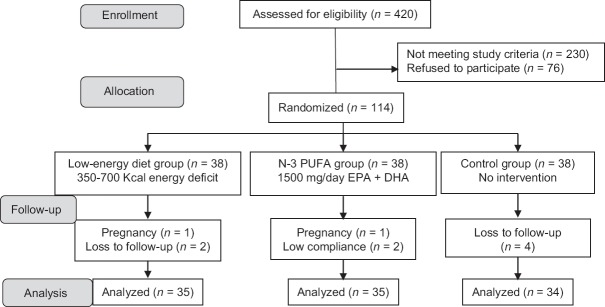
The study was a randomized controlled trial conducted in Urmia in Iran from October 2016 to May 2017. One hundred and fourteen eligible patients were randomly assigned to one of the three following groups: low-energy diet group, n-3 PUFA supplementation (fish oil) group (1500 mg/d), or control group for 12 weeks. Liver enzymes, lipid profile, insulin resistance, and body composition were assessed before and after the intervention.
One hundred and four patients completed the study. All groups lost weight, but the reductions were greater in the diet group (-2.97 ± 2.79 kg, = 0.001). The diet group had significant decreases in fat mass compared to other groups. Insulin resistance, total cholesterol, and low-density lipoprotein cholesterol significantly decreased only in the diet group, and patients who lost weight ≥4% showed significantly larger decreases in serum liver enzymes. N-3 PUFA had no beneficial effects on the study outcomes.
We found that 1500 mg/d n-3 PUFA supplied for 12 weeks, in contrast to 3.40 ± 2.98% weight loss, does not improve liver enzymes, body composition, and cardiometabolic risk factors in NAFLD patients.
体重减轻是NAFLD管理的基石,但维持体重却很困难。一些研究表明,n-3多不饱和脂肪酸(n-3 PUFA)可能对NAFLD有有益作用。我们旨在比较低能量饮食与补充n-3 PUFA对NAFLD患者肝酶、身体成分和心脏代谢危险因素的影响。
该研究为2016年10月至2017年5月在伊朗乌尔米耶进行的一项随机对照试验。114名符合条件的患者被随机分配到以下三组之一:低能量饮食组、n-3 PUFA补充剂(鱼油)组(1500毫克/天)或对照组,为期12周。在干预前后评估肝酶、血脂谱、胰岛素抵抗和身体成分。
104名患者完成了研究。所有组体重均减轻,但饮食组减轻幅度更大(-2.97±2.79千克,P = 0.001)。与其他组相比,饮食组的脂肪量显著减少。仅饮食组的胰岛素抵抗、总胆固醇和低密度脂蛋白胆固醇显著降低,体重减轻≥4%的患者血清肝酶下降幅度显著更大。n-3 PUFA对研究结果无有益影响。
我们发现,与体重减轻3.40±2.98%相比,12周内每天补充1500毫克n-3 PUFA并不能改善NAFLD患者的肝酶、身体成分和心脏代谢危险因素。