Xia Changhong, Zhang Dongsheng, Li Yanmei, Chen Jie, Zhou Haibo, Nie Long, Sun Yanyan, Guo Siyan, Cao Jianbiao, Zhou Fangzheng, Li Junlai
Department of Ultrasound, Chinese People's Liberation Army General Hospital, Beijing, China.
Department of Oncology, Suizhou Hospital, Hubei University of Medicine, Suizhou, China.
J Res Med Sci. 2019 Mar 25;24:26. doi: 10.4103/jrms.JRMS_129_17. eCollection 2019.
The aim of this study was to test the effect of TNF484 on cell proliferation, migration, and invasion of hepatocellular carcinoma (HCC) cells.
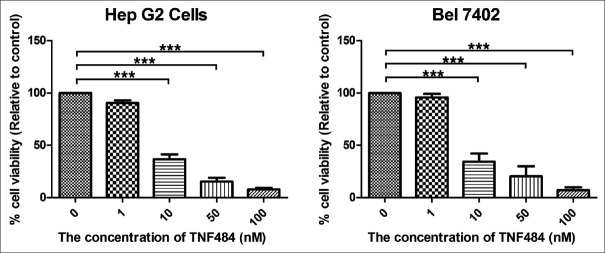
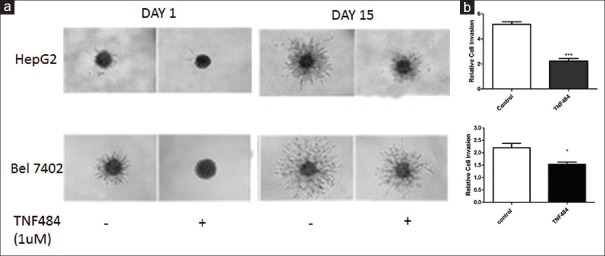
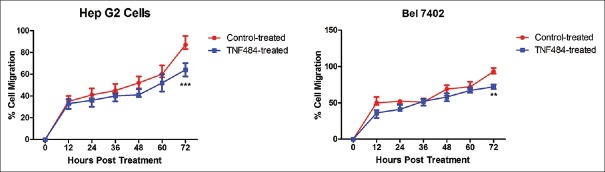
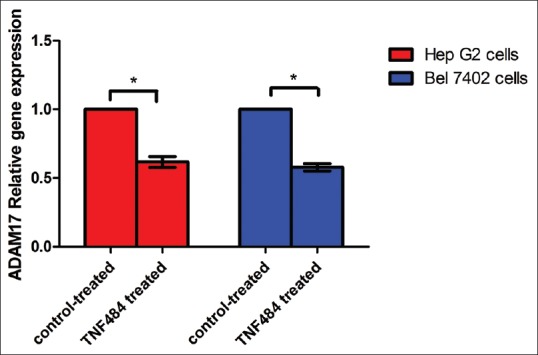
Various doses (0, 1, 10, 50, and 100 nM) of TNF484 were applied to the HepG2 and Bel7402 cells, and cell proliferation was measured by using 3-(4,5-dimethylthiazol-2-yl)-2,5 diphenyl tetrazolium bromide assay after 72 h. Cell migration rate was measured using the xCELLigence system, and the cell invasion ability was examined by the three-dimensional spheroid BME cell invasion assay. The expression level of ADAM17 was also measured with RT-PCR.
With the treatment of TNF484, the cell proliferation of HepG2 and Bel7402 cells was inhibited in a dose-dependent manner. Moreover, under TNF484 treatment, the cell migration rate as well as cell invasion ability of the HepG2 and Bel7402 cells were suppressed.
TNF484 could inhibit the cell proliferation, migration, and invasion of some HCC cell lines, making it a potential therapeutic option for liver cancer treatment.
本研究旨在测试TNF484对肝癌(HCC)细胞增殖、迁移和侵袭的影响。
将不同剂量(0、1、10、50和100 nM)的TNF484应用于HepG2和Bel7402细胞,72小时后使用3-(4,5-二甲基噻唑-2-基)-2,5-二苯基四氮唑溴盐法测量细胞增殖。使用xCELLigence系统测量细胞迁移率,并通过三维球体BME细胞侵袭试验检测细胞侵袭能力。还通过RT-PCR测量ADAM17的表达水平。
经TNF484处理后,HepG2和Bel7402细胞的增殖受到剂量依赖性抑制。此外,在TNF484处理下,HepG2和Bel7402细胞的迁移率和侵袭能力均受到抑制。
TNF484可抑制某些肝癌细胞系的细胞增殖、迁移和侵袭,使其成为肝癌治疗的潜在选择。