Piras Francesca, Spanu Carlo, Mocci Anna Maria, Demontis Mariella, Santis Enrico Pietro Luigi De, Scarano Christian
Department of Veterinary Medicine, University of Sassari, Italy.
Ital J Food Saf. 2019 Mar 26;8(1):8011. doi: 10.4081/ijfs.2019.8011. eCollection 2019 Mar 18.
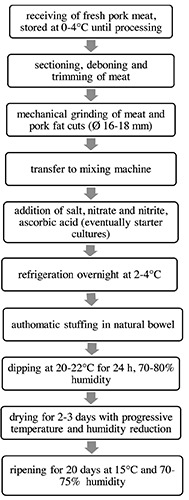
The aims of the present study were to evaluate the presence of in five fermented sausage processing plants and their products during the production process, and to trace the possible sources of contamination. A total of 270 samples were collected: mixture of ground pork meat and fat, products at the end of acidification, sausages at the end of ripening and, during production stages, surfaces in contact with meat and surfaces not in contact with meat. For samples of ground meat, product at the end of acidification and sausages at the end of ripening, the pH and water activity (a), were determined. All the samples were tested for the presence of . Thirtytwo isolates were obtained, subjected to serotyping and PFGE. The sausages at the end of ripening pH and a mean values were 5.39±0.24 and 0.91±0.03, respectively. was detected in three processing plants with an overall prevalence of 16.7% in food samples and 5.8% in environmental samples. prevalence was 24% in ground meat and products at the end of acidification and was also detected in a sample of sausage at the end of ripening (2%). In environmental samples, was detected in 6.6% of surfaces in contact with meat and 5% of surfaces not in contact with meat. Five serotypes were identified among 32 isolates: . Derby (37.5%), . Typhimurium and Rissen (both 25%), . Give and monophasic . Typhimurium (both 6.25%). Six different pulsotypes were obtained with PFGE. The serotypes and the PFGE pattern of the strains were specific for each facility with no overlapping between different processing plants. The same observation can be pointed out considering different sampling days for the same processing plants, thus presumably indicating the raw material (ground pork meat and fat) as the source of contamination. The detection of in a sample of sausage at the end of ripening highlights the ability of the pathogen to survive during manufacturing process.
本研究的目的是评估五家发酵香肠加工厂及其产品在生产过程中 的存在情况,并追踪可能的污染源。总共收集了270个样本:猪肉和脂肪的混合绞肉、酸化结束时的产品、成熟结束时的香肠,以及在生产阶段,与肉接触的表面和不与肉接触的表面。对于绞肉、酸化结束时的产品和成熟结束时的香肠样本,测定了pH值和水分活度(a)。所有样本都检测了 的存在情况。获得了32株分离株,进行了血清分型和脉冲场凝胶电泳(PFGE)。成熟结束时香肠的pH值和a平均值分别为5.39±0.24和0.91±0.03。在三家加工厂检测到了 ,食品样本中的总体患病率为16.7%,环境样本中的患病率为5.8%。在绞肉和酸化结束时的产品中 的患病率为24%,在成熟结束时的一个香肠样本中也检测到了(2%)。在环境样本中,在6.6%与肉接触的表面和5%不与肉接触的表面检测到了 。在32株分离株中鉴定出五种血清型:德比沙门氏菌(37.5%)、鼠伤寒沙门氏菌和里森沙门氏菌(均为25%)、吉夫沙门氏菌和单相鼠伤寒沙门氏菌(均为6.25%)。通过PFGE获得了六种不同的脉冲型。菌株的血清型和PFGE模式对每个工厂都是特异性的,不同加工厂之间没有重叠。考虑到同一加工厂的不同采样日期,也可以指出相同的观察结果,因此推测原材料(猪肉和脂肪的混合绞肉)是污染源。在成熟结束时的一个香肠样本中检测到 突出了病原体在制造过程中存活的能力。