Bavarian Health and Food Safety Authority (LGL), Oberschleissheim, Germany.
These authors contributed equally to this article.
Euro Surveill. 2019 May;24(18). doi: 10.2807/1560-7917.ES.2019.24.18.1800303.
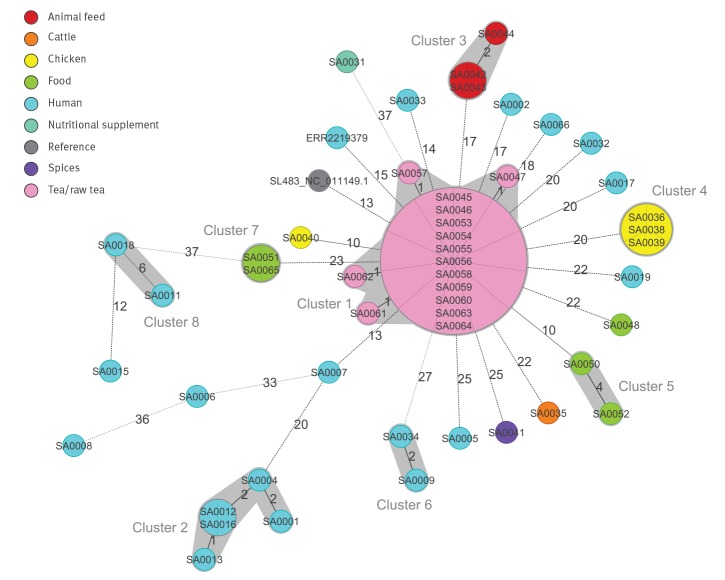
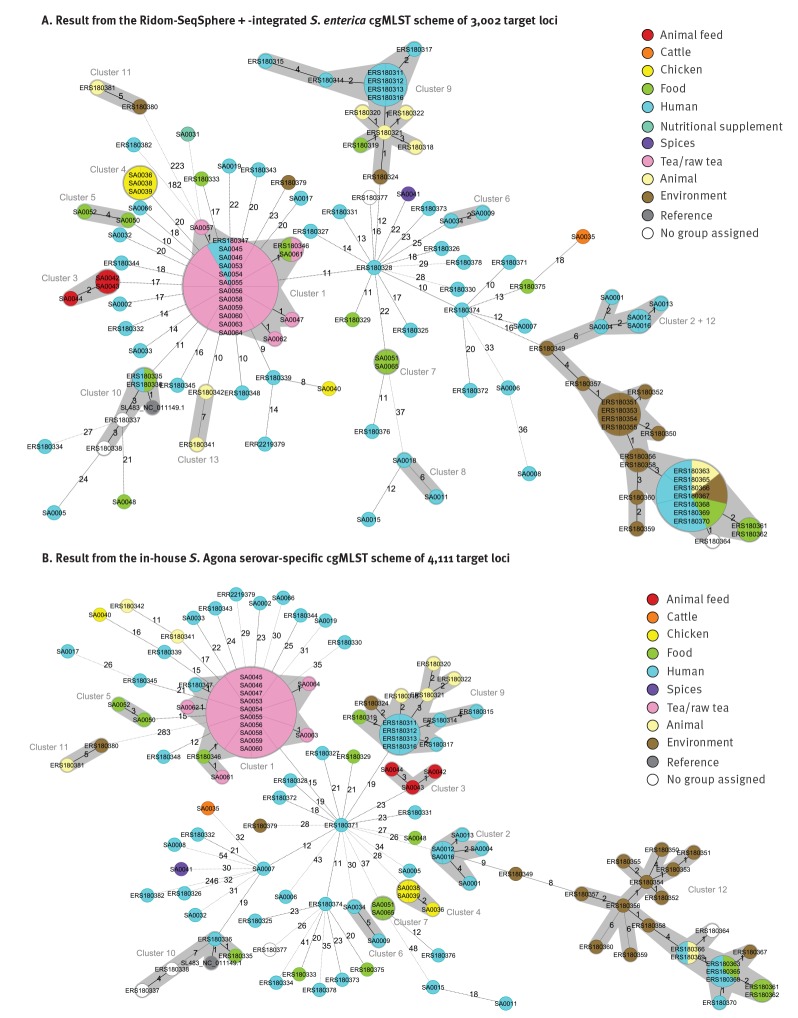
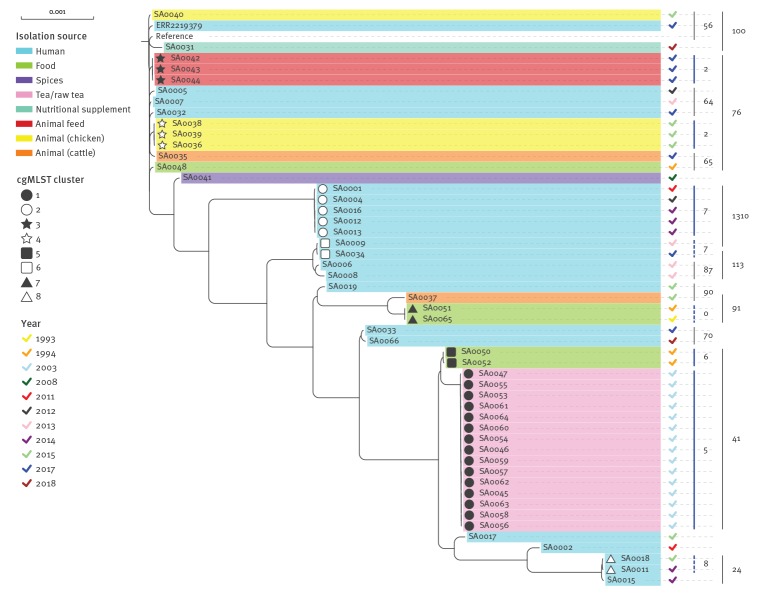
BackgroundIn 2017, a food-borne Agona outbreak caused by infant milk products from a French supplier occurred in Europe. Simultaneously, Agona was detected in animal feed samples in Bavaria.AimUsing next generation sequencing (NGS) and three data analysis methods, this study's objectives were to verify clonality of the Bavarian feed strains, rule out their connection to the outbreak, explore the genetic diversity of Bavarian Agona isolates from 1993 to 2018 and compare the analysis approaches employed, for practicality and ability to delineate outbreaks caused by the genetically monomorphic Agona serovar.MethodsIn this observational retrospective study, three 2017 Bavarian feed isolates were compared to a French outbreak isolate and 48 Agona isolates from our strain collections. The later included human, food, feed, veterinary and environmental isolates, of which 28 were epidemiologically outbreak related. All isolates were subjected to NGS and analysed by: (i) a publicly available species-specific core genome multilocus sequence typing (cgMLST) scheme, (ii) single nucleotide polymorphism phylogeny and (iii) an in-house serovar-specific cgMLST scheme. Using additional international Agona outbreak NGS data, the cluster resolution capacity of the two cgMLST schemes was assessed.ResultsWe could prove clonality of the feed isolates and exclude their relation to the French outbreak. All approaches confirmed former Bavarian epidemiological clusters.ConclusionEven for Agona, species-level cgMLST can produce reasonable resolution, being standardisable by public health laboratories. For single samples or homogeneous sample sets, higher resolution by serovar-specific cgMLST or SNP genotyping can facilitate outbreak investigations.
2017 年,一家法国供应商的婴儿配方奶粉引发了食源性阿贡纳菌疫情,疫情在欧洲爆发。同时,巴伐利亚州的动物饲料样本中也检测到了阿贡纳菌。
本研究旨在使用下一代测序(NGS)和三种数据分析方法,验证巴伐利亚州饲料菌株的克隆性,排除它们与疫情的关联,探索 1993 年至 2018 年间巴伐利亚州阿贡纳菌分离株的遗传多样性,并比较所采用的分析方法,以评估其实用性和区分由遗传单态性阿贡纳菌血清型引起的疫情的能力。
在这项观察性回顾性研究中,将三个 2017 年巴伐利亚州饲料分离株与一个法国疫情分离株以及来自我们菌株收集的 48 个阿贡纳菌分离株进行比较。后者包括人类、食品、饲料、兽医和环境分离株,其中 28 个与流行病学疫情相关。所有分离株均进行 NGS 分析,并采用以下三种方法:(i)公开的种特异性核心基因组多位点序列分型(cgMLST)方案,(ii)单核苷酸多态性系统发育和(iii)内部血清型特异性 cgMLST 方案。使用额外的国际阿贡纳菌疫情 NGS 数据,评估了两种 cgMLST 方案的聚类分辨率能力。
我们能够证明饲料分离株的克隆性,并排除它们与法国疫情的关系。所有方法均证实了巴伐利亚州以前的流行病学聚类。
即使对于阿贡纳菌,种水平的 cgMLST 也可以产生合理的分辨率,并且可以由公共卫生实验室标准化。对于单个样本或同质样本集,血清型特异性 cgMLST 或 SNP 基因分型的更高分辨率可以促进疫情调查。