Evans D G, Thomas S, Caunt J, Burch A, Brentnall A R, Roberts L, Howell A, Wilson M, Fox R, Hillier S, Sibbering D M, Moss S, Wallis M G, Eccles D M, Duffy S
Prevent Breast Cancer Centre, Wythenshawe Hospital Manchester Universities Foundation Trust, Wythenshawe, Manchester M23 9LT, UK.
Genomic Medicine, Division of Evolution and Genomic Sciences, The University of Manchester, Manchester Academic Health Science Centre, Manchester Universities Foundation Trust, St. Mary's Hospital, Oxford Road, Manchester M13 9WL, UK.
EClinicalMedicine. 2019 Jan;7:39-46. doi: 10.1016/j.eclinm.2019.01.005.
Many women who are at increased risk of breast cancer due to a mother or sister diagnosed with breast cancer aged under 40 do not currently qualify for surveillance before 40 years of age. There are almost no available data to assess whether mammography screening aged 35-39 years would be effective in this group, in terms of detection of breast cancer at an early stage or cost effective.
A cohort screening study (FH02) with annual mammography was devised for women aged 35-39 to assess the sensitivity and screening performance and potential survival of women with identified tumours.
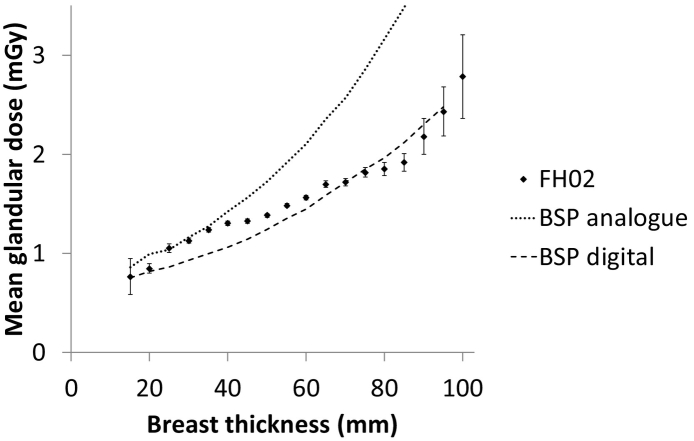
2899 women were recruited from 12/2006-12/2015. These women underwent 12,086 annual screening mammograms and were followed for 13,365.8 years. A total of 55 breast cancers in 54 women occurred during the study period (one bilateral) with 50 cancers (49 women) (15 CIS) adherent to the screening. Eighty percent (28/35) of invasive cancers were ≤ 2 cm and 80% also lymph node negative. Invasive cancers diagnosed in FH02 were significantly smaller than the comparable (POSH-unscreened prospective) study group (45% (131/293) ≤ 2 cm in POSH vs 80% (28/35) in FH02 p < 0.0001), and were less likely to be lymph-node positive (54% (158/290, 3 unknown) in POSH vs 20% (7/35) in FH02: p = 0.0002. Projected and actual survival were also better than POSH. Overall radiation dose was not higher than in an older screened population at mean dose on study per standard sized breast of 1.5 mGy.
Mammography screening aged 35-39 years detects breast cancer at an early stage and is likely to be as effective in reducing mortality as in women at increased breast cancer risk aged 40-49 years.
许多因母亲或姐妹在40岁之前被诊断出患有乳腺癌而患乳腺癌风险增加的女性,目前不符合40岁之前接受监测的条件。几乎没有可用数据来评估35 - 39岁的乳房X光筛查在该人群中对于早期发现乳腺癌是否有效或是否具有成本效益。
针对35 - 39岁女性设计了一项队列筛查研究(FH02),每年进行乳房X光检查,以评估已确诊肿瘤女性的敏感性、筛查性能和潜在生存率。
2006年12月至2015年12月期间招募了2899名女性。这些女性接受了12086次年度筛查乳房X光检查,并随访了13365.8年。研究期间,54名女性共发生了55例乳腺癌(1例双侧),其中50例癌症(49名女性)(15例原位癌)符合筛查情况。80%(28/35)的浸润性癌≤2厘米,且80%也为淋巴结阴性。在FH02中诊断出的浸润性癌明显小于可比的(POSH未筛查前瞻性)研究组(POSH中45%(131/293)≤2厘米,而FH02中为80%(28/35),p < 0.0001),且淋巴结阳性的可能性较小(POSH中为54%(158/290,3例未知),而FH02中为20%(7/35):p = 0.0002)。预计生存率和实际生存率也优于POSH。总体辐射剂量不高于年龄较大的筛查人群,研究中每标准大小乳房的平均剂量为1.5毫戈瑞。
35 - 39岁的乳房X光筛查可早期发现乳腺癌,在降低死亡率方面可能与40 - 49岁乳腺癌风险增加的女性同样有效。