Jiao Ruimin, Liu Yan, Liu Baoyan, Liu Zhishun
Department of Acupuncture Guang'anmen Hospital, China Academy of Chinese Medical Sciences.
China Academy of Chinese Medical Sciences.
Medicine (Baltimore). 2019 Apr;98(16):e15220. doi: 10.1097/MD.0000000000015220.
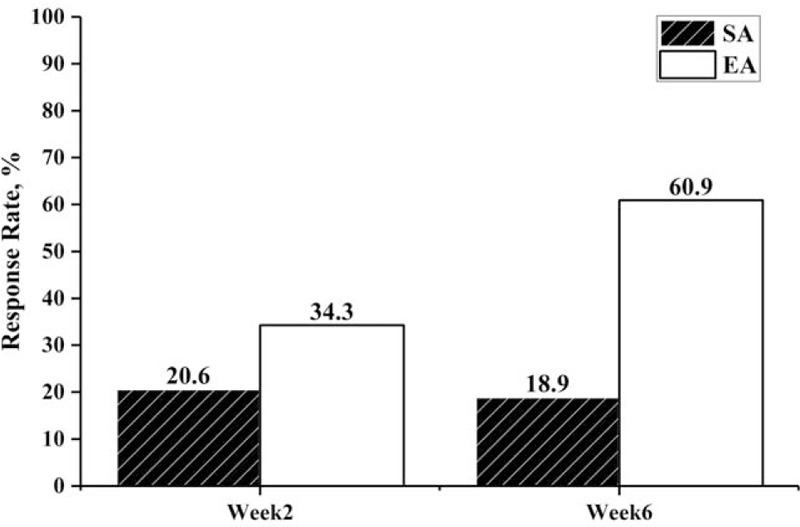
Postmenopausal women are at a higher risk of stress urinary incontinence (SUI). In a previous trial, electroacupuncture (EA) was shown to be an effective treatment for women with SUI. Here we present a secondary analysis to investigate the specific factors associated with response to acupuncture therapy among postmenopausal women with SUI.We conducted secondary analysis of data from a multicenter randomized controlled trial. This trial included a baseline period of 1 week and a treatment period of 6 weeks with electroacupuncture (EA) or sham electroacupuncture (SA). The patients were randomly assigned to 2 groups (EA group or SA group). Participants who showed a decrease in urine leakage by at least 50% from baseline level, as measured by 1-hour pad at week 6, were defined as responders. Baseline characteristics associated with response to acupuncture therapy (e.g., demographic, comorbidities, and lifestyle-related factors) were identified by logistic regression analysis and the interactions between treatment assignment and baseline characteristics assessed.This analysis included a total of 349 postmenopausal women, of whom 137 (39.3%) were classified as responders. Response rate in the EA group was significantly higher than that in the SA group (60.9% vs 18.9%, respectively; P < .001). On multivariable logistic regression analysis, only "mean number of urine pads used before treatment" remained a significant predictor of response to therapy (EA or SA). Greater weekly mean number of urine pads used before treatment showed a correlation with non-response to therapy, as the likelihood of clinical response reduced by 5.26% with increase in the weekly mean number of urine pads used (odds ratio 0.947, 95% confidence interval 0.902-0.993; P = .020). The interaction terms were not statistically significant.Postmenopausal women with SUI who used fewer number of pads per week before treatment were more likely to respond to therapy. This study provides valuable insights for pretreatment selection of women with SUI. Specific factors related to the therapeutic effects of acupuncture were not identified and need to be explored in future studies.Trial registration: Clinical Trials.gov: NCT01784172.
绝经后女性患压力性尿失禁(SUI)的风险更高。在之前的一项试验中,电针(EA)被证明是治疗SUI女性的有效方法。在此,我们进行一项二次分析,以研究绝经后SUI女性对针刺疗法反应的相关具体因素。我们对一项多中心随机对照试验的数据进行了二次分析。该试验包括1周的基线期和6周的电针(EA)或假电针(SA)治疗期。患者被随机分为两组(EA组或SA组)。在第6周通过1小时护垫测量,尿失禁量较基线水平至少减少50%的参与者被定义为有反应者。通过逻辑回归分析确定与针刺疗法反应相关的基线特征(如人口统计学、合并症和生活方式相关因素),并评估治疗分配与基线特征之间的相互作用。该分析共纳入349名绝经后女性,其中137名(39.3%)被归类为有反应者。EA组的反应率显著高于SA组(分别为60.9%和18.9%;P<0.001)。在多变量逻辑回归分析中,只有“治疗前使用尿垫的平均数量”仍然是治疗反应(EA或SA)的显著预测因素。治疗前每周使用尿垫的平均数量越多,与治疗无反应相关,因为随着每周使用尿垫平均数量的增加,临床反应的可能性降低5.26%(比值比0.947,95%置信区间0.902 - 0.993;P = 0.020)。交互项无统计学意义。治疗前每周使用尿垫数量较少的绝经后SUI女性更有可能对治疗有反应。本研究为SUI女性的治疗前选择提供了有价值的见解。未确定与针刺治疗效果相关的具体因素,未来研究需进一步探索。试验注册:ClinicalTrials.gov:NCT01784172。