Liu Zhishun, Xu Huanfang, Chen Yuelai, He Liyun, Liu Jia, Yan Shiyan, Du Ruosang, Wu Jiani, Liu Baoyan
Guang'anmen Hospital, China Academy of Chinese Medical Sciences, Beijing 100053, China.
Trials. 2013 Sep 30;14:315. doi: 10.1186/1745-6215-14-315.
Although available evidence relating to its effectiveness is weak, acupuncture is used as an alternative therapy for stress urinary incontinence. We report a protocol of a randomized controlled trial using electroacupuncture (the passing of a weak current between inserted acupuncture needles) to treat women with pure stress urinary incontinence.
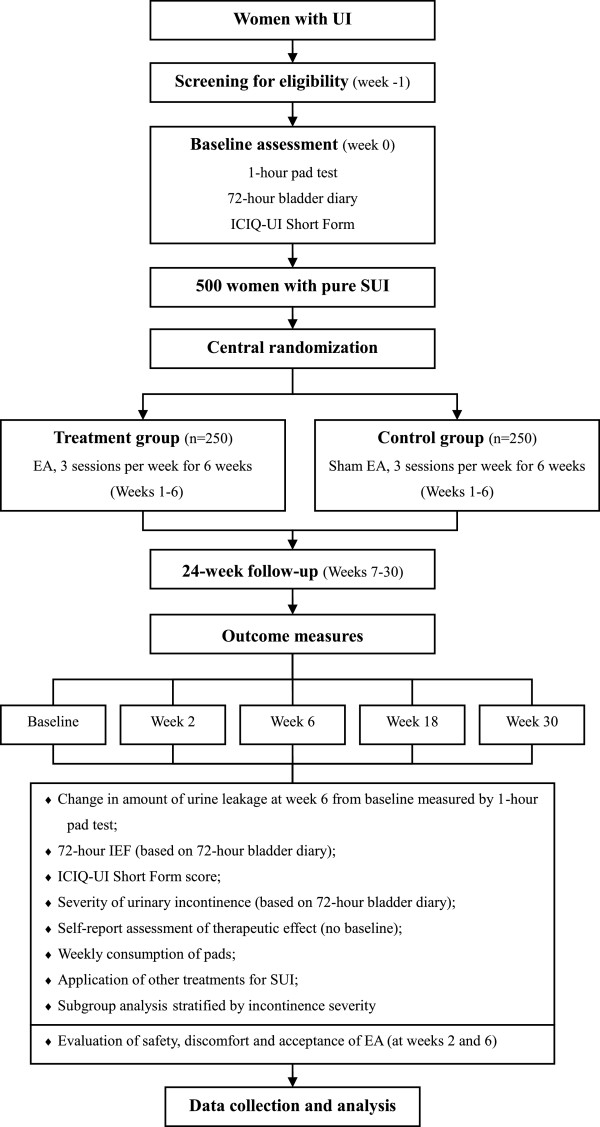
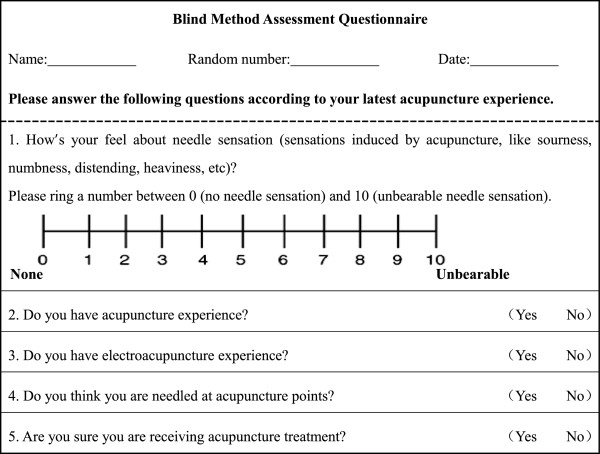
METHODS/DESIGN: This is a large-scale multicenter subject-blinded randomized controlled trial. A total of 500 women with pure stress urinary incontinence will be randomly assigned to two groups: a treatment group and a control group. The treatment group will receive electroacupuncture with deep needling at acupuncture points BL33 and BL35. The control group will receive sham electroacupuncture with non-penetrating needling at sham locations for the acupuncture points of BL33 and BL35. Participants will be given three sessions a week for 6 weeks. A 24-week-long follow-up will be conducted. The primary outcome will be the change in amount of urine leakage at the sixth week from a baseline measured by a 1-h pad test. The secondary outcomes include: the 72-h incontinence episode frequency based on a 72-h bladder diary; the score of International Consultation on Incontinence Questionnaire-Urinary Incontinence Short Form; the degree of urinary incontinence based on a 72-h bladder diary; self-assessment of the therapeutic effect; weekly consumption of pads; application of other treatments for stress urinary incontinence; and subgroup analysis stratified by incontinence severity. The safety of electroacupuncture will also be assessed.
This trial will help to identify whether electroacupuncture is effective for stress urinary incontinence, and, if so, whether it is a therapeutic effect rather than a placebo effect.
Clinical Trials.gov NCT01784172.
尽管有关针灸有效性的现有证据不足,但它仍被用作压力性尿失禁的替代疗法。我们报告一项随机对照试验方案,该方案使用电针疗法(在插入的针灸针之间通过微弱电流)治疗单纯性压力性尿失禁的女性。
方法/设计:这是一项大规模多中心受试者盲法随机对照试验。总共500名单纯性压力性尿失禁的女性将被随机分为两组:治疗组和对照组。治疗组将接受针刺BL33和BL35穴位的深刺电针疗法。对照组将接受在BL33和BL35穴位的假针刺部位进行非穿透性针刺的假电针疗法。参与者将每周接受三次治疗,持续6周。将进行为期24周的随访。主要结局将是通过1小时护垫试验测量的第六周时尿失禁量相对于基线的变化。次要结局包括:基于72小时膀胱日记的72小时尿失禁发作频率;国际尿失禁咨询问卷-尿失禁简表的得分;基于72小时膀胱日记的尿失禁程度;治疗效果的自我评估;每周护垫消耗量;压力性尿失禁的其他治疗方法的应用;以及按尿失禁严重程度分层的亚组分析。还将评估电针疗法的安全性。
该试验将有助于确定电针疗法对压力性尿失禁是否有效,如果有效,是治疗效果还是安慰剂效应。
ClinicalTrials.gov NCT01784172。