
泛素结合酶E2C、富含亮氨酸重复序列的G蛋白偶联受体、含WW结构域的氧化还原酶及血管生成拟态在浸润性乳腺癌中的临床病理意义
The clinicopathological significance of ubiquitin-conjugating enzyme E2C, leucine-rich repeated-containing G protein-coupled receptor, WW domain-containing oxidoreductase, and vasculogenic mimicry in invasive breast carcinoma.
作者信息
Shen Rong, Wu Ting, Huang Pan, Shao Qixiang, Chen Miao
机构信息
Department of Pathology, Zhenjiang First People's Hospital, Affiliated to Jiangsu University.
Department of Pathology, School of Medicine, Jiangsu University, Zhenjiang, Jiangsu, China.
出版信息
Medicine (Baltimore). 2019 Apr;98(16):e15232. doi: 10.1097/MD.0000000000015232.
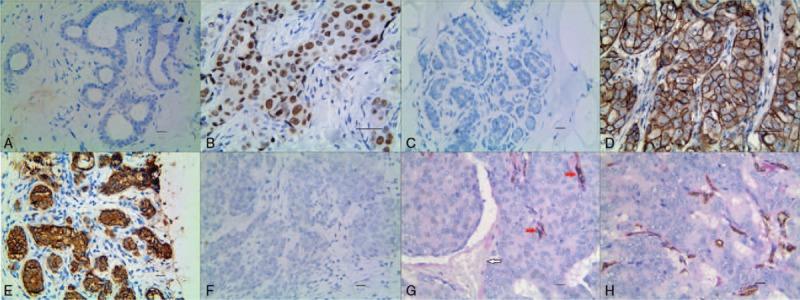
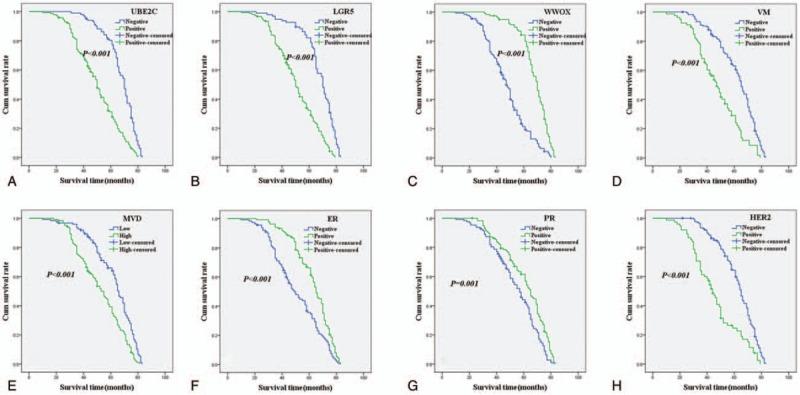
Ubiquitin-conjugating enzyme E2C (UBE2C), a crucial part of the ubiquitin-conjugating enzyme complex, is reported to promote progression of various cancers. Leucine-rich repeated-containing G protein-coupled receptor (LGR5), a biomarker of cancer stem cells, is reported to be responsible for the initiation and progression of cancers. WW domain-containing oxidoreductase (WWOX), a suppressor of tumor, is reported to inhibit initiation and progression of cancers. Vasculogenic mimicry (VM), a new blood supply pattern, is associated with progression of cancers. However, the clinicopathological significance of UBE2C, LGR5, WWOX, and VM in invasive breast carcinoma (IBC) remains elusive. The aim of this study is to investigate the positive rate of UBE2C, LGR5, WWOX, and VM in IBC and their clinical significance.Positive rates of UBE2C, LGR5, WWOX, and VM in 247 whole IBC samples were detected through immunohistochemistry. Patients data (including clinical, demography, follow-up) were collected.Levels of UBE2C, LGR5, VM, and microvessel density (MVD) were significantly higher, and level of WWOX was significantly lower in IBC specimens when compared with normal mammary gland tissues. Levels of UBE2C, LGR5, VM, and MVD were all positively associated with tumor stages, lymph node metastasis (LNM) stages, tumor grades, and tumor-node-metastasis (TNM) stages, and unfavorably with patients' overall survival (OS) and disease-free survival (DFS). Level of WWOX was negatively associated with tumor stages, LNM stages, grades, and TNM stages, and favorably with patients' OS and DFS. Multivariate analysis indicated that levels of UBE2C, LGR5, VM, MVD, and WWOX, as well as TNM stages were independently prognostic factors for OS and DFS in patients with IBC.UBE2C, LGR5, VM, MVD, and WWOX may be considered as promising indicator of IBC prognosis.
泛素结合酶E2C(UBE2C)是泛素结合酶复合物的关键组成部分,据报道可促进多种癌症的进展。富含亮氨酸重复序列的G蛋白偶联受体(LGR5)是癌症干细胞的生物标志物,据报道与癌症的发生和进展有关。含WW结构域的氧化还原酶(WWOX)是一种肿瘤抑制因子,据报道可抑制癌症的发生和进展。血管生成拟态(VM)是一种新的血液供应模式,与癌症进展相关。然而,UBE2C、LGR5、WWOX和VM在浸润性乳腺癌(IBC)中的临床病理意义仍不清楚。本研究的目的是调查UBE2C、LGR5、WWOX和VM在IBC中的阳性率及其临床意义。通过免疫组织化学检测了247例IBC全组织样本中UBE2C、LGR5、WWOX和VM的阳性率。收集了患者数据(包括临床、人口统计学、随访数据)。与正常乳腺组织相比,IBC标本中UBE2C、LGR5、VM和微血管密度(MVD)水平显著升高,而WWOX水平显著降低。UBE2C、LGR5、VM和MVD水平均与肿瘤分期、淋巴结转移(LNM)分期、肿瘤分级和肿瘤-淋巴结-转移(TNM)分期呈正相关,与患者总生存期(OS)和无病生存期(DFS)呈负相关。WWOX水平与肿瘤分期、LNM分期、分级和TNM分期呈负相关,与患者OS和DFS呈正相关。多因素分析表明,UBE2C、LGR5、VM、MVD和WWOX水平以及TNM分期是IBC患者OS和DFS的独立预后因素。UBE2C、LGR5、VM、MVD和WWOX可被视为IBC预后的有前景指标。

 Zotero 插件