Zhou Jiupeng, Guo Hui, Yang Yuanli, Zhang Yongfeng, Liu Heng
Xi'an Chest Hospital, Xi'an.
The First Affiliated Hospital of Xi'an Jiaotong University, Shaanxi Province, China.
Medicine (Baltimore). 2019 Apr;98(16):e15335. doi: 10.1097/MD.0000000000015335.
It has been reported that the encapsulated miRNAs from exosomes are potential biomarkers of tumors prognosis. Yet, the results are controversial, so it is obliged to do a meta-analysis to reach a definite conclusion.
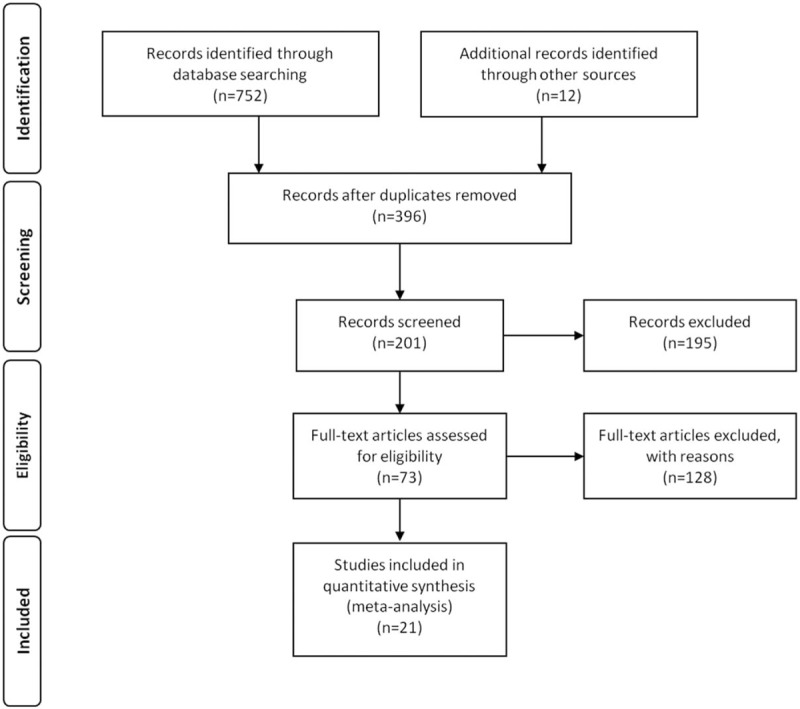
Studies were searched for published in PubMed, Embase, and Web of Science databases until April 20, 2018. A meta-analysis was conducted to appraise the role of exosomal miRNAs in prognosis of cancer patients.
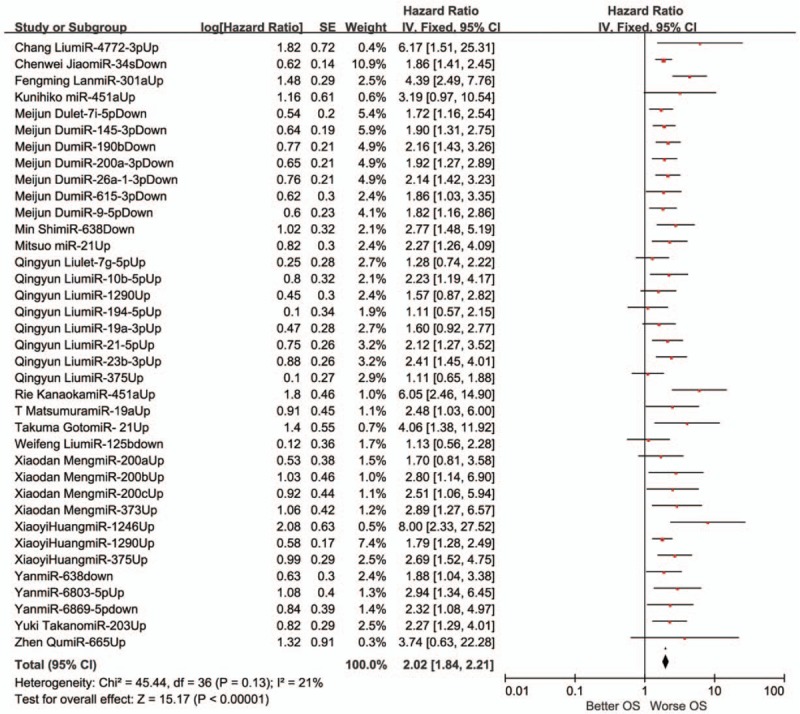
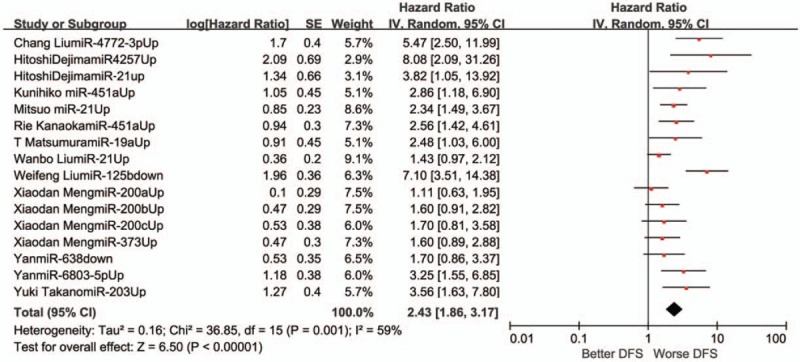
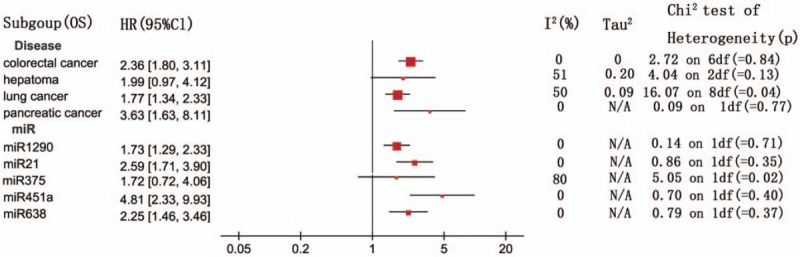
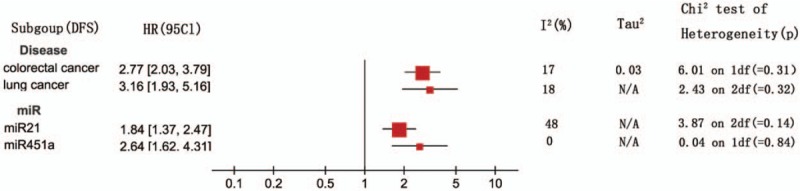
The different exosomal miRNAs expression was remarkably related to overall survival (OS) (hazard ratio [HR] = 2.02, 95% confidence interval [CI]: 1.84-2.21) and disease-free survival (DFS) (HR = 2.43, 95% CI: 1.86-3.17) of cancer patients. High exosomal miR-21 expression was associated with poor OS (HR = 2.59; 95% CI: 1.71-3.90) and DFS (HR = 1.84; 95% CI: 1.37-2.47). High exosomal miR-451a expression was associated with poor OS (HR = 4.81; 95% CI: 2.33-9.93) and DFS (HR = 2.64; 95% CI: 1.62-4.31). High exosomal miR-1290 expression was associated with poor OS (HR = 1.73; 95% CI: 1.29-2.33). Low exosomal miR-638 expression was associated with poor OS (HR = 2.25; 95% CI: 1.46-3.46).
The expression levels of exosomal miRNAs, particularly miR-21, miR-451a, miR-1290, and miR-638 could strongly predict prognosis of solid tumor patients and might be a potential target for tumor treatment.
据报道,外泌体中封装的微小RNA(miRNA)是肿瘤预后的潜在生物标志物。然而,结果存在争议,因此有必要进行荟萃分析以得出明确结论。
检索了截至2018年4月20日在PubMed、Embase和Web of Science数据库中发表的研究。进行荟萃分析以评估外泌体miRNA在癌症患者预后中的作用。
不同的外泌体miRNA表达与癌症患者的总生存期(OS)(风险比[HR]=2.02,95%置信区间[CI]:1.84-2.21)和无病生存期(DFS)(HR=2.43,95%CI:1.86-3.17)显著相关。外泌体miR-21高表达与较差的OS(HR=2.59;95%CI:1.71-3.90)和DFS(HR=1.84;95%CI:1.37-2.47)相关。外泌体miR-451a高表达与较差的OS(HR=4.81;95%CI:2.33-9.93)和DFS(HR=2.64;95%CI:1.62-4.31)相关。外泌体miR-1290高表达与较差的OS(HR=1.73;95%CI:1.29-2.33)相关。外泌体miR-638低表达与较差的OS(HR=2.25;95%CI:1.46-3.46)相关。
外泌体miRNA的表达水平,尤其是miR-21、miR-451a、miR-1290和miR-638,可以强烈预测实体瘤患者的预后,可能是肿瘤治疗的潜在靶点。