Galán-Jiménez Jaime, Berrocal Javier, Garcia-Alonso Jose, Azabal Manuel Jesús
Department of Computer and Telematic Systems Engineering, School of Technology, University of Extremadura, Avda. de la Universidad s/n, 10003 Cáceres, Spain.
Sensors (Basel). 2019 Apr 19;19(8):1875. doi: 10.3390/s19081875.
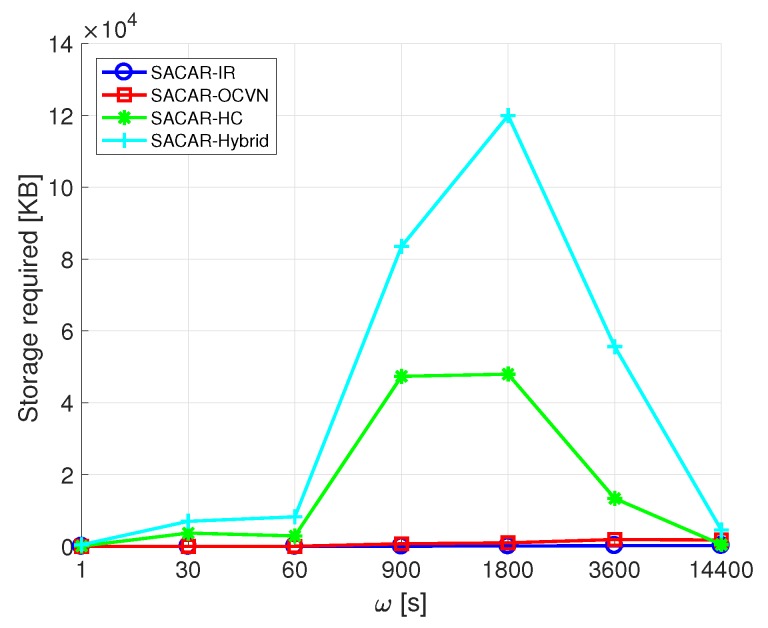
The massive amount of traffic required by the emerging Internet of Things (IoT) paradigm can be supported by the imminent arrival of 5G next-generation networks. However, the limited capacity of resources in IoT nodes, e.g., battery lifetime or buffer space, opens a challenge to be taken into account when proposing new routing solutions on IoT scenarios with intermittent connectivity. In this paper, we propose the concept of Opportunistic Context-Virtual Networks (OCVNs). The novelty of this approach is to create virtual groups of nodes that share interests in common for routing purposes. Therefore, only the nodes that are interested in the content of the messages that are flowing throughout the network are used as relaying nodes, providing their own resources for the sake of the communication. By leveraging the use of store-carry-and-forward mechanisms, a novel routing algorithm is proposed and evaluated over two realistic scenarios. Experimental results reveal that our solution outperforms other well-known opportunistic routing algorithms in terms of delivery probability and overhead ratio, while resource usage of relaying nodes is significantly reduced.
即将到来的5G下一代网络能够支持新兴物联网(IoT)范式所需的大量流量。然而,物联网节点中资源容量有限,例如电池寿命或缓冲区空间,这在针对具有间歇性连接的物联网场景提出新的路由解决方案时带来了一个需要考虑的挑战。在本文中,我们提出了机会上下文虚拟网络(OCVN)的概念。这种方法的新颖之处在于创建用于路由目的的具有共同兴趣的节点虚拟组。因此,只有那些对网络中流动的消息内容感兴趣的节点才被用作中继节点,为通信提供自身资源。通过利用存储-携带-转发机制,我们提出了一种新颖的路由算法,并在两个实际场景中进行了评估。实验结果表明,我们的解决方案在传输概率和开销率方面优于其他知名的机会路由算法,同时中继节点的资源使用显著减少。