DB Consulting Group, Inc, Silver Spring, Maryland;
Division of Reproductive Health, Centers for Disease Control and Prevention, Atlanta, Georgia.
Pediatrics. 2019 May;143(5). doi: 10.1542/peds.2018-3408.
Unintentional suffocation is the leading cause of injury death among infants <1 year old in the United States, with 82% being attributable to accidental suffocation and strangulation in bed. Understanding the circumstances surrounding these deaths may inform prevention strategies.
We analyzed data from the population-based Sudden Unexpected Infant Death Case Registry from 2011 to 2014. Cases categorized as explained suffocation with unsafe sleep factors (suffocation), per the Centers for Disease Control and Prevention's Sudden Unexpected Infant Death Case Registry classification system, were included and assigned a mechanism of obstruction, including soft bedding, overlay, or wedging. We calculated frequencies and percentages of suffocation deaths by mechanism and selected demographic and sleep-environment characteristics.
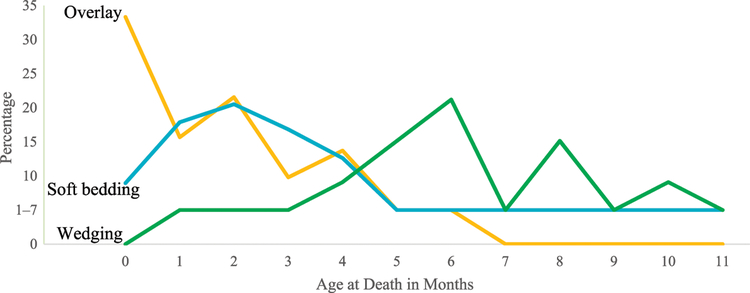
Fourteen percent of sudden unexpected infant death cases were classified as suffocation; these cases were most frequently attributed to soft bedding (69%), followed by overlay (19%) and wedging (12%). Median age at death in months varied by mechanism: 3 for soft bedding, 2 for overlay, and 6 for wedging. Soft-bedding deaths occurred most often in an adult bed (49%), in a prone position (82%), and with a blanket (or blankets) obstructing the airway (34%). Overlay deaths occurred most often in an adult bed (71%), and infants were overlaid by the mother (47%). Wedging deaths occurred most often when the infant became entrapped between a mattress and a wall (48%).
Safe sleep environments can reduce infant suffocation deaths. Increased knowledge about the characteristics of suffocation deaths can help inform prevention strategies by targeting highest-risk groups.
在美国,1 岁以下婴儿因意外伤害而死亡的首要原因是意外窒息,其中 82%是由于床上意外窒息和绞勒。了解这些死亡事件的相关情况可能有助于制定预防策略。
我们分析了 2011 年至 2014 年基于人群的突发意外婴儿死亡案例登记处的数据。根据疾病控制与预防中心的突发意外婴儿死亡案例登记处分类系统,将归类为有不安全睡眠因素的意外窒息(窒息)的案例纳入分析,并确定了阻塞机制,包括软床具、覆盖物或楔状物。我们按机制计算了窒息死亡的频率和百分比,并选择了人口统计学和睡眠环境特征。
14%的突发意外婴儿死亡案例被归类为窒息;这些案例最常归因于软床具(69%),其次是覆盖物(19%)和楔状物(12%)。死亡时的月龄中位数因机制而异:软床具为 3 个月,覆盖物为 2 个月,楔状物为 6 个月。软床具死亡事件最常发生在成人床上(49%),婴儿呈俯卧位(82%),且有毯子(或毯子)阻塞气道(34%)。覆盖物死亡事件最常发生在成人床上(71%),婴儿被母亲覆盖(47%)。楔状物死亡事件最常发生在婴儿被困在床垫和墙壁之间(48%)。
安全的睡眠环境可以减少婴儿窒息死亡。增加对窒息死亡特征的了解有助于通过针对高风险群体来制定预防策略。