Department of Horticulture, College of Aburaihan, University of Tehran, Tehran, Iran.
Department of Plant Sciences, University of California, Davis, CA, 95616, USA.
Sci Rep. 2019 Apr 23;9(1):6376. doi: 10.1038/s41598-019-42940-1.
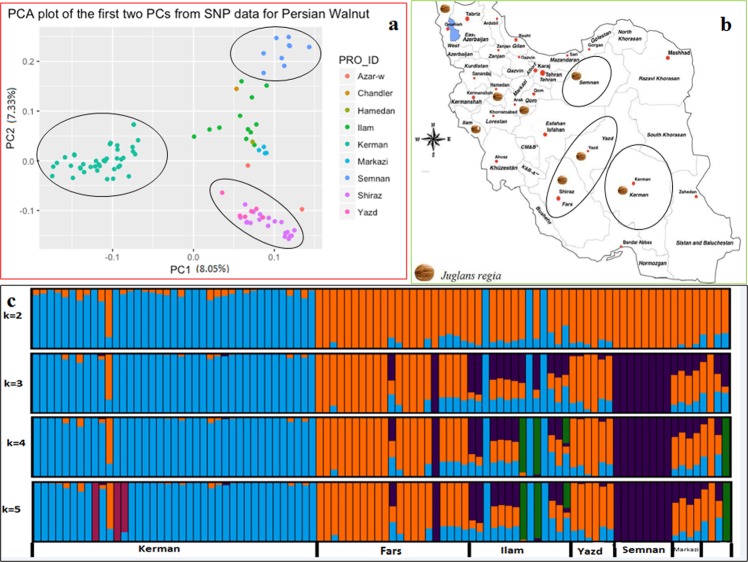
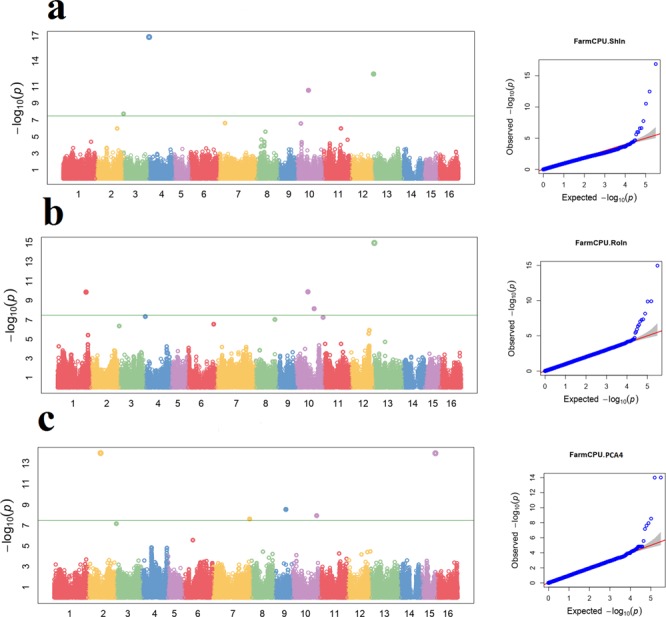
Persian plateau (including Iran) is considered as one of the primary centers of origin of walnut. Sampling walnut trees originating from this arena and exploiting the capabilities of next-generation sequencing (NGS) can provide new insights into the degree of genetic variation across the walnut genome. The present study aimed to explore the population structure and genomic variation of an Iranian collection of Persian walnut (Juglans regia L.) and identify loci underlying the variation in nut and kernel related traits using the new Axiom J. regia 700K SNP genotyping array. We genotyped a diversity panel including 95 walnut genotypes from eight Iranian provinces with a variety of climate zones. A majority of the SNPs (323,273, 53.03%) fell into the "Poly High Resolution" class of polymorphisms, which includes the highest quality variants. Genetic structure assessment, using several approaches, divided the Iranian walnut panel into four principal clusters, reflecting their geographic partitioning. We observed high genetic variation across all of the populations (H = 0.34 and H = 0.38). The overall level of genetic differentiation among populations was moderate (F = 0.07). However, the Semnan population showed high divergence from the other Iranian populations (on average F = 0.12), most likely due to its geographical isolation. Based on parentage analysis, the level of relatedness was very low among the Iranian walnuts examined, reflecting the geographical distance between the Iranian provinces considered in our study. Finally, we performed a genome-wide association study (GWAS), identifying 55 SNPs significantly associated with nut and kernel-related traits. In conclusion, by applying the novel Axiom J. regia 700K SNP array we uncovered new unexplored genetic diversity and identified significant marker-trait associations for nut-related traits in Persian walnut that will be useful for future breeding programs in Iran and other countries.
伊朗高原(包括伊朗)被认为是核桃的主要起源中心之一。对源自该地区的核桃树进行采样,并利用下一代测序(NGS)的能力,可以深入了解核桃基因组的遗传变异程度。本研究旨在利用新型 Axiom J. regia 700K SNP 基因分型阵列,探索伊朗波斯核桃(Juglans regia L.)的群体结构和基因组变异,并确定与坚果和核仁相关性状变异相关的基因座。我们对来自伊朗 8 个省份的 95 个核桃基因型的多样性面板进行了基因分型,这些省份具有多种气候带。大多数 SNP(323,273 个,占 53.03%)属于“多高分辨率”类别的多态性,包括最高质量的变体。使用几种方法进行遗传结构评估,将伊朗核桃面板分为四个主要聚类,反映了它们的地理分区。我们观察到所有种群的遗传变异都很高(H=0.34 和 H=0.38)。种群间的总体遗传分化程度适中(F=0.07)。然而,塞姆南种群与其他伊朗种群的分化程度很高(平均 F=0.12),这很可能是由于其地理位置的隔离。基于亲子关系分析,在所研究的伊朗核桃中,个体间的亲缘关系非常低,反映了我们研究中考虑的伊朗省份之间的地理距离。最后,我们进行了全基因组关联研究(GWAS),鉴定出 55 个与坚果和核仁相关性状显著相关的 SNP。总之,通过应用新型 Axiom J. regia 700K SNP 阵列,我们发现了新的未被探索的遗传多样性,并确定了与波斯核桃坚果相关性状显著相关的标记-性状关联,这将有助于伊朗和其他国家未来的育种计划。