Chen Lujun, Zhu Dawei, Feng Jun, Zhou You, Wang Qi, Feng Huijing, Zhang Junping, Jiang Jingting
1Department of Tumor Biological Treatment, The Third Affiliated Hospital of Soochow University, Changzhou, 213003 Jiangsu China.
2Jiangsu Engineering Research Center for Tumor Immunotherapy, The Third Affiliated Hospital of Soochow University, Changzhou, 213003 Jiangsu China.
Cancer Cell Int. 2019 Apr 16;19:101. doi: 10.1186/s12935-019-0813-2. eCollection 2019.
It is well known that human clear cell renal cell carcinoma (ccRCC) is a highly immunogenic and chemo-resistant tumor. Recently, emerging data suggest that the immune checkpoint blockade therapy is an important breakthrough in the treatment against ccRCC. HHLA2, a recently reported member of B7 family, is uniquely expressed in humans but not in mice, and it plays an important role in the functional inhibition of CD4 and CD8 T cells. Herein, we aimed to study the clinical implications of HHLA2 expression in human ccRCC and its potential regulatory role in the biological functions of the cancer cells.
In the present study, we examined HHLA2 expression in human ccRCC tissues and analyzed the clinical implications as well as prognostic value. The intervention of HHLA2 in human ccRCC cell lines ACHN and 786-O was performed and its effect on the cellular function of the cells was also analyzed. We also identified the differentially expressed genes upon HHLA2 knockdown in ccRCC cell lines by using gene microarray analysis.
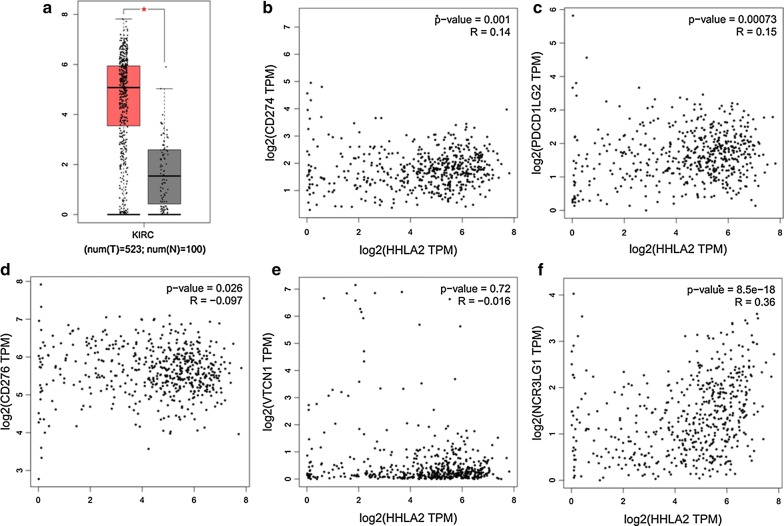
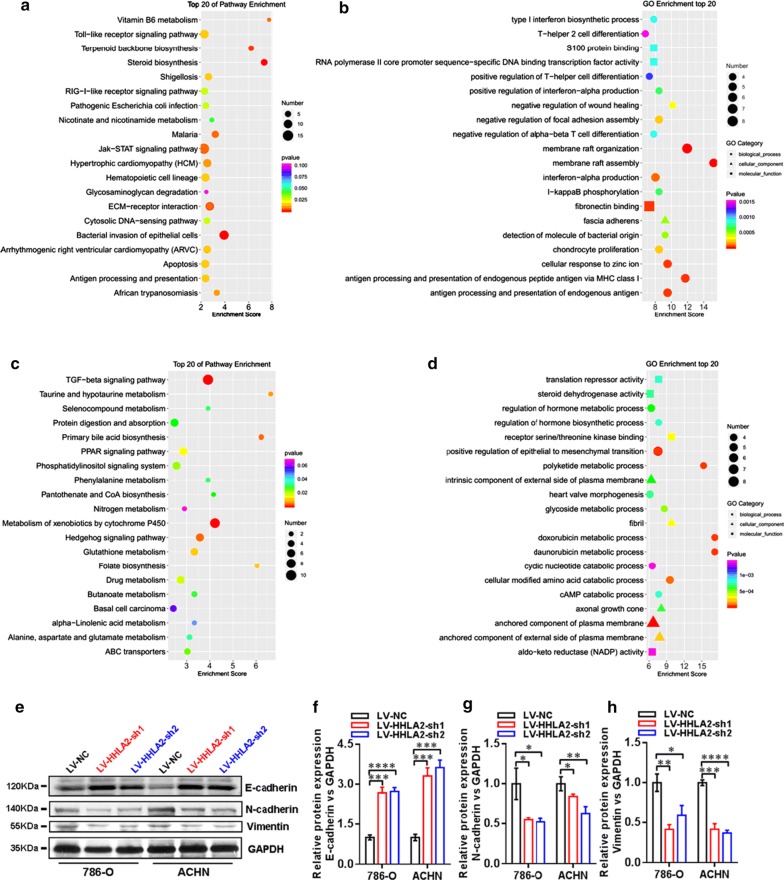
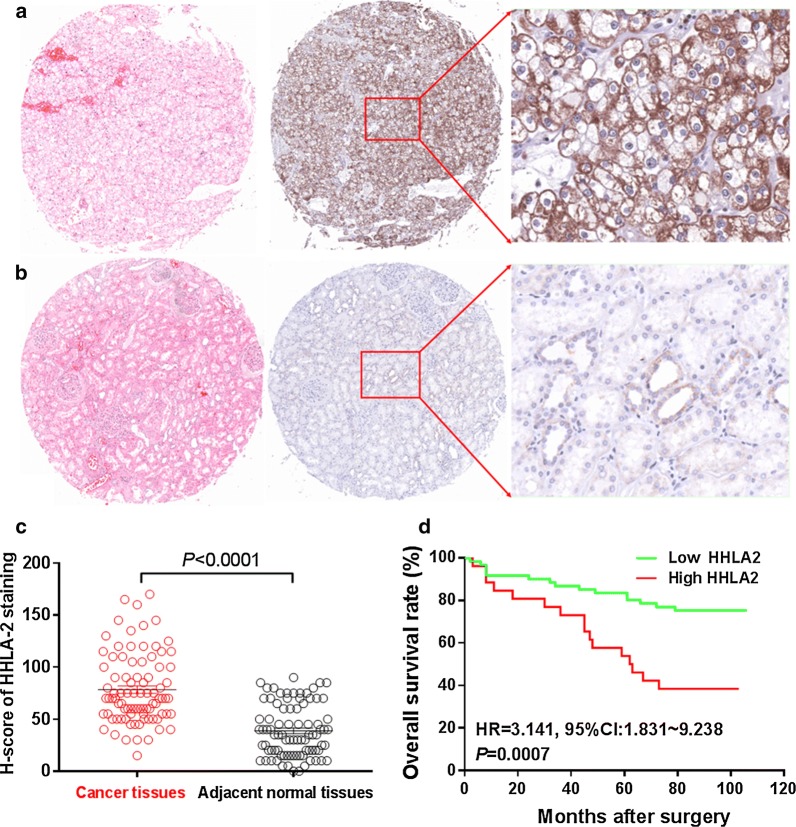
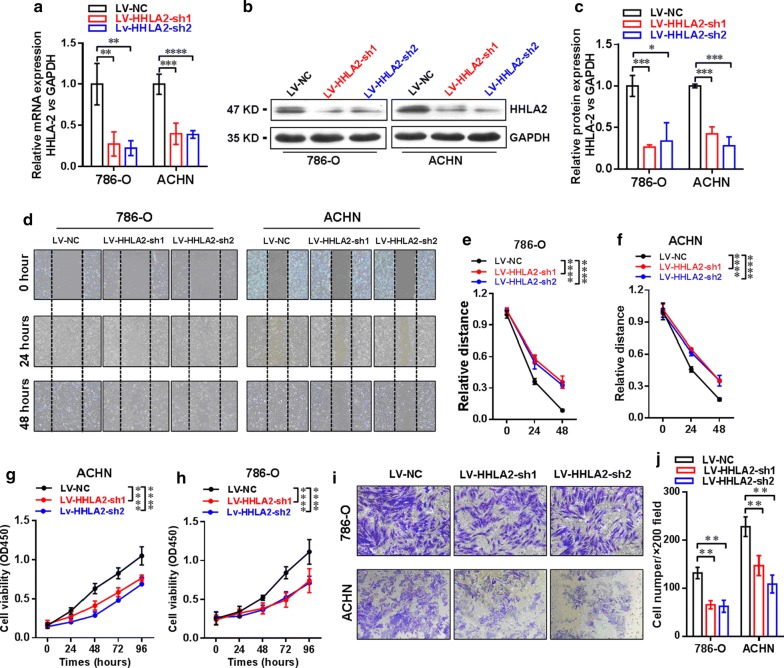
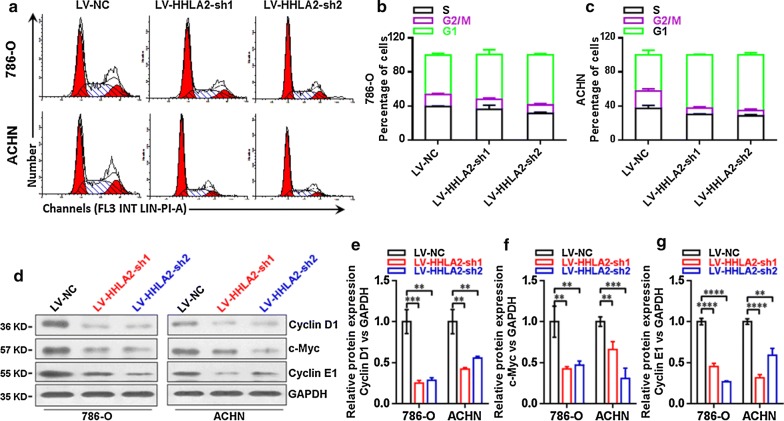
We found that higher HHLA2 mRNA expression level in human ccRCC tissues compared with that in adjacent normal tissues based on TCGA data, and the HHLA2 expression at mRNA level was positively and significantly correlated with PD-L1, PD-L2, B7-H6, but negatively and significantly correlated with B7-H3. Moreover, our immunohistochemistry study showed that the staining intensity of HHLA2 in human ccRCC tissues was significantly higher than that in the adjacent normal tissues, and the overall survival rate of ccRCC patients with higher HHLA2 expression was significantly poorer than that of the patients with lower HHLA2 expression. Higher expression of HHLA2 in ccRCC tissues was positively and significantly associated with larger tumor size and advanced TNM stage. The COX model revealed that the parameters including patient's age, TNM stage and HHLA2 expression level could be used as the independent risk factors respectively for the prognostic prediction of the patients. Our cellular study showed that upon knockdown of HHLA2 expression in human ccRCC cell lines, the cell viability, the migration and the invasion ability were significantly inhibited, while the cell cycle arrest at G1 phase was induced and the expressions of Cyclin D1, c-Myc and Cyclin E1 were decreased. In addition, according to the microarray data, the expressions of epithelia-to-mesenchymal transition markers, such as E-cadherin, N-cadherin and Vimentin, were significantly changed after knockdown of HHLA2 expression.
Our findings indicated that HHLA2 was involved in the progression of human ccRCC and could be used as an important prognostic predictor for this malignancy.
众所周知,人类透明细胞肾细胞癌(ccRCC)是一种具有高度免疫原性且对化疗耐药的肿瘤。最近,新出现的数据表明免疫检查点阻断疗法是ccRCC治疗中的一项重要突破。HHLA2是B7家族最近报道的成员,仅在人类中独特表达,在小鼠中不表达,并且在CD4和CD8 T细胞的功能抑制中起重要作用。在此,我们旨在研究HHLA2表达在人类ccRCC中的临床意义及其在癌细胞生物学功能中的潜在调节作用。
在本研究中,我们检测了HHLA2在人类ccRCC组织中的表达,并分析了其临床意义及预后价值。对人类ccRCC细胞系ACHN和786 - O进行HHLA2干预,并分析其对细胞功能的影响。我们还通过基因芯片分析鉴定了ccRCC细胞系中HHLA2敲低后差异表达的基因。
基于TCGA数据,我们发现人类ccRCC组织中HHLA2 mRNA表达水平高于相邻正常组织,且mRNA水平的HHLA2表达与PD - L1、PD - L2、B7 - H6呈正相关且显著相关,但与B7 - H3呈负相关且显著相关。此外,我们的免疫组织化学研究表明,HHLA2在人类ccRCC组织中的染色强度显著高于相邻正常组织,HHLA2表达较高的ccRCC患者的总生存率显著低于HHLA2表达较低的患者。ccRCC组织中HHLA2的高表达与更大的肿瘤大小和更高的TNM分期呈正相关且显著相关。COX模型显示,包括患者年龄、TNM分期和HHLA2表达水平等参数可分别作为患者预后预测的独立危险因素。我们的细胞研究表明,在人类ccRCC细胞系中敲低HHLA2表达后,细胞活力、迁移和侵袭能力显著受到抑制,同时诱导细胞周期停滞在G1期,且细胞周期蛋白D1、c - Myc和细胞周期蛋白E1的表达降低。此外,根据芯片数据,HHLA2表达敲低后,上皮 - 间质转化标志物如E - 钙黏蛋白、N - 钙黏蛋白和波形蛋白的表达发生了显著变化。
我们的研究结果表明,HHLA2参与了人类ccRCC的进展,可作为该恶性肿瘤的重要预后预测指标。