Gollasch Benjamin, Dogan Inci, Rothe Michael, Gollasch Maik, Luft Friedrich C
Experimental and Clinical Research Center (ECRC), A Joint Institution of the Charité Medical Faculty and Max Delbrück Center (MDC) for Molecular Medicine, Berlin, Germany.
HELIOS Klinikum Berlin-Buch, Berlin, Germany.
Physiol Rep. 2019 Apr;7(8):e14040. doi: 10.14814/phy2.14040.
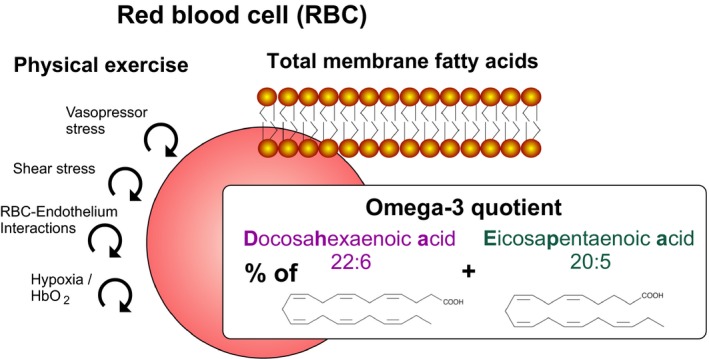
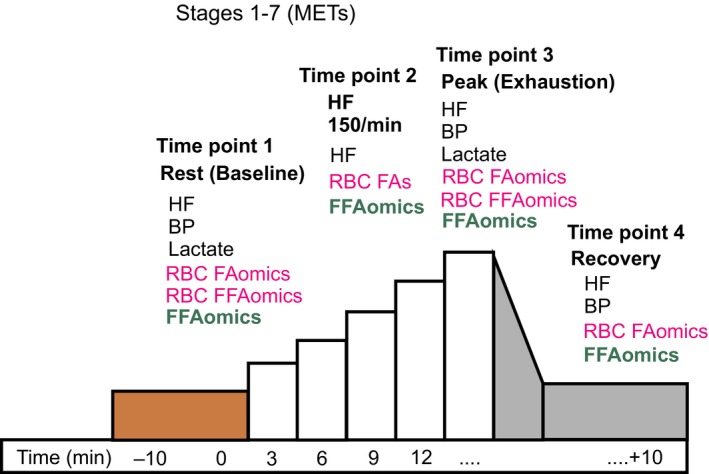
Omega-3 fatty acids have long been ascribed a positive cardiovascular function. However, the plasma measurements invariably ignore 40% of the blood specimen, cells that engage in continuous exchange with their environment. In our study, we included all components of the circulating blood. Erythrocyte or red-blood-cell (RBC) n-3 fatty acid status has been linked to cardiovascular disease and death. A low omega-3 index is an independent risk factor for cardiovascular disease and mortality. We tested the hypothesis that acute, maximal exercise would influence the relationship between RBC and serum fatty acids. RBC fatty acids profiling was achieved using targeted HPLC-MS mass spectrometry. Healthy volunteers performed maximal treadmill exercise testing using the modified Bruce protocol. Central hemodynamics were monitored and maximal workload was assessed in metabolic equivalents (METs). Venous blood was obtained for RBC lipidomics. With the incremental exercise test, no fatty acid-level variations were found in RBCs, while heart rate and arterial blood pressure increased significantly. No changes occurred in the omega-3 quotient, namely the percentage of eicosapentaenoic acid and docosahexaenoic acid in RBC fatty acids in the RBC membrane. Nonetheless, maximal (13.50 ± 1.97 METs) exercise intensity led to a decrease of RBC lauric acid (C12:0) in the recovery period. These data suggest that despite significant hemodynamic effects, short-term maximal exercise is insufficient to alter RBC n-3 and other fatty-acid status, including the omega-3 quotient, in healthy individuals. RBC lauric acid deserves further scrutiny as a potential regulator of cardiovascular and metabolic functions.
长期以来,ω-3脂肪酸一直被认为具有积极的心血管功能。然而,血浆检测总是忽略了40%的血液样本,即那些与周围环境持续进行物质交换的细胞。在我们的研究中,我们纳入了循环血液的所有成分。红细胞(RBC)的n-3脂肪酸状态与心血管疾病和死亡有关。低ω-3指数是心血管疾病和死亡率的独立危险因素。我们检验了这样一个假设:急性、最大强度运动将影响红细胞与血清脂肪酸之间的关系。红细胞脂肪酸谱分析采用靶向高效液相色谱-质谱联用技术完成。健康志愿者使用改良的布鲁斯方案进行最大强度跑步机运动测试。监测中心血流动力学,并以代谢当量(METs)评估最大工作量。采集静脉血用于红细胞脂质组学分析。在递增运动试验中,未发现红细胞中脂肪酸水平有变化,而心率和动脉血压显著升高。红细胞膜中红细胞脂肪酸中二十碳五烯酸和二十二碳六烯酸的百分比,即ω-3商数,没有变化。尽管如此,最大强度(13.50±1.97 METs)运动强度导致恢复期红细胞月桂酸(C12:0)减少。这些数据表明,尽管有显著的血流动力学效应,但短期最大强度运动不足以改变健康个体红细胞的n-3及其他脂肪酸状态,包括ω-3商数。红细胞月桂酸作为心血管和代谢功能的潜在调节因子值得进一步研究。