Gollasch Benjamin, Wu Guanlin, Liu Tong, Dogan Inci, Rothe Michael, Gollasch Maik, Luft Friedrich C
Experimental and Clinical Research Center (ECRC), A Joint Institution Between the Charité University Medicine and Max Delbrück Center (MDC) for Molecular Medicine, Berlin-Buch, Germany.
HELIOS Klinikum Berlin-Buch, Berlin, Germany.
Physiol Rep. 2020 Oct;8(20):e14601. doi: 10.14814/phy2.14601.
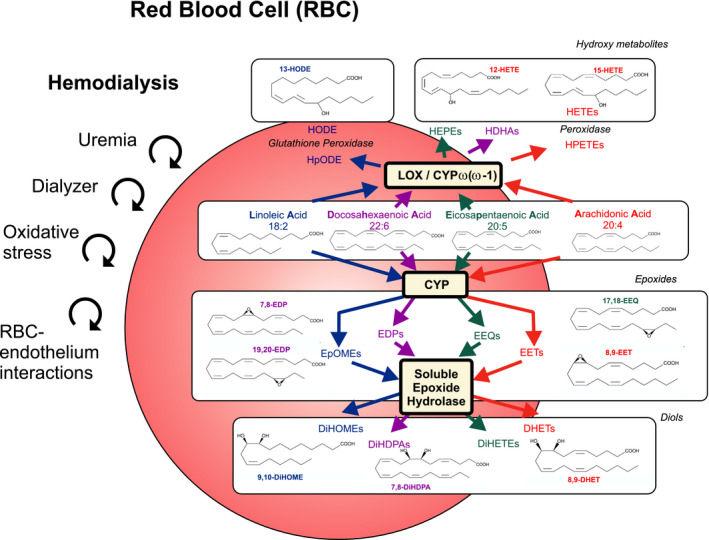
Fatty acid products derived from cytochromes P450 (CYP) monooxygenase and lipoxygenase (LOX)/CYP ω/(ω-1)-hydroxylase pathways are a superclass of lipid mediators with potent bioactivities. Whether or not the chronic kidney disease (CKD) and hemodialysis treatments performed on end-stage renal disease (ESRD) patients affect RBC epoxy fatty acids profiles remains unknown. Measuring the products solely in plasma is suboptimal. Since such determinations invariably ignore red blood cells (RBCs) that make up 3 kg of the circulating blood. RBCs are potential reservoirs for epoxy fatty acids that regulate cardiovascular function. We studied 15 healthy persons and 15 ESRD patients undergoing regular hemodialysis treatments. We measured epoxides derived from CYP monooxygenase and metabolites derived from LOX/CYP ω/(ω-1)-hydroxylase pathways in RBCs by LC-MS/MS tandem mass spectrometry. Our data demonstrate that various CYP epoxides and LOX/CYP ω/(ω-1)-hydroxylase products are increased in RBCs of ESRD patients, compared to control subjects, including dihydroxyeicosatrienoic acids (DHETs), epoxyeicosatetraenoic acids (EEQs), dihydroxydocosapentaenoic acids (DiHDPAs), and hydroxyeicosatetraenoic acids (HETEs). Hemodialysis treatment did not affect the majority of those metabolites. Nevertheless, we detected more pronounced changes in free metabolite levels in RBCs after dialysis, as compared with the total RBC compartment. These findings indicate that free RBC eicosanoids should be considered more dynamic or vulnerable in CKD.
细胞色素P450(CYP)单加氧酶和脂氧合酶(LOX)/CYP ω/(ω-1)-羟化酶途径衍生的脂肪酸产物是一类具有强大生物活性的脂质介质。终末期肾病(ESRD)患者所进行的慢性肾病(CKD)和血液透析治疗是否会影响红细胞环氧脂肪酸谱仍不清楚。仅在血浆中测量这些产物并不理想。因为这样的测定总是忽略了构成3千克循环血液的红细胞(RBC)。红细胞是调节心血管功能的环氧脂肪酸的潜在储存库。我们研究了15名健康人和15名接受定期血液透析治疗的ESRD患者。我们通过液相色谱-串联质谱法(LC-MS/MS)测量了红细胞中CYP单加氧酶衍生的环氧化物和LOX/CYP ω/(ω-1)-羟化酶途径衍生的代谢产物。我们的数据表明,与对照组相比,ESRD患者红细胞中各种CYP环氧化物和LOX/CYP ω/(ω-1)-羟化酶产物增加,包括二羟基二十碳三烯酸(DHETs)、环氧二十碳四烯酸(EEQs)、二羟基二十二碳五烯酸(DiHDPAs)和羟基二十碳四烯酸(HETEs)。血液透析治疗并未影响这些代谢产物中的大多数。然而,与红细胞总体部分相比,我们在透析后检测到红细胞中游离代谢产物水平有更明显的变化。这些发现表明,在慢性肾病中,游离红细胞类花生酸应被认为更具动态性或更易受影响。