Kim Jin Ho, Oh Jaewon, Kim Min Ji, Kim In Cheol, Uhm Jae Sun, Pak Hui Nam, Kang Seok Min
Division of Cardiology, Severance Cardiovascular Hospital, Cardiovascular Research Institute, Yonsei University College of Medicine, Seoul, Korea.
Departement of Cardiology, Konkuk University School of Medicine, Chungju, Korea.
Yonsei Med J. 2019 May;60(5):423-428. doi: 10.3349/ymj.2019.60.5.423.
We aimed to examine associations between right bundle branch block (RBBB) following heart transplantation (HT) and graft rejection.
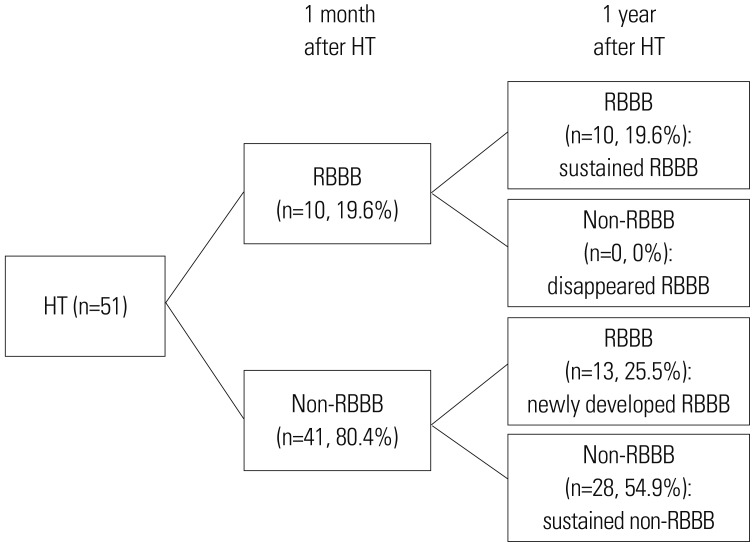
We investigated 51 patients who underwent endomyocardial biopsies, electrocardiogram, right-side cardiac catheterization, and echocardiography at 1 month and 1 year after HT. We classified patients into four groups according to the development of RBBB, based on electrocardiogram at 1 month and 1 year: 1) sustained RBBB, 2) disappeared RBBB, 3) newly developed RBBB, and 4) sustained non-RBBB. The RBBB was defined as an RSR' pattern in V1 with a QRS duration ≥100 ms on electrocardiogram.
The newly developed RBBB group (n=13, 25.5%) had a higher rate of new onset graft rejection (from grade 0 to grade ≥1R, 30.8% vs. 10.0% vs. 21.4%, =0.042) at 1 year, compared with sustained RBBB (n=10, 19.6%) and sustained non-RBBB group (n=28, 54.9%). In contrast, the incidence of resolved graft rejection (from grade ≥1R to grade 0) was higher in the sustained RBBB group than the newly developed RBBB and sustained non-RBBB groups (70.0% vs. 7.7% vs. 25.0%, =0.042). Left atrial volume index was significantly higher in the newly developed RBBB group than the sustained RBBB and sustained non-RBBB groups (60.6±25.9 mL/m² vs. 36.0±11.0 mL/m² vs. 38.4±18.1 mL/m², =0.003).
Close monitoring for new development of RBBB at 1 year after HT, which was associated with a higher incidence of new onset graft rejection, may be helpful to identify high risk patients for graft rejection.
我们旨在研究心脏移植(HT)后右束支传导阻滞(RBBB)与移植物排斥反应之间的关联。
我们调查了51例在HT后1个月和1年接受心内膜心肌活检、心电图、右侧心导管检查和超声心动图检查的患者。根据1个月和1年时的心电图RBBB发生情况,将患者分为四组:1)持续性RBBB,2)消失性RBBB,3)新发生的RBBB,4)持续性非RBBB。RBBB在心电图上定义为V1导联呈RSR′型且QRS时限≥100 ms。
与持续性RBBB组(n = 10,19.6%)和持续性非RBBB组(n = 28,54.9%)相比,新发生的RBBB组(n = 13,25.5%)在1年时新发移植物排斥反应的发生率更高(从0级到≥1R级,30.8%对10.0%对21.4%,P = 0.042)。相反,持续性RBBB组移植物排斥反应缓解(从≥1R级到0级)的发生率高于新发生的RBBB组和持续性非RBBB组(70.0%对7.7%对25.0%,P = 0.042)。新发生的RBBB组的左心房容积指数显著高于持续性RBBB组和持续性非RBBB组(60.6±25.9 mL/m²对36.0±11.0 mL/m²对38.4±18.1 mL/m²,P = 0.003)。
HT后1年密切监测RBBB的新发生情况,其与新发移植物排斥反应的较高发生率相关,可能有助于识别移植物排斥反应的高危患者。