Department of Medicine, Division of Cardiovascular Medicine, Vanderbilt University Medical Center, Nashville, TN, USA.
Department of Cell and Developmental Biology, Vanderbilt University, Nashville, TN, USA.
Sci Rep. 2019 Apr 24;9(1):6362. doi: 10.1038/s41598-019-42945-w.
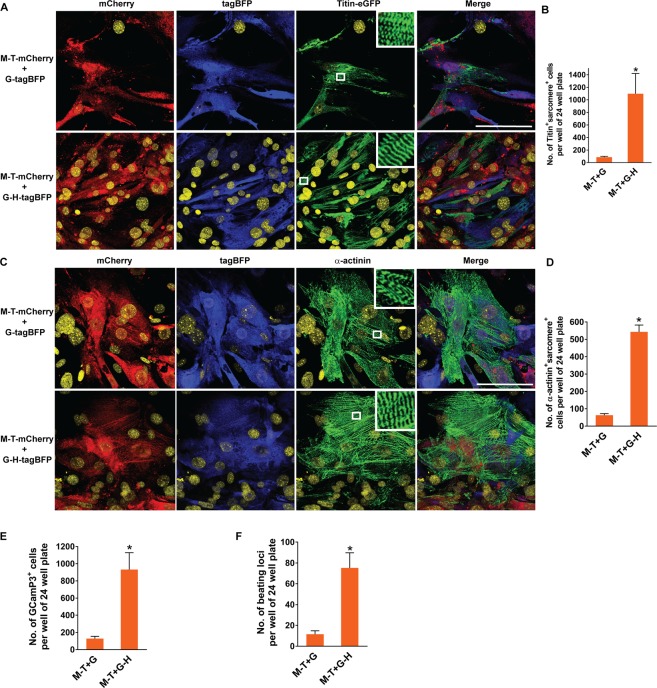
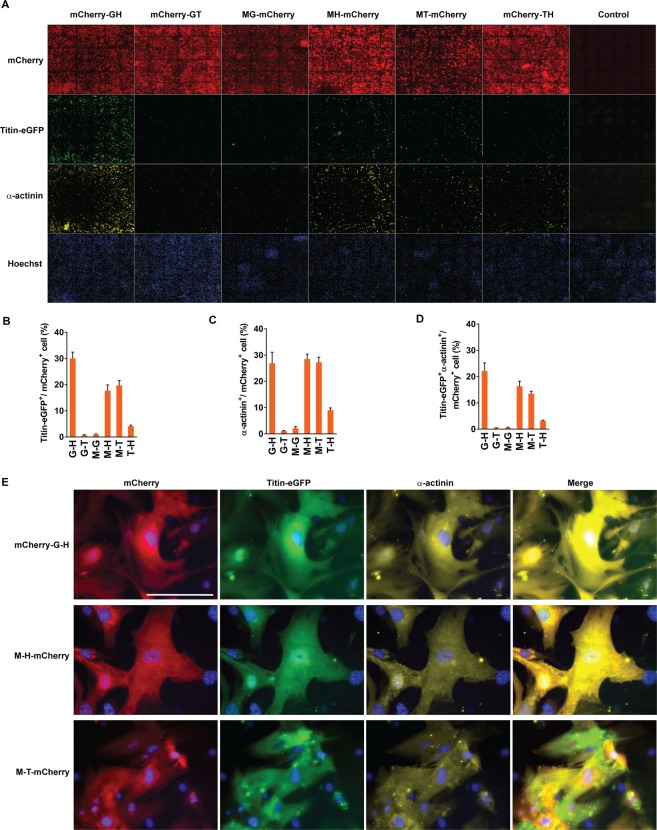
Previous studies have shown that forced expression of core cardiogenic transcription factors can directly reprogram fibroblasts to induced cardiomyocyte-like cells (iCMs). This cardiac reprogramming approach suggests a potential strategy for cardiomyocyte regeneration. However, a major challenge of this approach remains the low conversion rate. Here, we showed that ensuring expression of four cardiogenic transcription factors (i.e. Gata4 (G), Hand2 (H), Mef2c (M), and Tbx5 (T)) in individual fibroblasts is an initial bottleneck for cardiac reprogramming. Following co-transduction of three or four retroviral vectors encoding individual cardiogenic transcription factors, only a minor subpopulation of cells indeed expressed all three (GMT) or four (GHMT) factors. By selectively analyzing subpopulations of cells expressing various combinations of reprogramming factors, we found that co-expression of GMT in individual fibroblasts is sufficient to induce sarcomeric proteins. However, only a small fraction of those cells expressing GMT were able to develop organized sarcomeric structures and contractility. In contrast, ensuring expression of GHMT markedly enhanced the development of contractile cardiac structures and functions in fibroblasts, although its incremental effect on sarcomeric protein induction was relatively small. Our findings provide new insights into the mechanistic basis of inefficient cardiac reprogramming and can help to devise efficient reprogramming strategies.
先前的研究表明,强制表达核心心脏发生转录因子可以直接将成纤维细胞重编程为诱导心肌细胞样细胞(iCMs)。这种心脏重编程方法为心肌细胞再生提供了一种潜在策略。然而,这种方法的一个主要挑战仍然是转化率低。在这里,我们表明,确保单个成纤维细胞中表达四种心脏发生转录因子(即 Gata4(G)、Hand2(H)、Mef2c(M)和 Tbx5(T))是心脏重编程的初始瓶颈。在用三个或四个编码单个心脏发生转录因子的逆转录病毒载体共转导后,只有一小部分细胞确实表达了所有三个(GMT)或四个(GHMT)因子。通过选择性分析表达各种重编程因子组合的细胞亚群,我们发现单个成纤维细胞中 GMT 的共表达足以诱导肌节蛋白。然而,只有一小部分表达 GMT 的细胞能够形成有组织的肌节结构和收缩性。相比之下,确保 GHMT 的表达显著增强了成纤维细胞中收缩性心脏结构和功能的发育,尽管其对肌节蛋白诱导的增量效应相对较小。我们的发现为低效心脏重编程的机制基础提供了新的见解,并有助于设计有效的重编程策略。