1 Division of Cardiovascular Medicine Chang Gung Memorial Hospital Linkou Medical Center Taoyuan Taiwan.
4 College of Medicine Chang Gung University Taoyuan Taiwan.
J Am Heart Assoc. 2019 May 7;8(9):e012029. doi: 10.1161/JAHA.119.012029.
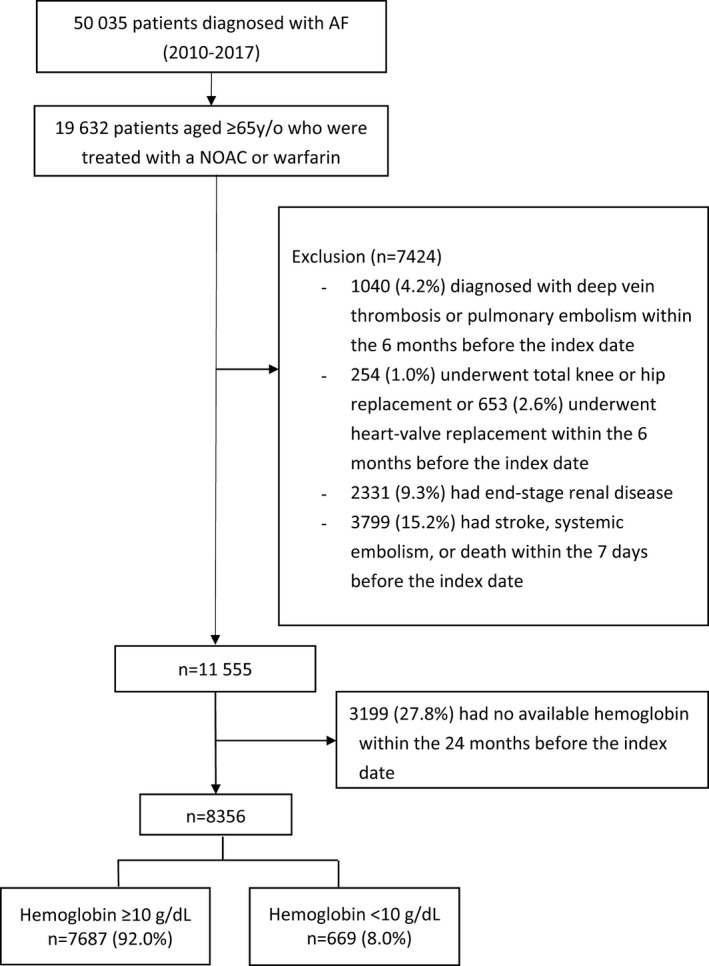
Background Major randomized trials assessing non-vitamin K antagonist oral anticoagulants ( NOAC s) for stroke prevention in atrial fibrillation generally excluded patients with hemoglobin <10 g/dL. This study evaluated the safety and effectiveness of NOAC s in patients with atrial fibrillation and anemia. Methods and Results A cohort study based on electronic medical records was conducted from 2010 to 2017 at a multicenter healthcare provider in Taiwan. It included 8356 patients with atrial fibrillation who had received oral anticoagulants (age, 77.0±7.3 years; 48.0% women). Patients were classified into 2 subgroups: 7687 patients with hemoglobin ≥10 g/ dL and 669 patients with hemoglobin <10 g/ dL . A Cox regression analysis was performed to assess the risks of ischemic stroke/systemic embolism, bleeding, and death associated with NOAC versus warfarin in both subgroups, respectively. In patients with hemoglobin ≥10 g/ dL , NOAC (n=4793) was associated with significantly lower risks of ischemic stroke/systemic embolism, major bleeding, and gastrointestinal tract bleeding than warfarin (n=2894); there was no difference in the risk of death. In patients with hemoglobin <10 g/ dL , NOAC (n=390) was associated with significantly lower risks of major bleeding (adjusted hazard ratio, 0.43; 95% CI, 0.30-0.62) and gastrointestinal tract bleeding than warfarin (n=279), but there was no difference in the risk of ischemic stroke/systemic embolism (adjusted hazard ratio, 0.79; 95% CI , 0.53-1.17) or death. Subgroup analyses suggested that NOAC was associated with fewer bleeding events, irrespective of cancer or peptic ulcer disease history. Conclusions In patients with atrial fibrillation with hemoglobin <10 g/ dL , NOAC was associated with lower bleeding risks than warfarin, with no difference in the risk of ischemic stroke/systemic embolism or death.
评估非维生素 K 拮抗剂口服抗凝剂(NOAC)用于预防心房颤动中风的主要随机试验一般排除血红蛋白<10 g/dL 的患者。本研究评估了心房颤动伴贫血患者使用 NOAC 的安全性和有效性。
本研究是一项基于电子病历的队列研究,于 2010 年至 2017 年在台湾的一家多中心医疗机构进行。共纳入 8356 例接受口服抗凝剂治疗的心房颤动患者(年龄 77.0±7.3 岁;48.0%为女性)。患者分为 2 个亚组:血红蛋白≥10 g/dL 的 7687 例患者和血红蛋白<10 g/dL 的 669 例患者。采用 Cox 回归分析分别评估两个亚组中 NOAC 与华法林相关的缺血性卒中/全身性栓塞、出血和死亡风险。在血红蛋白≥10 g/dL 的患者中,NOAC(n=4793)与华法林(n=2894)相比,缺血性卒中/全身性栓塞、大出血和胃肠道出血风险显著降低;两组死亡风险无差异。在血红蛋白<10 g/dL 的患者中,NOAC(n=390)与华法林(n=279)相比,大出血(校正风险比,0.43;95%CI,0.30-0.62)和胃肠道出血风险显著降低,但缺血性卒中/全身性栓塞风险无差异(校正风险比,0.79;95%CI,0.53-1.17)或死亡风险。亚组分析提示,不论是否合并癌症或消化性溃疡病史,NOAC 与出血事件减少相关。
在血红蛋白<10 g/dL 的心房颤动患者中,NOAC 与华法林相比,出血风险更低,缺血性卒中/全身性栓塞或死亡风险无差异。