Cincinnati Children's Hospital Medical Center, University of Cincinnati, Cincinnati, Ohio.
Seattle Children's Hospital, Seattle, Washington.
Arthritis Care Res (Hoboken). 2019 Jun;71(6):703-716. doi: 10.1002/acr.23871. Epub 2019 Apr 25.
To develop recommendations for the screening, monitoring, and treatment of uveitis in children with juvenile idiopathic arthritis (JIA).
Pediatric rheumatologists, ophthalmologists with expertise in uveitis, patient representatives, and methodologists generated key clinical questions to be addressed by this guideline. This was followed by a systematic literature review and rating of the available evidence according to the GRADE (Grading of Recommendations Assessment, Development and Evaluation) methodology. A group consensus process was used to compose the final recommendations and grade their strength as conditional or strong.
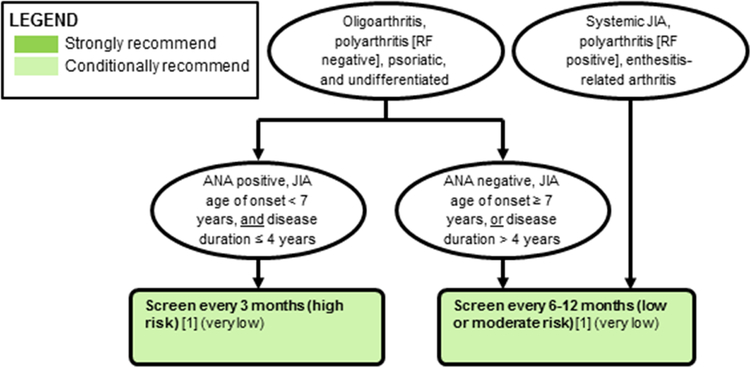
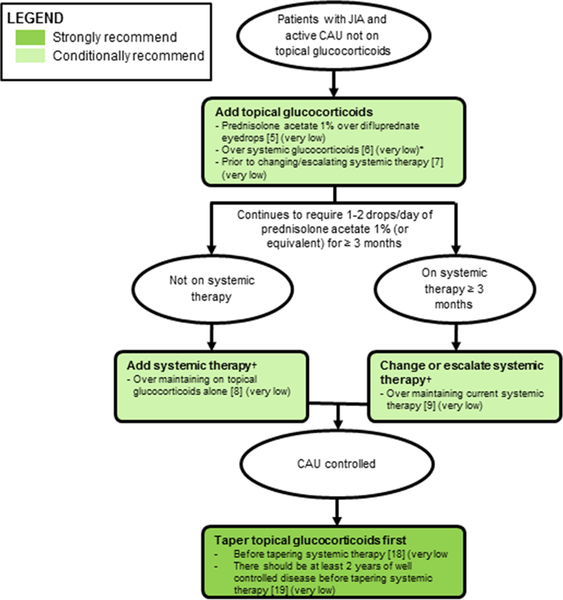
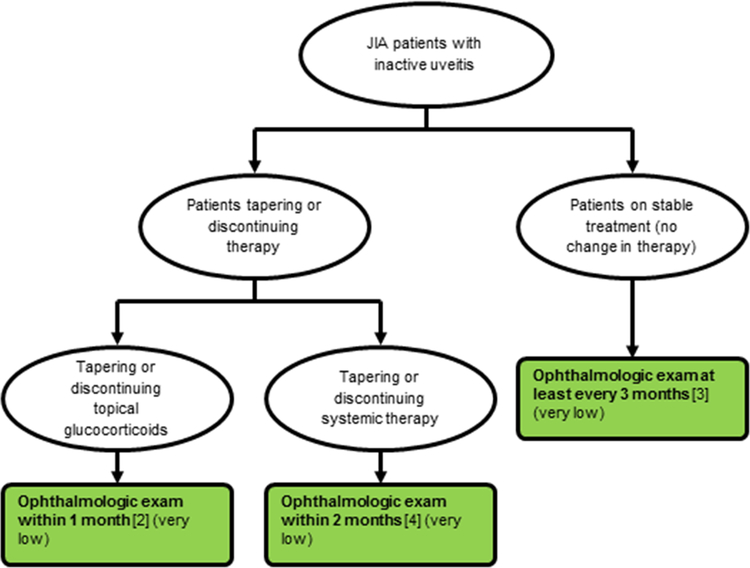
Due to a lack of literature with good quality of evidence, recommendations were formulated on the basis of available evidence and a consensus expert opinion. Regular ophthalmic screening of children with JIA is recommended because of the risk of uveitis, and the frequency of screening should be based on individual risk factors. Regular ophthalmic monitoring of children with uveitis is recommended, and intervals should be based on ocular examination findings and treatment regimen. Ophthalmic monitoring recommendations were strong primarily because of concerns of vision-threatening complications of uveitis with infrequent monitoring. Topical glucocorticoids should be used as initial treatment to achieve control of inflammation. Methotrexate and the monoclonal antibody tumor necrosis factor inhibitors adalimumab and infliximab are recommended when systemic treatment is needed for the management of uveitis. The timely addition of nonbiologic and biologic drugs is recommended to maintain uveitis control in children who are at continued risk of vision loss.
This guideline provides direction for clinicians and patients/parents making decisions on the screening, monitoring, and management of children with JIA and uveitis, using GRADE methodology and informed by a consensus process with input from rheumatology and ophthalmology experts, current literature, and patient/parent preferences and values.
制定儿童幼年特发性关节炎(JIA)患者葡萄膜炎的筛查、监测和治疗建议。
儿科风湿病学家、擅长葡萄膜炎的眼科医生、患者代表和方法学家提出了本指南需要解决的关键临床问题。接着进行了系统的文献回顾,并根据 GRADE(推荐评估、制定与评价)方法对现有证据进行了评分。使用小组共识流程来制定最终建议,并将其强度评定为有条件或强。
由于缺乏高质量证据的文献,因此根据现有证据和专家共识意见制定了建议。建议对 JIA 患儿进行常规眼科筛查,因为存在葡萄膜炎的风险,筛查频率应基于个体危险因素。建议对患有葡萄膜炎的患儿进行常规眼科监测,监测间隔应基于眼部检查结果和治疗方案。眼科监测建议主要是因为担心葡萄膜炎的视力威胁性并发症,如果监测不频繁。建议使用局部糖皮质激素作为初始治疗,以控制炎症。当需要全身治疗来管理葡萄膜炎时,推荐使用甲氨蝶呤和单克隆抗体肿瘤坏死因子抑制剂阿达木单抗和英夫利昔单抗。建议及时添加非生物和生物药物,以维持有持续视力丧失风险的患儿的葡萄膜炎控制。
本指南使用 GRADE 方法并通过来自风湿病学和眼科专家、现有文献以及患者/家长的偏好和价值观的共识流程提供了方向,为临床医生和患者/家长在 JIA 和葡萄膜炎患儿的筛查、监测和管理方面做出决策提供了指导。