State Key Laboratory of Veterinary Biotechnology, Harbin Veterinary Research Institute of Chinese Academy of Agricultural Sciences, Harbin 150069, China.
Key Laboratory of Special Animal Epidemic Disease of Ministry of Agriculture, Institute of Special Animal and Plant Sciences, Chinese Academy of Agricultural Sciences, Changchun 130112, China.
Viruses. 2019 Apr 24;11(4):380. doi: 10.3390/v11040380.
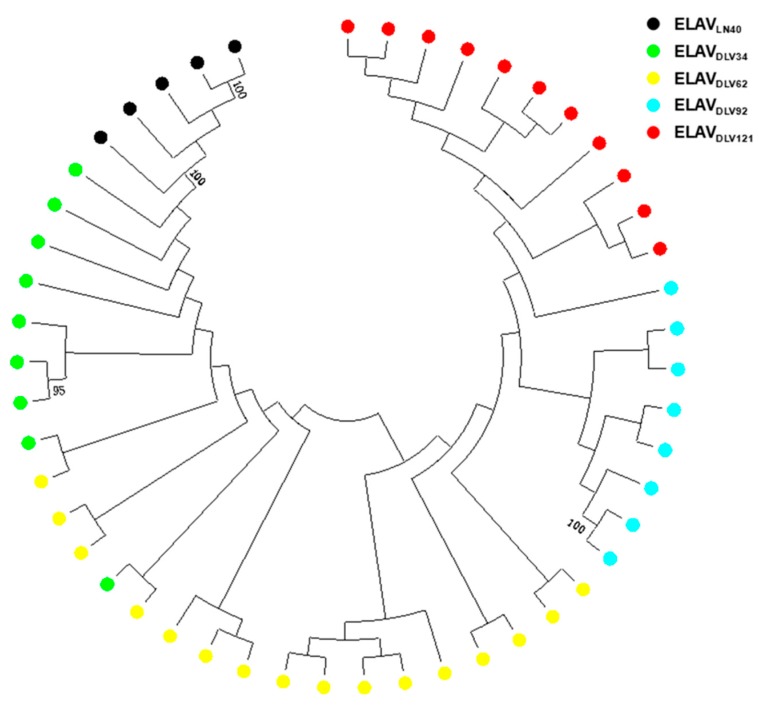
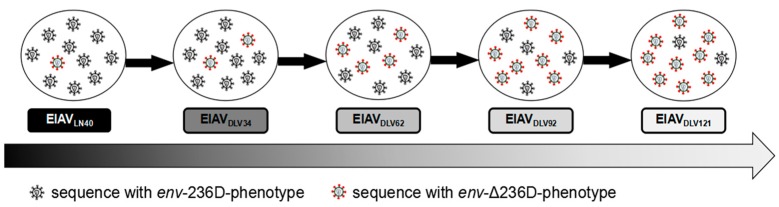
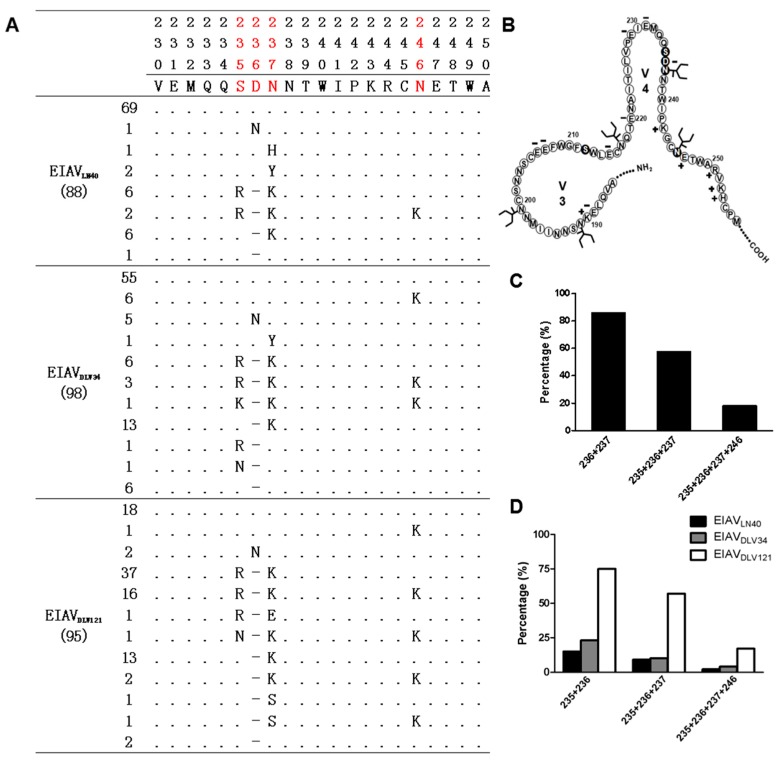
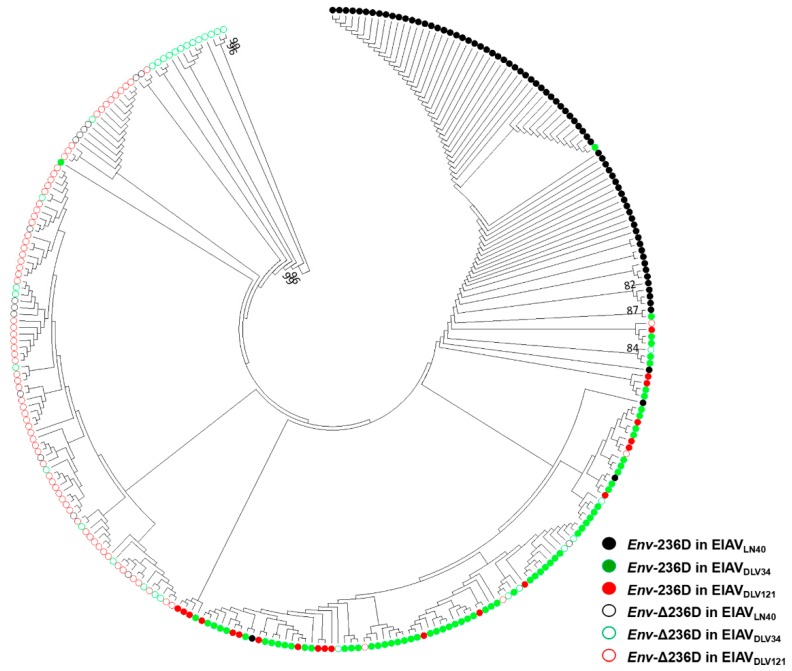
As the only widely used live lentiviral vaccine, the equine infectious anima virus (EIAV) attenuated vaccine was developed by in vitro passaging of a virulent strain for 121 generations. In our previous study, we observed that the attenuated vaccine was gradually selected under increased environmental pressure at the population level (termed a quasispecies). To further elucidate the potential correlation between viral quasispecies evolution and pathogenesis, a systematic study was performed by sequencing using several methods. Some key mutations were identified within Env, and we observed that increased percentages of these mutations were accompanied by an increased passage number and attenuated virulence. Phylogenetic analysis revealed that mutations related to the loss of virulence might have occurred evolutionarily. Among these mutations, deletion of amino acid 236 in the V4 region of Env resulted in the loss of one N-glycosylation site that was crucial for virulence. Notably, the 236-deleted sequence represented a "vaccine-specific" mutation that was also found in wild EIAV strains based on single genome amplification (SGA) analysis. Therefore, our results suggest that the EIAV attenuated vaccine may originate from a branch of quasispecies of EIAV. Generally, the presented results may increase our understanding of the attenuation mechanism of the EIAV vaccine and provide more information about the evolution of other lentiviruses.
作为唯一广泛使用的活的慢病毒疫苗,马传染性贫血病毒(EIAV)减毒疫苗是通过在体外对毒力株进行 121 代传代而开发的。在我们之前的研究中,我们观察到减毒疫苗在种群水平上逐渐受到环境压力的选择(称为准种)。为了进一步阐明病毒准种进化与发病机制之间的潜在相关性,我们使用多种方法进行了系统的测序研究。在Env 中鉴定到了一些关键突变,我们观察到这些突变的百分比增加伴随着传代次数的增加和毒力的减弱。系统发育分析表明,与毒力丧失相关的突变可能是进化而来的。在这些突变中,Env 中 V4 区氨基酸 236 的缺失导致一个对毒力至关重要的 N-糖基化位点的丢失。值得注意的是,236 缺失序列代表了一种“疫苗特异性”突变,基于单基因组扩增(SGA)分析,也在野生 EIAV 株中发现。因此,我们的结果表明,EIAV 减毒疫苗可能源自 EIAV 准种的一个分支。总的来说,所呈现的结果可能会增加我们对 EIAV 疫苗减毒机制的理解,并提供有关其他慢病毒进化的更多信息。