Departments of Mathematics, University of York, York YO10 5DD, UK.
Department of Biology, University of York, York YO10 5DD, UK.
Viruses. 2017 Nov 17;9(11):347. doi: 10.3390/v9110347.
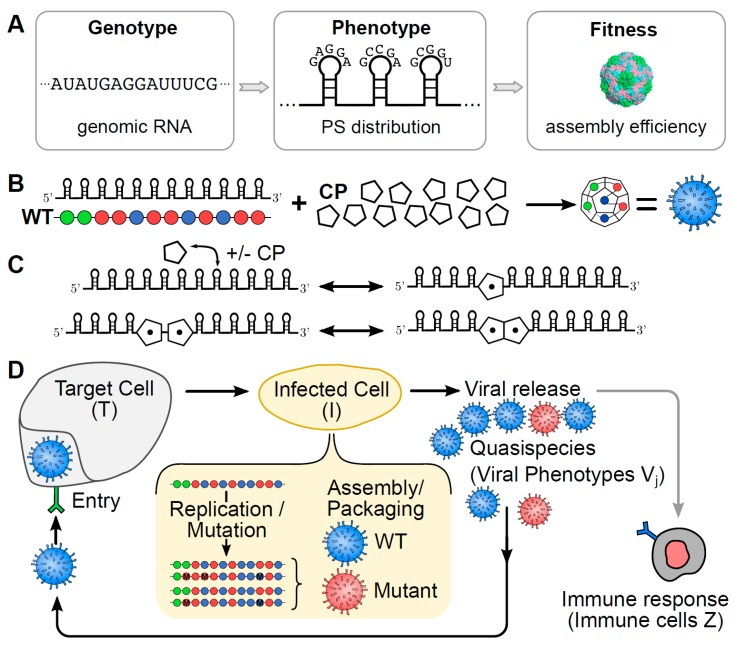
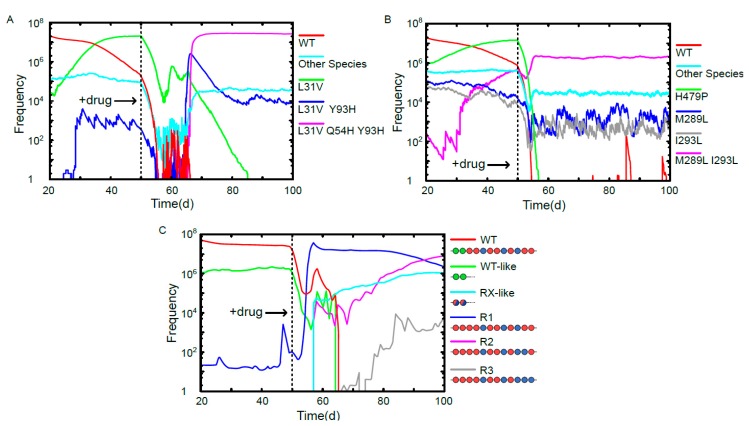
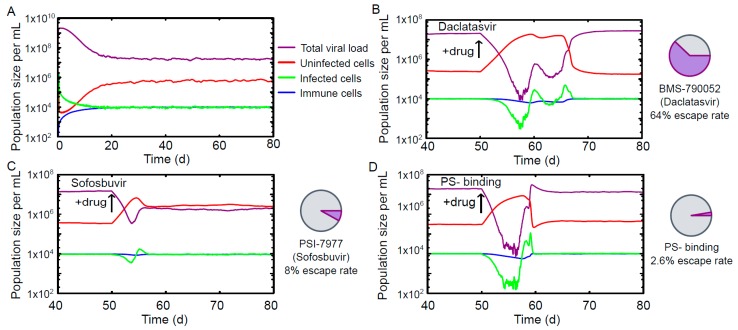
The rapid occurrence of therapy-resistant mutant strains provides a challenge for anti-viral therapy. An ideal drug target would be a highly conserved molecular feature in the viral life cycle, such as the packaging signals in the genomes of RNA viruses that encode an instruction manual for their efficient assembly. The ubiquity of this assembly code in RNA viruses, including major human pathogens, suggests that it confers selective advantages. However, their impact on viral evolution cannot be assessed in current models of viral infection that lack molecular details of virus assembly. We introduce here a quasispecies-based model of a viral infection that incorporates structural and mechanistic knowledge of packaging signal function in assembly to construct a phenotype-fitness map, capturing the impact of this RNA code on assembly yield and efficiency. Details of viral replication and assembly inside an infected host cell are coupled with a population model of a viral infection, allowing the occurrence of therapy resistance to be assessed in response to drugs inhibiting packaging signal recognition. Stochastic simulations of viral quasispecies evolution in chronic HCV infection under drug action and/or immune clearance reveal that drugs targeting all RNA signals in the assembly code collectively have a high barrier to drug resistance, even though each packaging signal in isolation has a lower barrier than conventional drugs. This suggests that drugs targeting the RNA signals in the assembly code could be promising routes for exploitation in anti-viral drug design.
治疗耐药突变株的迅速出现给抗病毒治疗带来了挑战。理想的药物靶点应该是病毒生命周期中高度保守的分子特征,例如 RNA 病毒基因组中的包装信号,这些信号为其高效组装提供了指令手册。这种组装密码在 RNA 病毒中的普遍性,包括主要的人类病原体,表明它赋予了选择性优势。然而,在缺乏病毒组装分子细节的当前病毒感染模型中,无法评估其对病毒进化的影响。我们在这里引入了一种基于准种的病毒感染模型,该模型结合了包装信号功能在组装中的结构和机制知识,构建了表型-适应性图谱,捕捉了这种 RNA 密码对组装产量和效率的影响。感染宿主细胞内病毒复制和组装的细节与病毒感染的种群模型相结合,允许评估在抑制包装信号识别的药物作用下出现治疗耐药的情况。在药物作用和/或免疫清除下慢性 HCV 感染中病毒准种进化的随机模拟表明,靶向组装密码中所有 RNA 信号的药物具有很高的耐药性障碍,尽管每个单独的包装信号的障碍低于传统药物。这表明,靶向组装密码中的 RNA 信号的药物可能是抗病毒药物设计中具有潜力的开发途径。