Centre for Clinical Research, Epidemiology, Modelling and Evaluation, Institute for Global Health, University College London, London, UK.
Department of Global Health and Development, London School of Hygiene and Tropical Medicine, London, UK.
BMC Public Health. 2019 Apr 25;19(1):431. doi: 10.1186/s12889-019-6757-6.
Little is known about the prevalence and correlates of intimate partner violence (IPV) among gay, bisexual and other men who have sex with men (GBMSM) in the UK. The aim of this study was to investigate the prevalence of IPV, associations of socio-economic and psychosocial factors with IPV, and the association of IPV with depression and sexual behaviour, among GBMSM in the PROUD trial of pre-exposure prophylaxis (PrEP).
PROUD enrolled 544 HIV-negative participants in England from 2012 to 2014; participants were randomised to immediate or deferred PrEP. This analysis included 436 GBMSM who had IPV data at month-12 and/or 24. Prevalence of IPV victimization and perpetration (lifetime, and in the past year) was assessed at these time-points. Generalized estimating equations were used to investigate associations with IPV, using pooled data from both time-points.
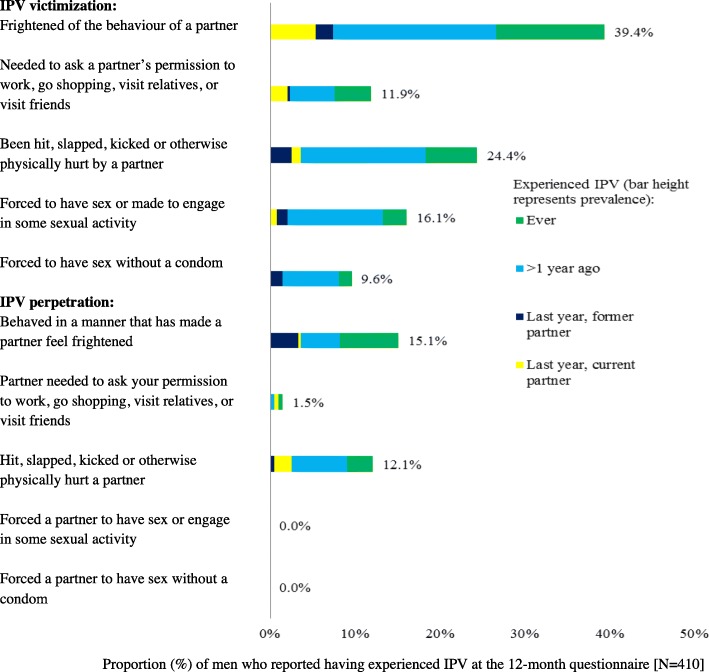
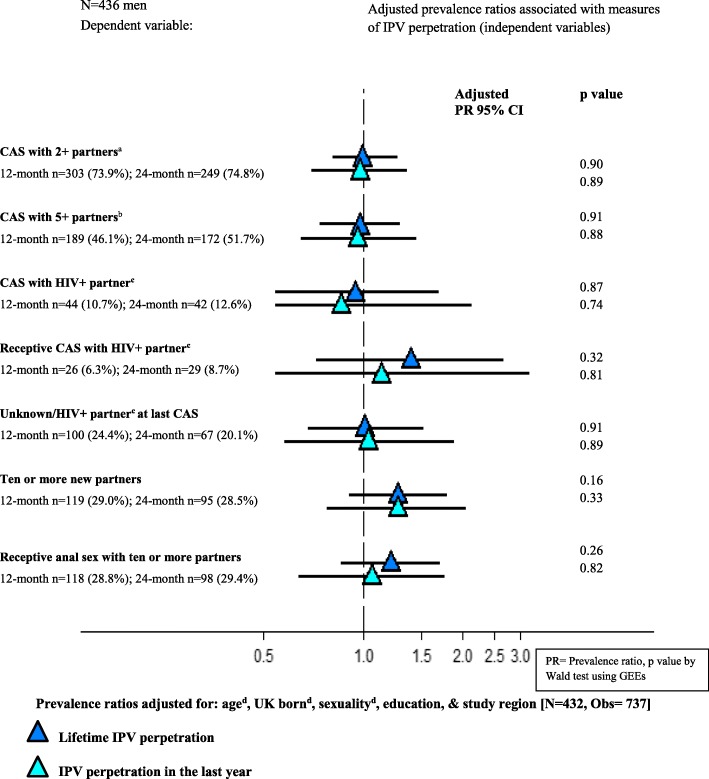
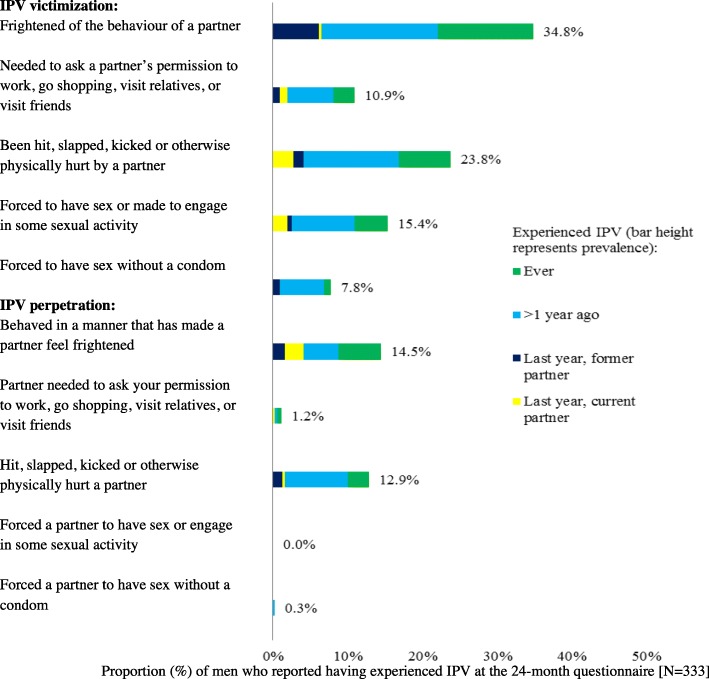
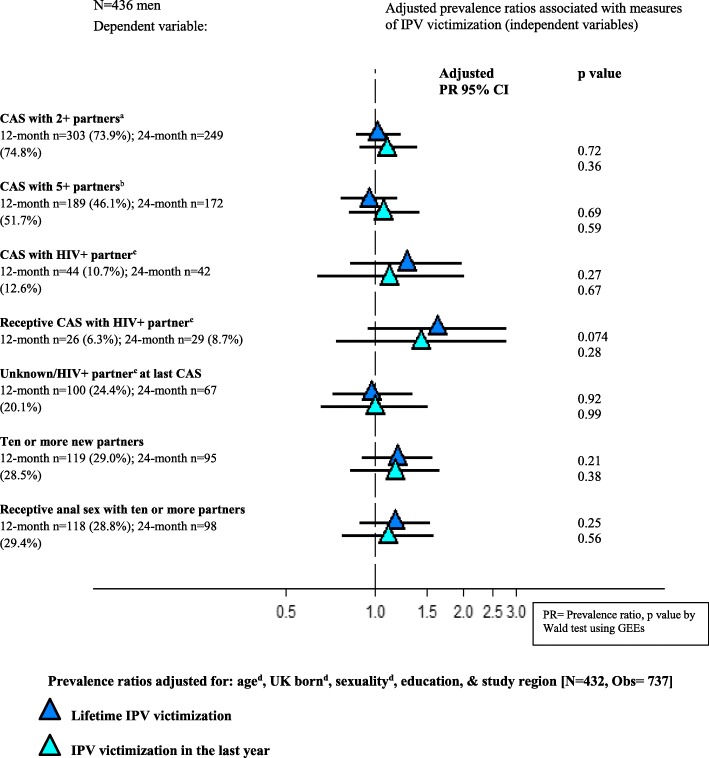
At month-12 (N = 410), 44.9% of men reported ever being a victim of IPV, 15.6% in the last year, and 19.5% reported ever perpetrating IPV, 7.8% in the last year. At month-24 (N = 333), the corresponding prevalence was 40.2 and 14.7% for lifetime and past year IPV victimization and 18.0 and 6.9% for lifetime and past year IPV perpetration. IPV prevalence did not differ by randomised arm. Men reporting internalized homophobia and sexualized drug use were more likely to report IPV. Lifetime and last year experience of IPV victimization and perpetration were strongly associated with depressive symptoms (PHQ-9 ≥ 10) (adjusted for socio-demographics: lifetime IPV victimization PR 2.57 [95% CI: 1.71, 3.86]; past year IPV victimization PR 2.93 [95% CI: 1.96, 4.40]; lifetime IPV perpetration PR 2.87 [95% CI: 1.91, 4.32]; past year IPV perpetration PR 3.47 [95% CI: 2.13, 5.64], p < 0.001 for all); IPV was not consistently associated with measures of condomless anal sex or high partner numbers.
GBMSM at high-risk of HIV who are seeking/taking PrEP may experience a high burden of IPV, which may be linked to depression. Training on awareness of and enquiry for IPV among GBMSM in sexual health clinics is recommended.
ClinicalTrials.gov identifier: NCT02065986 . Registered 19 February 2014 (retrospectively registered).
关于英国男同性恋、双性恋和其他男男性行为者(GBMSM)中亲密伴侣暴力(IPV)的流行率和相关因素知之甚少。本研究旨在调查 PROUD 试验中暴露前预防(PrEP)中 GBMSM 的 IPV 流行率、社会经济和心理社会因素与 IPV 的关联,以及 IPV 与抑郁和性行为的关联。
PROUD 于 2012 年至 2014 年期间在英格兰招募了 544 名 HIV 阴性参与者;参与者被随机分配到立即或延迟接受 PrEP。这项分析包括了在第 12 个月和/或第 24 个月时具有 IPV 数据的 436 名 GBMSM。在这两个时间点评估了 IPV 受害和施暴(终生和过去一年)的发生率。使用来自两个时间点的 pooled 数据,使用广义估计方程调查与 IPV 的关联。
在第 12 个月(N=410)时,44.9%的男性报告曾遭受过 IPV 伤害,15.6%是在过去一年,19.5%报告曾实施过 IPV,7.8%是在过去一年。在第 24 个月(N=333),相应的终生和过去一年 IPV 受害率分别为 40.2%和 14.7%,而终生和过去一年 IPV 施暴率分别为 18.0%和 6.9%。IPV 的流行率与随机分组臂无关。报告内化恐同和性化药物使用的男性更有可能报告 IPV。终生和过去一年的 IPV 受害和施暴经历与抑郁症状(PHQ-9≥10)强烈相关(调整社会人口统计学因素后:终生 IPV 受害的 PR 2.57 [95%CI:1.71, 3.86];过去一年 IPV 受害的 PR 2.93 [95%CI:1.96, 4.40];终生 IPV 施暴的 PR 2.87 [95%CI:1.91, 4.32];过去一年 IPV 施暴的 PR 3.47 [95%CI:2.13, 5.64],p<0.001);IPV 与避孕套使用减少或性伴侣数量增加的性行为指标不一致相关。
有感染 HIV 高风险且正在寻求/接受 PrEP 的 GBMSM 可能会经历 IPV 的高负担,这可能与抑郁有关。建议在性健康诊所对 GBMSM 进行有关 IPV 的认识和询问方面的培训。
ClinicalTrials.gov 标识符:NCT02065986。2014 年 2 月 19 日注册(追溯注册)。