Cai Jie, Zhang Yi, Wang Yuying, Li Shengxian, Wang Lihua, Zheng Jun, Jiang Yihong, Dong Ying, Zhou Huan, Hu Yaomin, Ma Jing, Liu Wei, Tao Tao
Division of Endocrinology and Metabolism, Department of Internal Medicine, Renji Hospital, School of Medicine, Shanghai Jiaotong University, Pudong, China.
Shanghai Key Laboratory for Assisted Reproduction and Reproductive Genetics, Center for Reproductive Medicine, Renji Hospital, School of Medicine, Shanghai Jiaotong University, Pudong, China.
Front Endocrinol (Lausanne). 2019 Apr 10;10:222. doi: 10.3389/fendo.2019.00222. eCollection 2019.
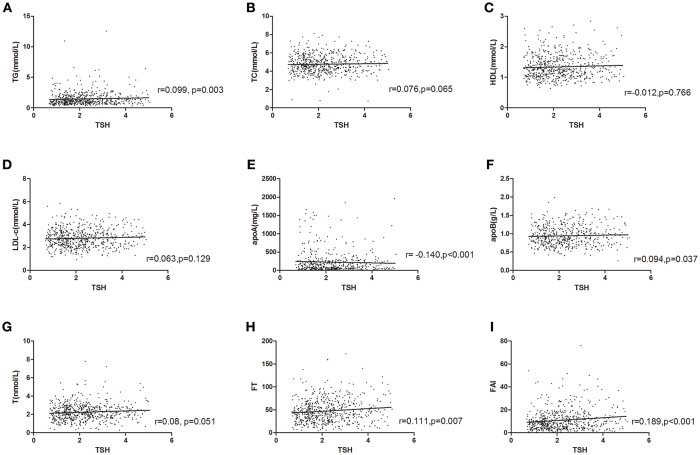
Infertility and dyslipidemia are frequently present in both women with polycystic ovary syndrome (PCOS) and subjects with thyroid dysfunction. Limited study regarding the association between thyroid stimulating hormone (TSH) level and phenotypes in euthyroid PCOS women. We aimed to determine whether the variation of TSH level associates with phenotypes in euthyroid PCOS patients. Cross-sectional study including 600 PCOS and 200 age, body mass index (BMI), and thyroid autoimmunity-matched Chinese women from Renji hospital, Shanghai Jiaotong university during January 2010 and August 2018. The anthropometric and serum biochemical parameters related to TSH, thyroid autoimmunity, lipid profiles, and sex steroids were detected. The TSH level is higher in (2.29 ± 1.24 vs. 1.86 ± 0.90 mu/L, < 0.001) in PCOS than controls. In euthyroid PCOS patients, TSH, TG, TC, LDL-c, and apoB level increased from non-hyperandrogenism (nonHA) to HA group (all < 0.05). TSH level is positively associated with TG, apoB, free T, FAI, and negatively associated with apoA (all < 0.05). The percentage of HA increased from TSH level (57.93% in TSH < = 2.5 group vs. 69.46% in TSH > 2.5 mU/L group, = 0.006). HA phenotype is increased with TSH level independently of age, BMI, WC, LDL-C. Besides, in multivariate logistic regression analysis TSH and TG significantly associated with HA phenotype. Higher TSH level is associated with increased prevalence of HA phenotype independent of age, BMI and thyroid autoimmunity in euthyroid PCOS.
多囊卵巢综合征(PCOS)女性和甲状腺功能障碍患者中常出现不孕和血脂异常。关于促甲状腺激素(TSH)水平与甲状腺功能正常的PCOS女性表型之间关联的研究有限。我们旨在确定TSH水平的变化是否与甲状腺功能正常的PCOS患者的表型相关。横断面研究纳入了2010年1月至2018年8月期间来自上海交通大学仁济医院的600名PCOS患者以及200名年龄、体重指数(BMI)和甲状腺自身免疫相匹配的中国女性。检测了与TSH、甲状腺自身免疫、血脂谱和性类固醇相关的人体测量学和血清生化参数。PCOS患者的TSH水平高于对照组(2.29±1.24 vs. 1.86±0.90μ/L,<0.001)。在甲状腺功能正常的PCOS患者中,TSH、甘油三酯(TG)、总胆固醇(TC)、低密度脂蛋白胆固醇(LDL-c)和载脂蛋白B(apoB)水平从非高雄激素血症(nonHA)组到高雄激素血症(HA)组升高(均<0.05)。TSH水平与TG、apoB、游离T、游离雄激素指数(FAI)呈正相关,与载脂蛋白A(apoA)呈负相关(均<0.05)。HA的百分比随TSH水平升高(TSH≤2.5组为57.93%,TSH>2.5 mU/L组为69.46%,P = 0.006)。HA表型随TSH水平升高,与年龄、BMI、腰围(WC)、LDL-C无关。此外,在多因素逻辑回归分析中,TSH和TG与HA表型显著相关。在甲状腺功能正常的PCOS患者中,较高的TSH水平与HA表型患病率增加相关,与年龄、BMI和甲状腺自身免疫无关。