Dvorak Christopher C, Higham Christine, Shimano Kristin A
Division of Pediatric Allergy, Immunology, and Bone Marrow Transplant, Benioff Children's Hospital, University of California, San Francisco, San Francisco, CA, United States.
Front Pediatr. 2019 Apr 9;7:133. doi: 10.3389/fped.2019.00133. eCollection 2019.
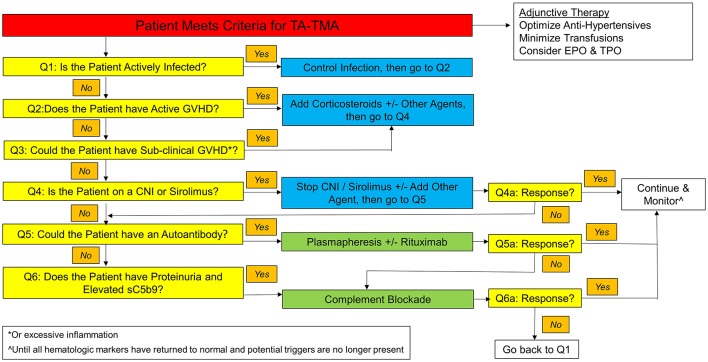
Transplant-associated thrombotic microangiopathy (TA-TMA) is an endothelial damage syndrome that is increasingly identified as a complication of both autologous and allogeneic hematopoietic cell transplantation (HCT) in children. If not promptly diagnosed and treated, TA-TMA can lead to significant morbidity (e.g., permanent renal injury) or mortality. However, as the recognition of the early stages of TA-TMA may be difficult, we propose a TA-TMA "triad" of hypertension, thrombocytopenia (or platelet transfusion refractoriness), and elevated lactate dehydrogenase (LDH). While not diagnostic, this triad should prompt further evaluation for TA-TMA. There is increased understanding of the risk factors for the development of TA-TMA, including those which are inherent (e.g., race, genetics), transplant approach-related (e.g., second HCT, use of HLA-mismatched donors), and related to post-transplant events (e.g., receipt of calcineurin inhibitors, development of graft-vs. -host-disease, or certain infections). This understanding should lead to enhanced screening for TA-TMA signs and symptoms in high-risk patients. The pathophysiology of TA-TMA is complex, resulting from a cycle of activation of endothelial cells to produce a pro-coagulant state, along with activation of antigen-presenting cells and lymphocytes, as well as activation of the complement cascade and microthrombi formation. This has led to the formulation of a "Three-Hit Hypothesis" in which patients with either an underlying predisposition to complement activation or pre-existing endothelial injury (Hit 1) undergo a toxic conditioning regimen causing endothelial injury (Hit 2), and then additional insults are triggered by medications, alloreactivity, infections, and/or antibodies (Hit 3). Understanding this cycle of injury permits the development of a specific TA-TMA treatment algorithm designed to treat both the triggers and the drivers of the endothelial injury. Finally, several intriguing approaches to TA-TMA prophylaxis have been identified. Future work on the development of a single diagnostic test with high specificity and sensitivity, and the development of a robust risk-scoring system, will further improve the management of this serious post-transplant complication.
移植相关血栓性微血管病(TA-TMA)是一种内皮损伤综合征,越来越多地被认为是儿童自体和异基因造血细胞移植(HCT)的并发症。如果不及时诊断和治疗,TA-TMA可导致严重的发病(如永久性肾损伤)或死亡。然而,由于TA-TMA早期阶段可能难以识别,我们提出了TA-TMA的“三联征”,即高血压、血小板减少(或血小板输注无效)和乳酸脱氢酶(LDH)升高。虽然这三联征不能确诊,但应促使对TA-TMA进行进一步评估。人们对TA-TMA发生的危险因素有了更多的了解,包括内在因素(如种族、遗传)、与移植方法相关的因素(如第二次HCT、使用HLA不匹配的供体)以及与移植后事件相关的因素(如接受钙调神经磷酸酶抑制剂、发生移植物抗宿主病或某些感染)。这种认识应导致对高危患者加强TA-TMA体征和症状的筛查。TA-TMA的病理生理学很复杂,是由内皮细胞激活以产生促凝状态的循环导致的,同时伴有抗原呈递细胞和淋巴细胞的激活,以及补体级联反应的激活和微血栓形成。这导致了“三击假说”的形成,即具有补体激活潜在倾向或先前存在内皮损伤的患者(第一击)接受导致内皮损伤的毒性预处理方案(第二击),然后药物、同种异体反应性、感染和/或抗体引发额外的损伤(第三击)。了解这种损伤循环有助于制定一种特定的TA-TMA治疗算法,旨在治疗内皮损伤的触发因素和驱动因素。最后,已经确定了几种有趣的TA-TMA预防方法。未来开发具有高特异性和敏感性的单一诊断测试以及强大的风险评分系统的工作,将进一步改善这种严重移植后并发症的管理。